CBSE Class 9  >  Class 9 Test  >  Mathematics (Maths)   >  Test: Polynomials - 2 - Class 9 MCQ

Polynomials - 2 - Free MCQ Practice Test with solutions, Class 9 Maths


MCQ Practice Test & Solutions: Test: Polynomials - 2 (25 Questions)

You can prepare effectively for Class 9 Mathematics (Maths) Class 9 with this dedicated MCQ Practice Test (available with solutions) on the important topic of "Test: Polynomials - 2". These 25 questions have been designed by the experts with the latest curriculum of Class 9 2026, to help you master the concept.

Test Highlights:

  • - Format: Multiple Choice Questions (MCQ)
  • - Duration: 25 minutes
  • - Number of Questions: 25

Sign up on EduRev for free to attempt this test and track your preparation progress.

Test: Polynomials - 2 - Question 1

√2 is a polynomial of degree

Detailed Solution: Question 1

The degree of a polynomial is the highest power that is present in it. The degree of the constant polynomial is Zero.

Test: Polynomials - 2 - Question 2

If a+b+c = 0, then a3+b3+c3 is equal to

Detailed Solution: Question 2

If a + b + c = 0, then a3 + b3 + c3 is equal to:

The expression for a3 + b3 + c3 can be simplified using the identity:

  • a3 + b3 + c3 - 3abc = (a + b + c)(a2 + b2 + c2 - ab - ac - bc)

Since a + b + c = 0, we can substitute this into the identity:

  • This results in: a3 + b3 + c3 = 3abc

Thus, the value of a3 + b3 + c3 is 3abc.

Test: Polynomials - 2 - Question 3

A polynomial containing two nonzero terms is called a ________.

Detailed Solution: Question 3

A binomial is a mathematical expression with two terms.
Examples of binomials.
binomial
All of these examples are binomials. Study them for a bit, and see if you can spot a pattern. The following is a list of what binomials must have:
They must have two terms.
If the variables are the same, then the exponents must be different.
Exponents must be whole positive integers. They cannot be negatives or fractions.
A term is a combination of numbers and variables. In the example 3x + 5, our first term is 3x, and our second term is 5. Terms are separated by either addition or subtraction. In our first example, notice how the 3x and 5 are separated by addition. In the last example, we have a binomial whose two terms both have the same variable s. Notice how each term has its variable to a different exponent. The first term has an exponent of 5, and the second term has an exponent of 4. While we can have fractions for our numbers, we cannot have fractional exponents.
Here are some examples of expressions that are not binomials.

Test: Polynomials - 2 - Question 4

The expanded form of (3x−5)3 is

Detailed Solution: Question 4

Use the identity:
(a−b)= a− 3a2b + 3ab− b3
Identify:
a = 3x and b = 5
(3x−5)= (3x)3 - 3(3x)2(5) + 3(3x)(5)2 - (5)3
= 27x3 - 3(9x2)(5) + 3(3x)(25) - 125
= 27x− 135x+ 225x − 125
Final answer: (3x−5)= 27x− 135x+ 225x − 125
Correct Option: A

Test: Polynomials - 2 - Question 5

Detailed Solution: Question 5

Test: Polynomials - 2 - Question 6

Degree of the polynomial 4x4 + 0x3 + 0x5 + 5x + 7 is:

Detailed Solution: Question 6

4x4 + 0x3 + 0x5 + 5x + 7

Notice the term 0x5 — since it has a zero coefficient, it does not count toward the degree.

The highest power of x with a non-zero coefficient is 4 (from 4x4).

Test: Polynomials - 2 - Question 7

(x + 1) is a factor of the polynomial

Detailed Solution: Question 7

Option a
f(x) = x4 + 3x3 + 3x2 + x + 1
Substitute x = -1:
( -1 )4 + 3( -1 )3 + 3( -1 )2 + ( -1 ) + 1 = 1 - 3 + 3 - 1 + 1 = 1 ≠ 0
So, (x + 1) is not a factor of this polynomial.

Option b
f(x) = x3 + x2 - x + 1
Substitute x = -1:
( -1 )3 + ( -1 )2 - ( -1 ) + 1 = -1 + 1 + 1 + 1 = 2 ≠ 0
So, (x + 1) is not a factor of this polynomial.

Option c
f(x) = x4 + x3 + x2 + 1
Substitute x = -1:
( -1 )4 + ( -1 )3 + ( -1 )2 + 1 = 1 - 1 + 1 + 1 = 2 ≠ 0
So, (x + 1) is not a factor of this polynomial.

Option d
f(x) = x3 + x2 + x + 1
Substitute x = -1:
( -1 )3 + ( -1 )2 + ( -1 ) + 1 = -1 + 1 - 1 + 1 = 0
Since the result is zero, (x + 1) is a factor of this polynomial.

Correct answer: d) x3 + x2 + x + 1

Test: Polynomials - 2 - Question 8

A polynomial containing three nonzero terms is called a ________.

Detailed Solution: Question 8

A trinomial is a polynomial consisting of exactly three non-zero terms. Therefore, the correct answer is trinomial.

Test: Polynomials - 2 - Question 9

If x + 2 is a factor of x3 – 2ax2 + 16, then value of a is

Detailed Solution: Question 9

use factor theorem as x+2 is factor of
x³-2ax²+16 so put x = -2 and equate the equation to 0
so putting x = -2
(-2)³-2a(-2)²+16 =0
-8-8a+16=0
-8a = -8
a = 8/8= 1
So,
a = 1

Test: Polynomials - 2 - Question 10

Detailed Solution: Question 10

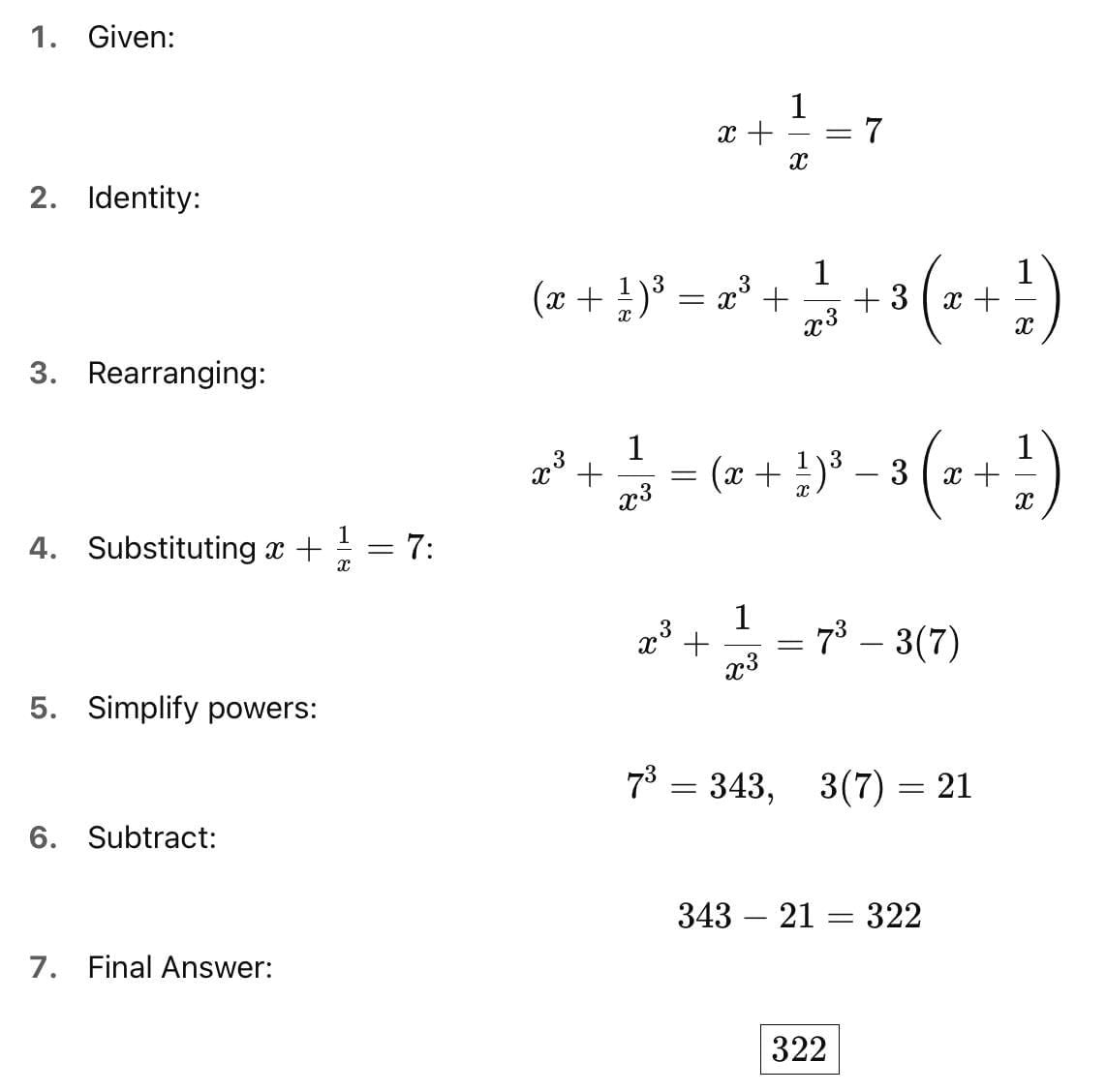
(0.75 * 0.75 * 0.75 + 0.25 * 0.25 * 0.25)/(0.75 * 0.75 - 0.75 * 0.25 + 0.25 * 0.25)

= (0.421875 + 0.015625)/(0.5625 - 0.1875 + 0.0625)

= (0.4375)/(0.4375)

= 1

Test: Polynomials - 2 - Question 11

If one of the factor of x2 + x – 20 is (x + 5). Find the other

Detailed Solution: Question 11

1. Given Factor: We know that one factor is (x + 5). 2. Express the Quadratic as a Product of Two Binomials: Let the other factor be (x + k). Then, (x + 5)(x + k) = x2 + (k + 5)x + 5k. 3. Compare Coefficients with x2 + x - 20: Coefficient of x: k + 5 = 1 → Solve for k: k = 1 - 5 = -4. Constant Term: 5k = -20 → Solving this also gives k = -4. 4. Determine the Other Factor: With k = -4, the other factor is (x - 4). 5. Verification by Multiplication: (x + 5)(x - 4) = x2 + x - 20. This matches the original quadratic, confirming our solution.

Test: Polynomials - 2 - Question 12

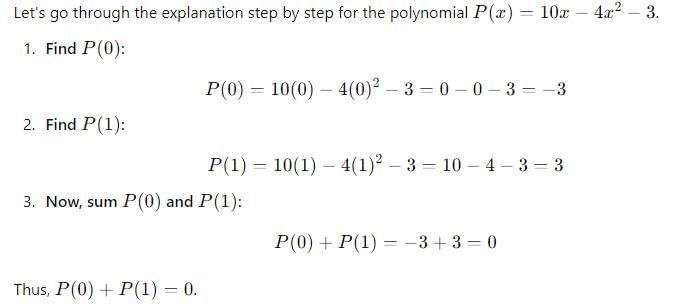
If P(x) = 10x−4x2−3, then the value of p(0)+p(1) is

Detailed Solution: Question 12

Test: Polynomials - 2 - Question 13

The coefficient of x3 in 2x+x2−5x3+x4 is

Detailed Solution: Question 13

To determine the coefficient of x3 in the polynomial 2x + x2 - 5x3 + x4, we examine each term:- The term with x3 is -5x3.- Therefore, the coefficient of x3 is -5.

Test: Polynomials - 2 - Question 14

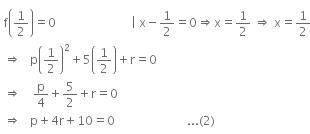
If both x - 2 and are the factors of px2 + 5x + r, then

Detailed Solution: Question 14

Let f(x) = px2 + 5 x + r
If (x - 2) is a factor of f (x), then by factor theorem
f(2) = 0 | x - 2 = 0 ⇒ x = 2
⇒ p(2)2 + 5(2) + r = 0
⇒ 4p + r + 10 = 0    ...(1)

If  is a factor of f (x), then by factor theorem,

Subtracting (2) from (1), we get
3p - 3r = 0
⇒    p = r

Test: Polynomials - 2 - Question 15

If x + 2 is a factor of x3 – 2ax2 + 16, then value of a is

Detailed Solution: Question 15

Calculating P(-2): P(-2) = (-2)3 - 2a(-2)2 + 16. This gives us -8 - 8a + 16 = 0. Simplifying, we have 8 - 8a = 0, leading to a = 1.

Test: Polynomials - 2 - Question 16

The value of the polynomial 5x−4x2+3, when x = −1 is

Detailed Solution: Question 16

It is given that

p(x) = 5x - 4x² + 3

We have to find the value when x = -1

p(-1) = 5(-1) - 4(-1)² + 3

By further calculation

p(-1) = -5 - 4 + 3

So we get

p(-1) = -9 + 3

p(-1) = -6

Therefore, the value is -6.

Test: Polynomials - 2 - Question 17

If x2+kx+6 = (x+2)(x+3), then the value of ‘k’ is

Detailed Solution: Question 17

Expanding the right-hand side: (x + 2)(x + 3) = x2 + 3x + 2x + 6 = x2 + 5x + 6. Comparing both sides x2 + kx + 6 and x2 + 5x + 6, we find that k = 5.

Test: Polynomials - 2 - Question 18

The remainder when the polynomial x4+2x3−3x2+x−1 is divided by (x−2) is

Detailed Solution: Question 18

To find the remainder when the polynomial f(x) = x4 + 2x3 - 3x2 + x - 1 is divided by (x - 2), we use the Remainder Theorem. The theorem states that the remainder of a polynomial f(x) divided by (x - a) is f(a). Here, a = 2. Substitute x = 2 into the polynomial: f(2) = 24 + 2(23) - 3(22) + 2 - 1. Calculate each term step by step: 24 = 16, 2(23) = 2(8) = 16, -3(22) = -3(4) = -12. Combine the results: 16 + 16 - 12 + 2 - 1 = 21. Thus, the remainder is 21, and the correct answer is A.

Test: Polynomials - 2 - Question 19

The remainder obtained when the polynomial p(x) is divided by (b – ax) is

Detailed Solution: Question 19

b-ax=0

b=ax

b/a=x

i.e. remainder is p(b/a)

Test: Polynomials - 2 - Question 20

The value of x3+y3+15xy−125 when x+y = 5 is

Detailed Solution: Question 20

x³+y³+15xy-125
=x³ + y³ +3 xy ×5 - 125
=x³ + y³ +3xy(x+y) - (5)³
= (x+y) ³ - (5)³
=(5)³ - (5)³
=0

Test: Polynomials - 2 - Question 21

If p(x) = x + 3, then p(x) + p(-x) is equal to

Detailed Solution: Question 21

Given p(x) = x+3, put x = -x in the given equation, we get p(-x) = -x+3
Now, p(x)+ p(-x) = x+ 3+ (-x)+ 3=6

Test: Polynomials - 2 - Question 22

One of the factors of (16y2−1)+(1−4y)2 is

Detailed Solution: Question 22

To factorise the expression (16y2 - 1)(1 - 4y)2, follow these steps:

  • The first part, 16y2 - 1, is a difference of squares. It can be rewritten as (4y - 1)(4y + 1).
  • The second part, (1 - 4y)2, is a perfect square trinomial, which expands to (1 - 4y)(1 - 4y).
  • Combine the factors: (4y - 1), (4y + 1), and two instances of (1 - 4y).

Therefore, one of the factors is (4y - 1).

Test: Polynomials - 2 - Question 23

If the polynomial x3−6x2+ax+3 leaves a remainder 7 when divided by (x−1), then the value of ‘a’ is

Detailed Solution: Question 23

According to the Remainder Theorem, substituting x = 1 into the polynomial should yield the remainder. Given polynomial: f(x) = x3 - 6x2 + ax + 3. Substitute x = 1: f(1) = (1)3 - 6(1)2 + a(1) + 3 = 1 - 6 + a + 3 = -2 + a. Since the remainder is 7: -2 + a = 7, a = 9.

Test: Polynomials - 2 - Question 24

Test: Polynomials - 2 - Question 25

The value of (a2−b2)3+(b2−c2)3+(c2−a2)3 is

Detailed Solution: Question 25

Let (a²-b²) =x , (b²-c²) =y , (c²-a²) = z we know that a+b+ c=0 and, a³ + b³ + c³ = 3abc so, 3(a+b)(a-b)(b+c) (b-c)(c+a)(c-a) = 3(a+b)(b+c)(c+a)(a-b)(b-c)(c-a)

40 videos|468 docs|55 tests
Information about Test: Polynomials - 2 Page
In this test you can find the Exam questions for Test: Polynomials - 2 solved & explained in the simplest way possible. Besides giving Questions and answers for Test: Polynomials - 2, EduRev gives you an ample number of Online tests for practice
40 videos|468 docs|55 tests
Download as PDF