You can prepare effectively for NEET Biology Class 12 with this dedicated MCQ Practice Test (available with solutions) on the important topic of "Test: Populations & their Interactions". These 40 questions have been designed by the experts with the latest curriculum of NEET 2026, to help you master the concept.
Test Highlights:
Sign up on EduRev for free to attempt this test and track your preparation progress.
The density of a population in a given habitat during a given period, fluctuates due to changes in certain basic processes. On this basis, fill up boxes A and B in the given flow chart with correct option.
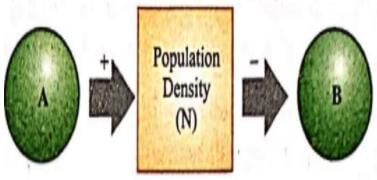
Detailed Solution: Question 1
Topic in NCERT: Population Dynamics
Line in NCERT: "the density of a population in a given habitat during a given period, fluctuates due to changes in four basic processes, two of which (natality and immigration) contribute to an increase in population density and two (mortality and emigration) to a decrease."
What does the shape of the given age pyramids reflects about the growth status of the related population?
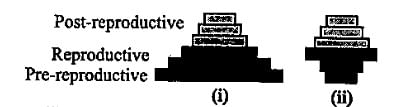
Detailed Solution: Question 2
Topic in NCERT: Age Pyramids and Population Growth Status
Line in NCERT: "The shape of the pyramids reflects the growth status of the population - (a) whether it is growing, (b) stable or (c) declining."
The population growth is generally described by the following equation:
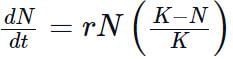
What does 'r' represent in the given equation?
Detailed Solution: Question 3
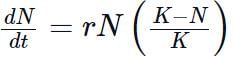
Topic in NCERT: Intrinsic Rate of Natural Increase
Line in NCERT: "The r in this equation is called the ‘intrinsic rate of natural increase' and is a very important parameter chosen for assessing impacts of any biotic or abiotic factor on population growth."
The plant-animal interactions often involve co-evolution of the mutualists so that
Detailed Solution: Question 4
Topic in NCERT: Mutualism in Plant-Animal Interactions
Line in NCERT: "the mutually beneficial system should also be safeguarded against ‘cheaters', for example, animals that try to steal nectar without aiding in pollination." "In many species of fig trees, there is a tight one-to-one relationship with the pollinator species of wasp." "It means that a given fig species can be pollinated only by its 'partner' wasp species and no other species." "The female wasp uses the fruit not only as an oviposition (egg-laying) site but uses the developing seeds within the fruit for nourishing its larvae." "The wasp pollinates the fig inflorescence while searching for suitable egg-laying sites." "Orchids show a bewildering diversity of floral patterns many of which have evolved to attract the right pollinator insect (bees and bumblebees) and ensure guaranteed pollination by it." "Here you can see how co-evolution operates." "If the female bee's colour patterns change even slightly for any reason during evolution, pollination success will be reduced unless the orchid flower co-evolves to maintain the resemblance of its petal to the female bee."
An association between roots of higher plants and fungi is called
Detailed Solution: Question 5
Topic in NCERT: Mutualism
Line in NCERT: "Similarly, the mycorrhizae are associations between fungi and the roots of higher plants."
Species interaction with negative influence on both is referred to as
Detailed Solution: Question 6
Topic in NCERT: Interspecific Interactions
Line in NCERT: "Both the species benefit in mutualism and both lose in competition in their interactions with each other."
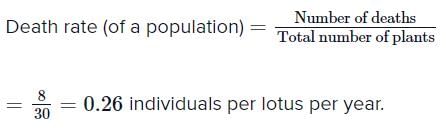
In a pond, last year there were 30 lotus plants. Through reproduction, 25 new lotus plants were added in one year while 8 plants died. The birth and death rates for the lotus population respectively are ___ and ____ individuals per lotus per year.
Detailed Solution: Question 7

Which of the following is not an example of using relative density to measure population density in a certain area?
Detailed Solution: Question 8
Total number of individuals of a species per unit area and per unit time is called:
Detailed Solution: Question 9
Topic in NCERT: Population Density
Line in NCERT: "the density of a population in a given habitat called population density (designated as N)"
Percentage of individuals of a given age group in a given population is called as
Detailed Solution: Question 10
Topic in NCERT: Population Structure and Dynamics
Line in NCERT: "The proportion of different age groups of males and females in a population is often presented graphically as age pyramid; its shape indicates whether a population is stationary, growing or declining."
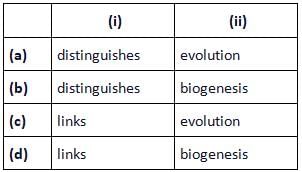
Population ecology is an important area because it _____(i)_______ ecology to population genetics and _____(ii)________
identify (i) and (ii) in the above statement and select the correct option.

Detailed Solution: Question 11
Topic in NCERT: POPULATIONS
Line in NCERT: "Population ecology is, therefore, an important area because it links ecology to population genetics and evolution."
In a given population of 2000 individuals, 80 births and 125 deaths were reported over a given period of time. Which of the following graphs will correspond to it?
Detailed Solution: Question 12
Parameters related to age structure include
Detailed Solution: Question 13
Topic in NCERT: Population Attributes
Line in NCERT: "Another attribute characteristic of a population is sex ratio."
The age structures of a population influences population growth because
Detailed Solution: Question 14
Topic in NCERT: Population Structure and Dynamics
Line in NCERT: "The proportion of different age groups of males and females in a population is often presented graphically as age pyramid; its shape indicates whether a population is stationary, growing or declining."
Which of the following factors has a negative effect on the population growth rate?
Detailed Solution: Question 15
Topic in NCERT: POPULATION DYNAMICS
Line in NCERT: "two (mortality and emigration) to a decrease."
If N population density at time t, then population density at time t+1 can be written as
Nt +1=Nt +[(A+B)−(C+D)]
Select the correct option for A, B, C and D in the above equation.
Detailed Solution: Question 16
Topic in NCERT: Population Density
Line in NCERT: "Nt + [(B + I) - (D + E)]"
Which of the following is not a factor that would limit the growth of a population?
Detailed Solution: Question 17
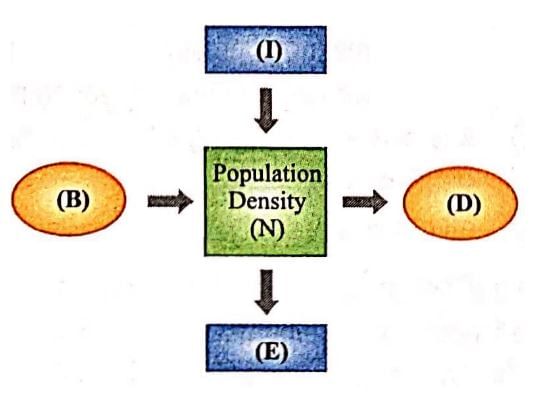
The given figure represents different factors affecting population density (N) If B = nasality, D = mortality, E = emigration and I = immigration; then select the incorrect option regarding these.

Detailed Solution: Question 18
Topic in NCERT: Population Dynamics
Line in NCERT: "Under normal conditions, births and deaths are the most important factors influencing population density, the other two factors assuming importance only under special conditions."
Exponential growth is observed in a population when
Detailed Solution: Question 19
Topic in NCERT: Exponential Growth
Line in NCERT: "Ideally, when resources in the habitat are unlimited, each species has the ability to realise fully its innate potential to grow in number, as Darwin observed while developing his theory of natural selection. Then the population grows in an exponential or geometric fashion."
In a population per capita birth rate is 0.15 and per capita death rate is 0.08 during a unit time period. What is the value of r (intrinsic rate of natural increase) for the given population?
Detailed Solution: Question 20
Topic in NCERT: Intrinsic Rate of Natural Increase
Line in NCERT: "The r in this equation is called the ‘intrinsic rate of natural increase' and is a very important parameter chosen for assessing impacts of any biotic or abiotic factor on population growth."
The maximum possible number of individuals that a habitat can support is called its
Detailed Solution: Question 21
Topic in NCERT: Carrying Capacity
Line in NCERT: "In nature, a given habitat has enough resources to support a maximum possible number, beyond which no further growth is possible. Let us call this limit as nature's carrying capacity (K) for that species in that habitat."
Which of the following equations correctly represents verhulst-Pearl logistic growth?
Detailed Solution: Question 22
Topic in NCERT: Logistic Growth
Line in NCERT: "This type of population growth is called Verhulst-Pearl Logistic Growth (Figure 11.3) and is described by the following equation: dN/dt = rN(K-N)"
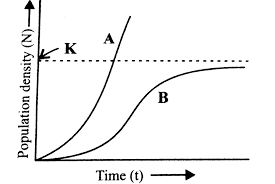
Study the population growth curves (A and B) in the given graph and select the incorrect option

Detailed Solution: Question 23
Topic in NCERT: Logistic Growth Model
Line in NCERT: "the logistic growth model is considered a more realistic one."
A population with a larger proportion of older individuals than younger ones will likely to
Detailed Solution: Question 24
Topic in NCERT: Population Dynamics and Age Structure
Line in NCERT: "the proportion of different age groups of males and females in a population is often presented graphically as age pyramid; its shape indicates whether a population is stationary, growing or declining."
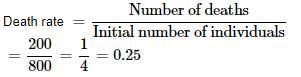
In a life table, the number of individuals alive at the beginning of the 1 st year to 2 nd year interval is 800. During this interval, 200 individuals die. The death rate for this interval is
Detailed Solution: Question 25
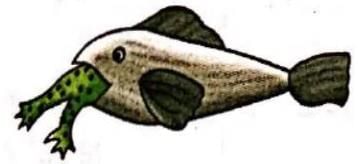
Which type of interaction is being shown in the given figure?

Detailed Solution: Question 26
Topic in NCERT: Population Interactions
Line in NCERT: "Predation, parasitism and commensalism share a common characteristic, the interacting species live closely together."
Obligate parasites are those organisms which
Detailed Solution: Question 27
The interdependent evolution of flowering plants and pollinating insects together is known as
Detailed Solution: Question 28
Topic in NCERT: Plant-Animal Interactions
Line in NCERT: "the evolutions of the flower and its pollinator species are tightly linked with one another."
When two similar species live in the same area, they may evolve to become more different in order to ________________.
Detailed Solution: Question 29
Topic in NCERT: Competition and Co-existence
Line in NCERT: "species facing competition might evolve mechanisms that promote co-existence rather than exclusion."
Do humans exhibit any mutualistic relationships?
Detailed Solution: Question 30
69 videos|305 docs|161 tests |