Civil Engineering (CE) Exam  >  Civil Engineering (CE) Test  >  GATE 2027 Mock Test Series  >  Test: Precipitation - 1 - Civil Engineering (CE) MCQ

GATE Civil Engineering (CE) 2027 Test: Precipitation - 1 Free Online Test


MCQ Practice Test & Solutions: Test: Precipitation - 1 (10 Questions)

You can prepare effectively for Civil Engineering (CE) GATE Civil Engineering (CE) 2027 Mock Test Series with this dedicated MCQ Practice Test (available with solutions) on the important topic of "Test: Precipitation - 1". These 10 questions have been designed by the experts with the latest curriculum of Civil Engineering (CE) 2026, to help you master the concept.

Test Highlights:

  • - Format: Multiple Choice Questions (MCQ)
  • - Duration: 30 minutes
  • - Number of Questions: 10

Sign up on EduRev for free to attempt this test and track your preparation progress.

Test: Precipitation - 1 - Question 1

A tropical cyclone is a?

Detailed Solution: Question 1

D. Zone of low pressure with anticlockwise winds in the Northern Hemisphere.

Tropical cyclones are intense low-pressure systems with closely spaced isobars and strong circular winds around a central low (the eye in mature systems).

The sense of rotation is produced by the Coriolis force: winds circulate anticlockwise in the Northern Hemisphere and clockwise in the Southern Hemisphere.

Typical organised tropical cyclones have scales of order 100-200 km (storm core) though the overall system can be larger; the steep pressure gradient shown by close isobars gives rise to high wind speeds.

Hence, option D is correct.

Test: Precipitation - 1 - Question 2

Orographic precipitation occurs due to air masses being lifted to higher altitudes by

Detailed Solution: Question 2

The moist air masses may get lifted-up to higher altitudes due to the presence of mountain barriers and consequently undergo cooling, condensation and precipitation, such a precipitation is known as orographic precipitation.

Test: Precipitation - 1 - Question 3

The average annual rainfall over the whole of India is estimated as

Test: Precipitation - 1 - Question 4

Variability of annual rainfall in India is

Test: Precipitation - 1 - Question 5

The standard Symons' type raingauge has a collecting area of diameter

Test: Precipitation - 1 - Question 6

The standard recording raingauge adopted in India is of

Detailed Solution: Question 6

Natural syphon type is adopted as the standard recording type raingauge in India. It is also known as float-type gauge.

Test: Precipitation - 1 - Question 7

The following recording raingauges does not produce the mass curve of precipitation as record:

Detailed Solution: Question 7

The Tipping-bucket type gauge gives data on the intensity of rainfall.

Test: Precipitation - 1 - Question 8

When specific information about the density of snowfall is not available, the water equivalent -of snowfall is taken as

Test: Precipitation - 1 - Question 9

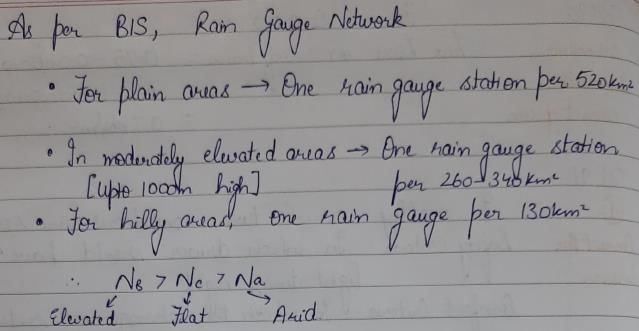
A, B and C are three catchments each having an area of about 10,000 km2 situated in an arid zone, mountainous region of a tropical zone and flat region of a tropical zone respectively. The desirable number of hydrometeorological stations for each of these three areas, NA, NB and NC respectively will be such that

Detailed Solution: Question 9
Test: Precipitation - 1 - Question 10

The monthly rainfall at a place. A during September 1982 was recorded as 55 mm above normal. Here the term Normal means.

33 docs|280 tests
Information about Test: Precipitation - 1 Page
In this test you can find the Exam questions for Test: Precipitation - 1 solved & explained in the simplest way possible. Besides giving Questions and answers for Test: Precipitation - 1, EduRev gives you an ample number of Online tests for practice
Download as PDF