
Preparation and Properties of colloids - Free MCQ Practice Test with solutions,
MCQ Practice Test & Solutions: Test: Preparation and Properties of colloids (15 Questions)
You can prepare effectively for JEE Chemistry for JEE Main & Advanced with this dedicated MCQ Practice Test (available with solutions) on the important topic of "Test: Preparation and Properties of colloids". These 15 questions have been designed by the experts with the latest curriculum of JEE 2026, to help you master the concept.
Test Highlights:
- - Format: Multiple Choice Questions (MCQ)
- - Duration: 20 minutes
- - Number of Questions: 15
Sign up on EduRev for free to attempt this test and track your preparation progress.

During the action of enzyme "Zymase", glucose is converted into_____, with the liberation of carbon dioxide gas.
Detailed Solution: Question 1

Detailed Solution: Question 2

The efficiency of an enzyme in catalysing a reaction is due to its capacity
Detailed Solution: Question 3
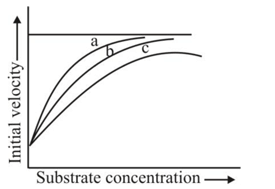
The figure given below shows three velocity-substrate concentration curves for an enzyme reaction. What do the curves  and c depict respectively?
Detailed Solution: Question 4
 shows normal enzyme reaction, while curve
  shows a competitive inhibition reaction, in which competitive inhibitors that resemble the substrate molecules, bind to the active site of the enzyme, whereas, curve
  shows non-competitive inhibition reaction, in which the inhibitor binds to a part of the enzyme or enzyme substrate complex, other than the active site, known as the allosteric site.
The density of gold is  . If
. If  of gold is dispersed in one litre of water to give a sol having spherical gold particles of radius 10
  , then the number of gold particles per
  of
of
the sol will be :
Detailed Solution: Question 5




 No. of gold sol particles in

 No. of gold sol particles in one

Detailed Solution: Question 6
Cloud or fog is a colloidal system in which the dispersed phase and the dispersion medium are
Detailed Solution: Question 7
Which of the following constitutes irreversible colloidal system in water as dispersion medium?
Detailed Solution: Question 8
Which one of the following statements is not correct in respect of lyophilic sols?
Detailed Solution: Question 9
Detailed Solution: Question 10
The stabilization of the dispersed phase in a lyophobic sol is due to
Detailed Solution: Question 11
A detergent  solution becomes a colloidal sol at a concentration of
  On an average
  colloidal particles are present in
  . What is the average number of ions which are contained by one colloidal particle (micelle)?
  Given:
Detailed Solution: Question 12
 in 1 litre solution

 No. of molecules per colloidal particle
Detailed Solution: Question 13
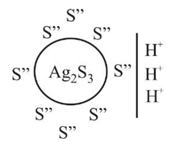
 white precipitate of
  is peptized with di.
  . The sol particle will carry
Detailed Solution: Question 14

 (Positive charge)
The sol prepared by Bredig's Arc method is X and the charge of sol particles of it is q.  and q are respectively.
Detailed Solution: Question 15
335 videos|697 docs|300 tests |
