Electronics and Communication Engineering (ECE) Exam  >  Electronics and Communication Engineering (ECE) Test  >  GATE ECE (Electronics) Mock Test Series 2027  >  Test: Push-Pull Class B Amplifier - Electronics and Communication Engineering (ECE) MCQ

GATE ECE (Electronics) Test: Push-Pull Class B Amplifier Free Online Test


MCQ Practice Test & Solutions: Test: Push-Pull Class B Amplifier (10 Questions)

You can prepare effectively for Electronics and Communication Engineering (ECE) GATE ECE (Electronics) Mock Test Series 2027 with this dedicated MCQ Practice Test (available with solutions) on the important topic of "Test: Push-Pull Class B Amplifier". These 10 questions have been designed by the experts with the latest curriculum of Electronics and Communication Engineering (ECE) 2026, to help you master the concept.

Test Highlights:

  • - Format: Multiple Choice Questions (MCQ)
  • - Duration: 30 minutes
  • - Number of Questions: 10

Sign up on EduRev for free to attempt this test and track your preparation progress.

Test: Push-Pull Class B Amplifier - Question 1

Which of these is not true for a class B amplifier?

Detailed Solution: Question 1

The class B amplifier has zero DC bias as the transistors are biased at cut-off only. Each transistor conducts when the input is greater than the base-emitter voltage. The conduction angle is only 180° for this amplifier. They have higher efficiency than class A amplifiers.

Test: Push-Pull Class B Amplifier - Question 2

How do we obtain sinusoidal output out of a class B amplifier?

Detailed Solution: Question 2

To obtain sinusoidal output from a class B amplifier, two transistors must be used. Such a circuit is a class B push-pull amplifier, used in unturned power amplifiers and audio frequency power amplifiers.

Test: Push-Pull Class B Amplifier - Question 3

The efficiency of a class B push-pull amplifier is

Detailed Solution: Question 3
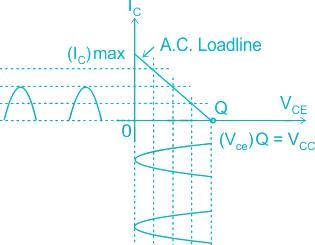
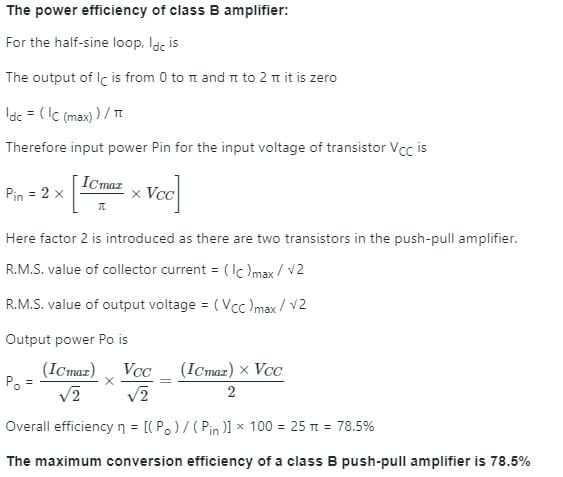
Class B push-pull amplifier employs two identical transistors with input signals applied to two stages that are 180° apart from each other. The transistor to be operated in class B mode is kept at the cut off bias and current in this state will be equal to zero. The maximum efficiency of the class B amplifier is 78.5%.

Derivation:
The input and output waveforms during the class B operation.

Test: Push-Pull Class B Amplifier - Question 4

Read statements and select the correct option below.

A: A push-pull amplifier decreases harmonic distortion
B: Output has half-wave symmetry

Detailed Solution: Question 4

A push-pull amplifier reduced harmonic distortion as it cancels even harmonic frequencies. Net current in load I = K(I1 - I2)
Due to this, even harmonics cancel out and decrease harmonic distortion. Thus output has half-wave symmetry.

Test: Push-Pull Class B Amplifier - Question 5

Which of these is incorrect for complementary symmetry push-pull amplifiers?

Detailed Solution: Question 5

The complementary symmetry push-pull amplifier uses one NPN and one PNP transistor to conduct in positive and negative cycles respectively. It does not affect efficiency or figure of merit, but since no transformer is being used, it is easier to fabricate on ICs.

Test: Push-Pull Class B Amplifier - Question 6

What is the output of a class B amplifier for sinusoidal input?

Detailed Solution: Question 6

If Q-point is in cut-off, then IC varies only in the positive direction, for saturation, it varies in the negative direction. So the output of Class B amplifier is half sinusoidal. There is no effect in the shape or the frequency of the wave.

Test: Push-Pull Class B Amplifier - Question 7

In a class B amplifier, it is found that DC power is 25W, find the ac power.

Detailed Solution: Question 7

For a class B amplifier, figure of merit = 0.4 = dc power/ac power
Thus AC power = DC power/0.4 = 25/0.4 = 62.5 W.

Test: Push-Pull Class B Amplifier - Question 8

What is the disadvantage of a class B push-pull amplifier?

Detailed Solution: Question 8

A class B amplifier helps increase efficiency, and the figure of merit reduces. The q power dissipation reduces and cross over distortion increases. Due to two transistors, when one transistor turns off the other does not begin conduction immediately, hence output current is zero for a short interval.

Test: Push-Pull Class B Amplifier - Question 9

Why does no DC current flow in the primary winding of the output transformer of class B push-pull amplifier?

Detailed Solution: Question 9

The net DC current in the primary winding of the output transformer is zero because DC collector currents of both transistors being used flow in opposite directions and hence transformer saturation doesn’t occur.

Test: Push-Pull Class B Amplifier - Question 10

Which is the main disadvantage of class B amplifiers?

Detailed Solution: Question 10

Since class B amplifier uses a balanced centre-tapped transformer in its design, making it expensive to construct.

26 docs|263 tests
Information about Test: Push-Pull Class B Amplifier Page
In this test you can find the Exam questions for Test: Push-Pull Class B Amplifier solved & explained in the simplest way possible. Besides giving Questions and answers for Test: Push-Pull Class B Amplifier, EduRev gives you an ample number of Online tests for practice
Download as PDF