
Raoult's and Henry's law - Free MCQ Practice Test with solutions, JEE Chemistry
MCQ Practice Test & Solutions: Test: Raoult's and Henry's law (15 Questions)
You can prepare effectively for JEE Chemistry for JEE Main & Advanced with this dedicated MCQ Practice Test (available with solutions) on the important topic of "Test: Raoult's and Henry's law". These 15 questions have been designed by the experts with the latest curriculum of JEE 2026, to help you master the concept.
Test Highlights:
- - Format: Multiple Choice Questions (MCQ)
- - Duration: 20 minutes
- - Number of Questions: 15
Sign up on EduRev for free to attempt this test and track your preparation progress.

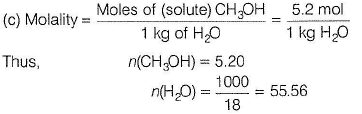
A 5.2 molal aqueous solution of methyl alcohol (CH3OH) is supplied. What is the mole fraction of methyl alcohol in the solution?
Detailed Solution: Question 1

Two 1-litre flask  and
and  are connected to each other by a valve which is closed. Flask A has benzene in equilibrium with its vapours at
  . The flask
  , is evacuated, and the valve is opened. Which of the following is true. If temperature is kept constant.'
Detailed Solution: Question 2

Detailed Solution: Question 3
 and
and  OH form non-ideal solution. Solutions that do not obey Raoult's law over the entire range of concentration are known as non-ideal solutions. Ethyl iodide and ethyl alcohol are chemically dissimilar and form a non-ideal solution.
Vapour pressure (in torr) of an ideal solution of two liquids  and
and  is given by :
  where
where  is the mole fraction of
  in the mixture. The vapour pressure (in torr) of equimolar mixture of the two liquids will be :
and is given by : where is the mole fraction of in the mixture. The vapour pressure (in torr) of equimolar mixture of the two liquids will be :Detailed Solution: Question 4


 torr
torr 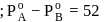
 torr
torr torr
torrThe vapour pressure (at the standard boiling point of water) of an aqueous solution containing  by mass of a non-volatile normal solute (molecular mass = 28) will be
by mass of a non-volatile normal solute (molecular mass = 28) will beDetailed Solution: Question 5
 ;
;
 torr
torrAt a particular temperature, the vapour pressures of two liquids  and
and  are respectively 120 and
  of mercury. If 2 moles of
  and 3 moles of
  are mixed to form an ideal solution, the vapour pressure of the solution at the same temperature will be (in mm of mercury)
Detailed Solution: Question 6



Which one of the following binary mixtures forms an azeotrope with minimum boiling point type?
Detailed Solution: Question 7
 ethanol.
The vapour pressure of pure benzene and toluene at a particular temperature are  and
and  respectively. Then the mole fraction of benzene in vapour phase in contact with equimolar solution of benzene and toluene is
Detailed Solution: Question 8
 vapour pressure of pure benzene
  vapour pressure of toluene



A solution at  is composed of
  of benzene and
  of toluene. If the vapour pressure of pure benzene and pure toluene at this temperature are
  torr and
  torr, respectively, then the total vapour pressure of the solution and the benzene mole fraction in equilibrium with it will be, respectively :
is composed of of benzene and of toluene. If the vapour pressure of pure benzene and pure toluene at this temperature are torr and torr, respectively, then the total vapour pressure of the solution and the benzene mole fraction in equilibrium with it will be, respectively :Detailed Solution: Question 9

 torr,
torr,  torr
torr


 torr
torr torr
torr  torr
torr

Detailed Solution: Question 10
 , which is equal to mole fraction of solute which is independent of temperature.
For an ideal solution of two components  and B, which of the following is true?
and B, which of the following is true?Detailed Solution: Question 11
Which one of the following gases has the lowest value of Henry's law constant?
Detailed Solution: Question 12
 i.e. as the solubility increases, value of Henry's law constant decreases. Since
  is most soluble in water among the given set of gases. Therefore
  has the lowest value of Henry's law constant.
Which of the following statement is correct if the intermolecular forces in liquids  and
and  are in the order
Detailed Solution: Question 13
At  and 1 atmosphere partial pressure of hydrogen,
  of hydrogen measured at STP dissolves in
  of water. If water at
  is exposed to a gaseous mixture having a total pressure of
  of
of  (excluding the vapour pressure of water) and containing
  hydrogen by volumne, then the volume of hydrogen measured at STP that will dissolve in 1 L of water is
Detailed Solution: Question 14

 of
of  atmosphere
 ; or
; or 

100 mL of liuqid 'A' was mixed with 25 ml of a liquid 'B' to give a non-ideal solution of A-B mixture showing (-) ve deviation from Raoult's law. The volume of this mixture would be
Detailed Solution: Question 15
332 videos|699 docs|300 tests |
