JEE Exam  >  JEE Test  >  Chemistry Main & Advanced  >  Test: Reactions of alkenes - JEE MCQ

Reactions of alkenes - Free MCQ Practice Test with solutions, JEE Chemistry


MCQ Practice Test & Solutions: Test: Reactions of alkenes (20 Questions)

You can prepare effectively for JEE Chemistry for JEE Main & Advanced with this dedicated MCQ Practice Test (available with solutions) on the important topic of "Test: Reactions of alkenes". These 20 questions have been designed by the experts with the latest curriculum of JEE 2026, to help you master the concept.

Test Highlights:

  • - Format: Multiple Choice Questions (MCQ)
  • - Duration: 20 minutes
  • - Number of Questions: 20

Sign up on EduRev for free to attempt this test and track your preparation progress.

Test: Reactions of alkenes - Question 1

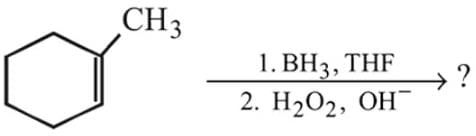
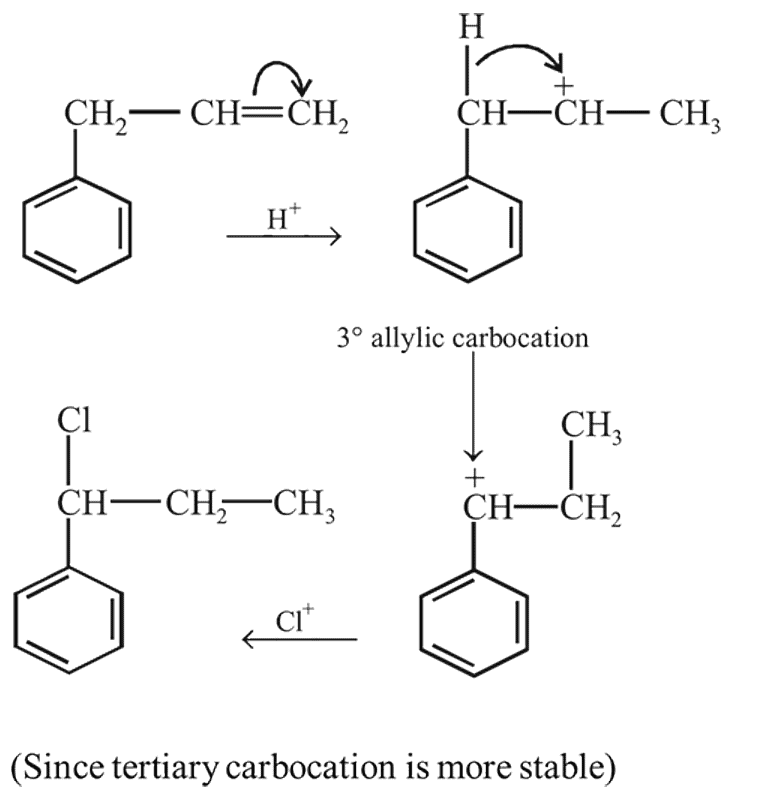
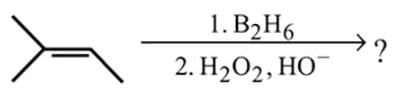
The major product of the following reaction sequence is
Detailed Solution: Question 1

Hydroboration oxidation reaction.

Test: Reactions of alkenes - Question 2

Identify the addition reaction which is not undergone by the alkenes

Detailed Solution: Question 2

Alkenes do not undergo mercuration, indeed they undergo oxymercuration , a process in which an alkene is converted into an alcohol.

Test: Reactions of alkenes - Question 3

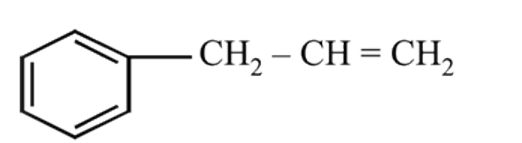
What is the correct product of reaction?

Detailed Solution: Question 3

The reaction is hydroboration which is addition of H2O to alkene (anti Makownikoff's's rule)

Test: Reactions of alkenes - Question 4

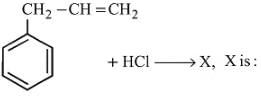
In the presence of peroxide, HCl and HI do not give anti-Markownikoff's addition of alkenes because:

Detailed Solution: Question 4

Anti-Markownikoff addition is possible only in case of HBr and not in HCl and HI. In HBr both the chain initiation and propagation steps are exothermic, while in HCl, first step is exothermic, and second step is endothermic and in HI, no step is exothermic. Hence HCl and HI do not undergo antiMarkownikoff's addition.

Test: Reactions of alkenes - Question 5

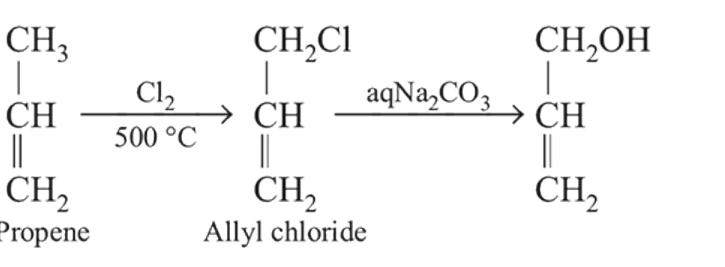
Consider the following sequence of reactions

Compound 'B' is

Detailed Solution: Question 5
Test: Reactions of alkenes - Question 6

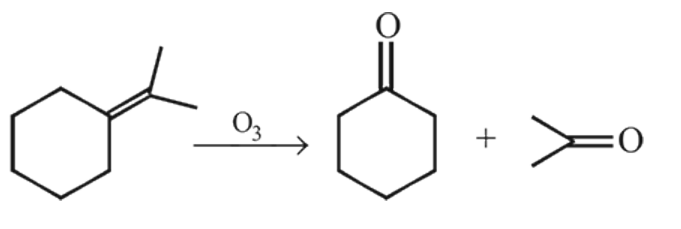
Which one of the following compounds gives acetone (CH3)2C = O as one of the product of its ozonolysis?

Detailed Solution: Question 6
Test: Reactions of alkenes - Question 7


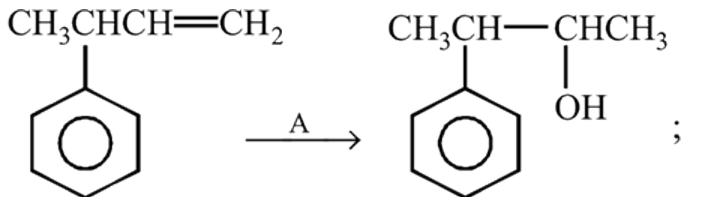
Reagent A may be:

Detailed Solution: Question 7

Oxymercuration - demercuration reaction addition of H2O molecule is according to Markovnikoff's rule.

Test: Reactions of alkenes - Question 8

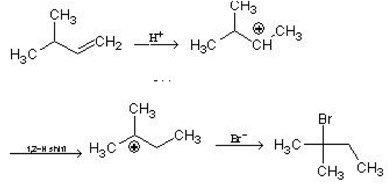
What is the major product expected from the following reaction?
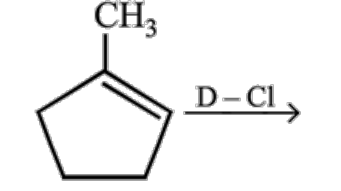
Where D is an isotope of hydrogen

Detailed Solution: Question 8
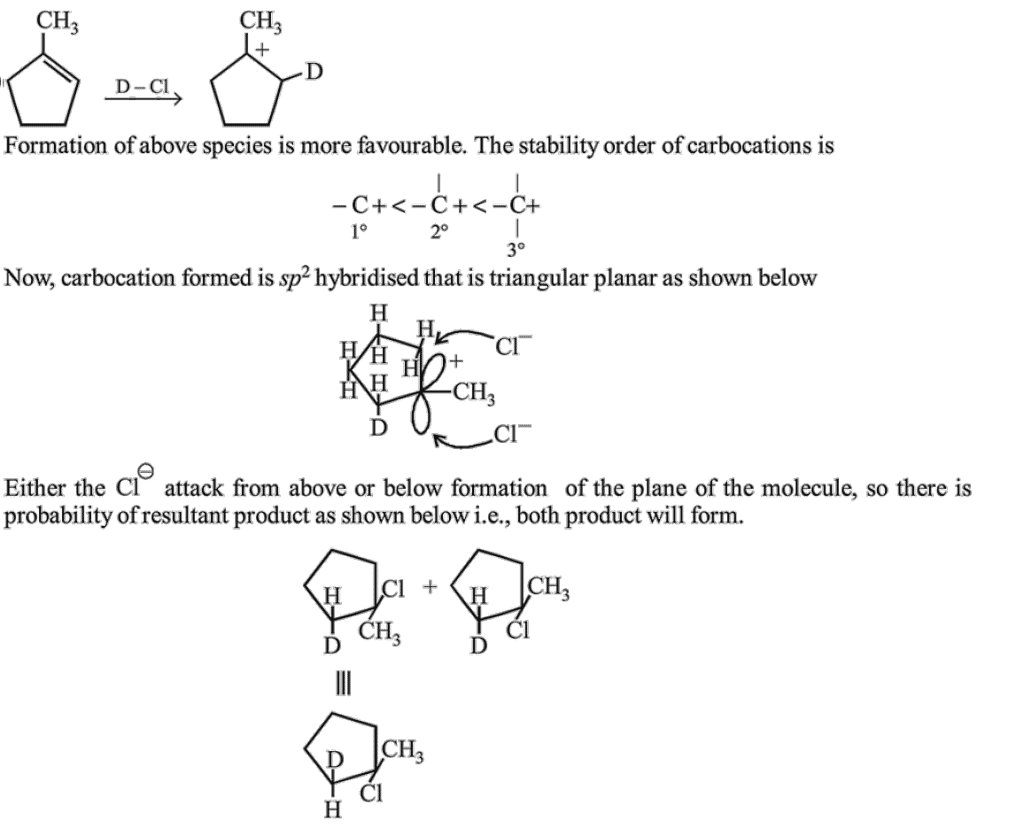
Test: Reactions of alkenes - Question 9

Addition of HI to double bond of propene yields isopropyl iodide and not n -propyl iodide as the major product, because addition proceeds through

Detailed Solution: Question 9
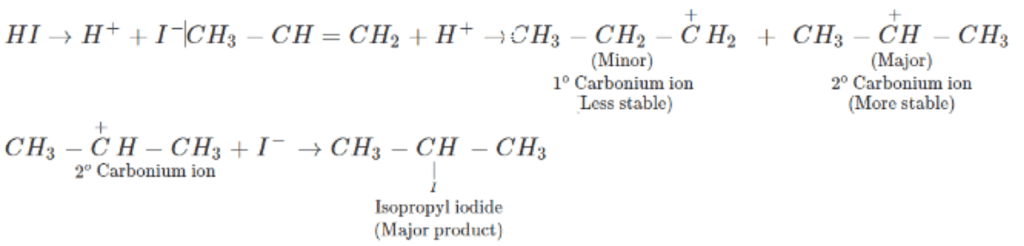
The addition of HI on the double bond of propene yields isopropyl iodide and not n-propyl iodide as the major product. This is because the addition proceeds through a more stable carbonium ion.

Test: Reactions of alkenes - Question 10

The principal organic product formed in the reaction,

is

Detailed Solution: Question 10

A molecule of Hbr is added to C = C double bond. Br is added to less substituted terminal carbon atom. (The anti markonikov's addition of HBr to unsymmetrical alkenes in presence of peroxides)

Test: Reactions of alkenes - Question 11


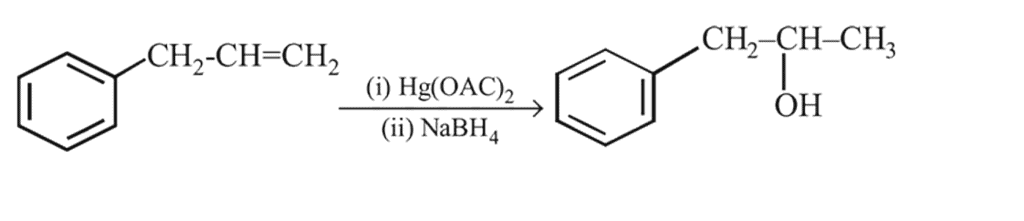
On mercuration-demercuration produces the major product:

Detailed Solution: Question 11
Test: Reactions of alkenes - Question 12

Detailed Solution: Question 12

Test: Reactions of alkenes - Question 13

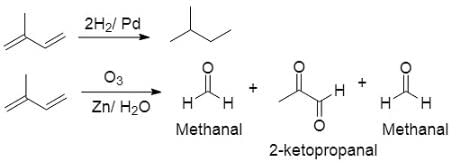
An organic compound A(C5H8) on hydrogenation gives compound B(C5H12) ). Compound A on reductive ozonolysis give methanal and 2-ketopropanal. The compound (A) is

Detailed Solution: Question 13
Test: Reactions of alkenes - Question 14

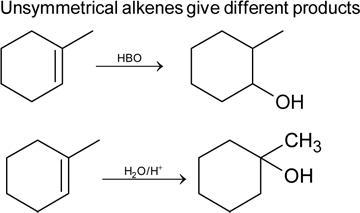
Hydroboration oxidation and acid hydration will not give the same products in case of

Detailed Solution: Question 14
Test: Reactions of alkenes - Question 15

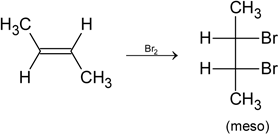
The eddition of Br2 to trans-But-2-ene produces

Detailed Solution: Question 15

Test: Reactions of alkenes - Question 16

In the reaction sequence the reactant A is

Detailed Solution: Question 16

Test: Reactions of alkenes - Question 17

Detailed Solution: Question 17

Test: Reactions of alkenes - Question 18

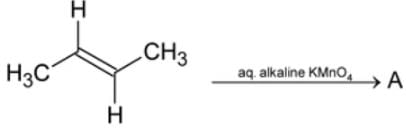
alkene

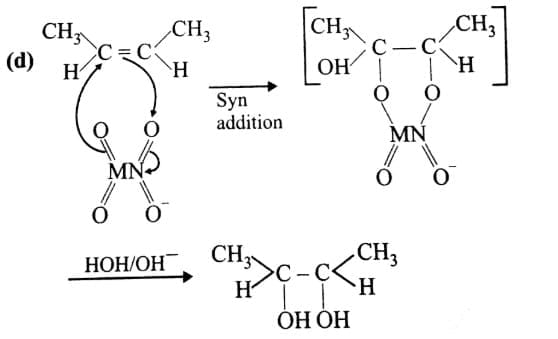
Which of the following is true about this reaction?

Detailed Solution: Question 18

Option D is correct.

Alkaline potassium permanganate adds two hydroxyl groups across a double bond by syn addition, giving a vicinal diol.

When syn addition occurs on a trans (oppositely substituted) disubstituted alkene, the two new stereocentres are formed with the same absolute configuration in one product and the opposite configuration in the other; these two products are non-superimposable mirror images.

Therefore the reaction of the given trans alkene with cold, aqueous alkaline KMnO4 yields a racemic mixture of the enantiomers (R,R) and (S,S) of 2,3-butanediol, produced by syn addition.

Test: Reactions of alkenes - Question 19


A and B are respectively

Detailed Solution: Question 19

Fomation of A is hydration by Markownikov's orientation. Fomation of B is by HEO reaction (An Markomilkov's orentation)

Test: Reactions of alkenes - Question 20

Which of the following compound does not decolourise bromine-water solution ?

Detailed Solution: Question 20

benzene not decolurise bromine water solution , and only 3 option has 0 degre of unsaturation

335 videos|697 docs|300 tests
Information about Test: Reactions of alkenes Page
In this test you can find the Exam questions for Test: Reactions of alkenes solved & explained in the simplest way possible. Besides giving Questions and answers for Test: Reactions of alkenes, EduRev gives you an ample number of Online tests for practice
Download as PDF