
Recursion- 3 - Free MCQ Practice Test with solutions, GATE CSE (CSE)
MCQ Practice Test & Solutions: Test: Recursion- 3 (20 Questions)
You can prepare effectively for Computer Science Engineering (CSE) Question Bank for GATE Computer Science Engineering with this dedicated MCQ Practice Test (available with solutions) on the important topic of "Test: Recursion- 3". These 20 questions have been designed by the experts with the latest curriculum of Computer Science Engineering (CSE) 2026, to help you master the concept.
Test Highlights:
- - Format: Multiple Choice Questions (MCQ)
- - Duration: 55 minutes
- - Number of Questions: 20
Sign up on EduRev for free to attempt this test and track your preparation progress.

Consider the following recursive function fun(x, y). What is the value of fun(4, 3)
int fun(int x, int y)
{
if (x == 0)
return y;
return fun(x - 1, x + y);
int fun(int x, int y)
{
if (x == 0)
return y;
return fun(x - 1, x + y);
Detailed Solution: Question 1
Predict output of following program
#include <stdio.h>
int fun(int n)
{
if (n == 4)
return n;
else return 2*fun(n+1);
}
int main()
{
printf("%d ", fun(2));
return 0;
#include <stdio.h>
int fun(int n)
{
if (n == 4)
return n;
else return 2*fun(n+1);
}
int main()
{
printf("%d ", fun(2));
return 0;
Detailed Solution: Question 2

What does the following function do?
int fun(int x, int y)
{
if (y == 0) return 0;
return (x + fun(x, y-1));
int fun(int x, int y)
{
if (y == 0) return 0;
return (x + fun(x, y-1));
Detailed Solution: Question 3
What does the following function print for n = 25?
void fun(int n)
{
if (n == 0)
return;
printf("%d", n%2);
fun(n/2);
Detailed Solution: Question 4
Output of following program?
#include<stdio.h>
void print(int n)
{
if (n > 4000)
return;
printf("%d ", n);
print(2*n);
printf("%d ", n);
}
int main()
{
print(1000);
getchar();
return 0;
}
#include<stdio.h>
void print(int n)
{
if (n > 4000)
return;
printf("%d ", n);
print(2*n);
printf("%d ", n);
}
int main()
{
print(1000);
getchar();
return 0;
}
Detailed Solution: Question 5
What does fun2() do in general?
int fun(int x, int y)
{
if (y == 0) return 0;
return (x + fun(x, y-1));
}
int fun2(int a, int b)
{
if (b == 0) return 1;
return fun(a, fun2(a, b-1));
}
int fun(int x, int y)
{
if (y == 0) return 0;
return (x + fun(x, y-1));
}
int fun2(int a, int b)
{
if (b == 0) return 1;
return fun(a, fun2(a, b-1));
}
Detailed Solution: Question 6
Predict the output of following program
#include <stdio.h>
int f(int n)
{
if(n <= 1)
return 1;
if(n%2 == 0)
return f(n/2);
return f(n/2) + f(n/2+1);
}
int main()
{
printf("%d", f(11));
return 0;
}
#include <stdio.h>
int f(int n)
{
if(n <= 1)
return 1;
if(n%2 == 0)
return f(n/2);
return f(n/2) + f(n/2+1);
}
int main()
{
printf("%d", f(11));
return 0;
}
Detailed Solution: Question 7
Find the number of elements in the following array.
float f [6] [4] [2];
Detailed Solution: Question 8
What does the following function do?
int fun(unsigned int n)
{
if (n == 0 || n == 1)
return n;
if (n%3 != 0)
return 0;
return fun(n/3);
}
int fun(unsigned int n)
{
if (n == 0 || n == 1)
return n;
if (n%3 != 0)
return 0;
return fun(n/3);
}
Detailed Solution: Question 9
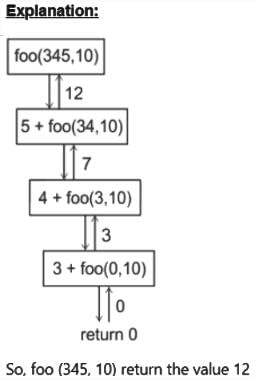
Consider the following recursive C function that takes two arguments
unsigned int foo(unsigned int n, unsigned int r) {
if (n > 0) return (n%r) + foo (n/r, r));
else return 0;
}
What is the return value of the function foo when it is called as foo(345, 10) ?
Detailed Solution: Question 10
Consider the same recursive C function that takes two arguments
unsigned int foo(unsigned int n, unsigned int r) {
if (n > 0) return (n%r + foo (n/r, r ));
else return 0;
}
What is the return value of the function foo when it is called as foo(513, 2)?
unsigned int foo(unsigned int n, unsigned int r) {
if (n > 0) return (n%r + foo (n/r, r ));
else return 0;
}
Detailed Solution: Question 11
Output of following program?
#include <stdio.h>
int fun(int n, int *f_p)
{
int t, f;
if (n <= 1)
{
*f_p = 1;
return 1;
}
t = fun(n- 1,f_p);
f = t+ * f_p;
*f_p = t;
return f;
}
int main()
{
int x = 15;
printf (" %d n", fun(5, &x));
return 0;
}
#include <stdio.h>
int fun(int n, int *f_p)
{
int t, f;
if (n <= 1)
{
*f_p = 1;
return 1;
}
t = fun(n- 1,f_p);
f = t+ * f_p;
*f_p = t;
return f;
}
int main()
{
int x = 15;
printf (" %d n", fun(5, &x));
return 0;
}
Detailed Solution: Question 12
#include<stdio.h>
int f(int *a, int n)
{
if(n <= 0) return 0;
else if(*a % 2 == 0) return *a + f(a+1, n-1);
else return *a - f(a+1, n-1);
}
int main()
{
int a[] = {12, 7, 13, 4, 11, 6};
printf("%d", f(a, 6));
getchar();
return 0;
}
int f(int *a, int n)
{
if(n <= 0) return 0;
else if(*a % 2 == 0) return *a + f(a+1, n-1);
else return *a - f(a+1, n-1);
}
int main()
{
int a[] = {12, 7, 13, 4, 11, 6};
printf("%d", f(a, 6));
getchar();
return 0;
}
Detailed Solution: Question 13
Consider the C function given below.
int f(int j)
{
static int i = 50;
int k;
if (i == j)
{
printf(“something”);
k = f(i);
return 0;
}
else return 0;
}
Which one of the following is TRUE?
int f(int j)
{
static int i = 50;
int k;
if (i == j)
{
printf(“something”);
k = f(i);
return 0;
}
else return 0;
}
Detailed Solution: Question 14
Which of the following statements are CORRECT?
1) Static allocation of all data areas by a compiler makes it impossible to implement recursion.
2) Automatic garbage collection is essential to implement recursion
3) Dynamic allocation of activation records is essential to implement recursion
4) Both heap and stack are essential to implement recursion
Detailed Solution: Question 15
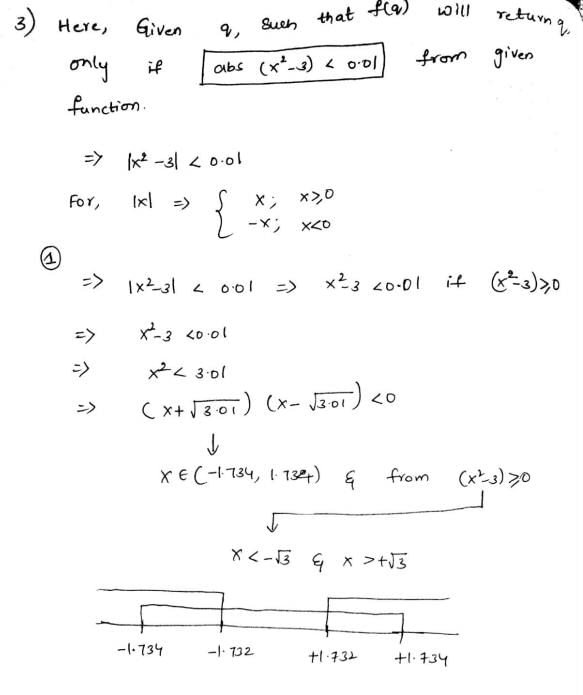
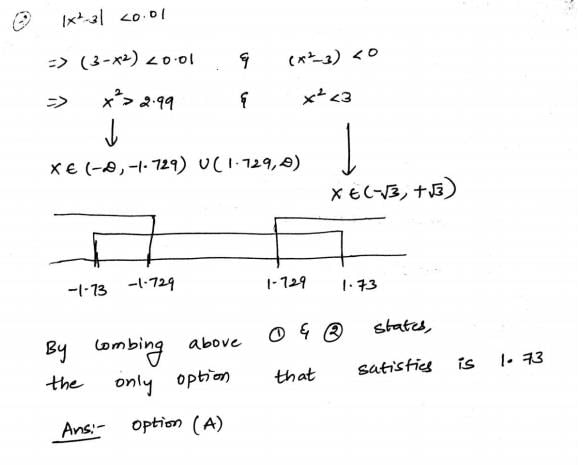
Consider the following function
double f(double x){
if (abs(x*x - 3) < 0.01) return x;
else return f(x/2 + 1.5/x);
}
Give a value q (to 2 decimals) such that f(q) will return q:_____.
double f(double x){
if (abs(x*x - 3) < 0.01) return x;
else return f(x/2 + 1.5/x);
}
Give a value q (to 2 decimals) such that f(q) will return q:_____.
Detailed Solution: Question 16
Consider the following C function.
int fun (int n)
{
int x=1, k;
if (n==1) return x;
for (k=1; k<n; ++k)
x = x + fun(k) * fun(n – k);
return x;
}
The return value of fun(5) is __________.
int fun (int n)
{
int x=1, k;
if (n==1) return x;
for (k=1; k<n; ++k)
x = x + fun(k) * fun(n – k);
return x;
}
The return value of fun(5) is __________.
Detailed Solution: Question 17
Consider the following recursive C function. If get(6) function is being called in main() then how many times will the get() function be invoked before returning to the main()?
void get (int n)
{
if (n < 1) return;
get(n-1);
get(n-3);
printf("%d", n);
}
void get (int n)
{
if (n < 1) return;
get(n-1);
get(n-3);
printf("%d", n);
}
Detailed Solution: Question 18
The function f is defined as follows:
int f (int n) {
if (n <= 1) return 1;
else if (n % 2 == 0) return f(n/2);
else return f(3n - 1);
}
Assuming that arbitrarily large integers can be passed as a parameter to the function, consider the following statements.
1. The function f terminates for finitely many different values of n ≥ 1.
ii. The function f terminates for infinitely many different values of n ≥ 1.
iii. The function f does not terminate for finitely many different values of n ≥ 1.
iv. The function f does not terminate for infinitely many different values of n ≥ 1.
Which one of the following options is true of the above?
int f (int n) {
if (n <= 1) return 1;
else if (n % 2 == 0) return f(n/2);
else return f(3n - 1);
}
Assuming that arbitrarily large integers can be passed as a parameter to the function, consider the following statements.
1. The function f terminates for finitely many different values of n ≥ 1.
ii. The function f terminates for infinitely many different values of n ≥ 1.
iii. The function f does not terminate for finitely many different values of n ≥ 1.
iv. The function f does not terminate for infinitely many different values of n ≥ 1.
Which one of the following options is true of the above?
Detailed Solution: Question 19
Detailed Solution: Question 20
63 videos|8 docs|165 tests |
63 videos|8 docs|165 tests |
