
Religion, Sculptures & Seals - Free MCQ Practice Test with solutions, UPSC
MCQ Practice Test & Solutions: Test: Religion, Sculptures & Seals (15 Questions)
You can prepare effectively for UPSC Additional Study Material for UPSC with this dedicated MCQ Practice Test (available with solutions) on the important topic of "Test: Religion, Sculptures & Seals". These 15 questions have been designed by the experts with the latest curriculum of UPSC 2026, to help you master the concept.
Test Highlights:
- - Format: Multiple Choice Questions (MCQ)
- - Duration: 20 minutes
- - Number of Questions: 15
Sign up on EduRev for free to attempt this test and track your preparation progress.

In which of the following site, the terracotta sculpture of the Mother Goddes is found?
Detailed Solution: Question 1
Which of the following materials was mainly used in the manufacturing of Harappan seals?
Detailed Solution: Question 2

Consider the following statements concerning the Indus valley people stone sculpture:
1. They used red, grey sandstone and steatite.
2. A red sandstone figure of a naked male torso was found in Banawali
Which of the statements given above is/are correct?
1. They used red, grey sandstone and steatite.
2. A red sandstone figure of a naked male torso was found in Banawali
Which of the statements given above is/are correct?
Detailed Solution: Question 3
Consider the following statements regarding the IVC people metal sculpture:
1. They used the Lost Wax Technique for creating sculptures
2. The dancing girl from Mohen-jo-Daro was standing in the swastika dance posture.
3. They created bronze animal figures as well.
Which of the statements given above is/are correct?
1. They used the Lost Wax Technique for creating sculptures
2. The dancing girl from Mohen-jo-Daro was standing in the swastika dance posture.
3. They created bronze animal figures as well.
Which of the statements given above is/are correct?
Detailed Solution: Question 4
Which of the following animal was not found on the seal depicting the male deity (Pasupati Mahadeva)?
Detailed Solution: Question 5
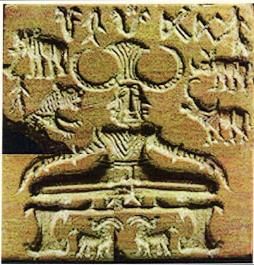
Consider the following statements concerning the use of seals by the Indus Valley People :
1. The seals were used for the identification of the trader.
2. The seals were used for decorative amulets.
3. The seals were used for educational purposes.
Which of the statements given above is/are correct?
1. The seals were used for the identification of the trader.
2. The seals were used for decorative amulets.
3. The seals were used for educational purposes.
Which of the statements given above is/are correct?
Detailed Solution: Question 6
Consider the following statements:
1. The Indus Valley Civilization pottery had inconsistency in its structure.
2. Red and Black pottery were more prevalent.
Which of the statements given above is/are correct?
1. The Indus Valley Civilization pottery had inconsistency in its structure.
2. Red and Black pottery were more prevalent.
Which of the statements given above is/are correct?
Detailed Solution: Question 7
Which of the following tree the Indus people considered as their sacred one?
Detailed Solution: Question 8
Consider the following statements concerning the Indus people religious life:
1. The Indus people probably believed in an after-life.
2. The religion had held a dominating sway over the daily lives of the masses.
Which of the statements given above is/are correct?
1. The Indus people probably believed in an after-life.
2. The religion had held a dominating sway over the daily lives of the masses.
Which of the statements given above is/are correct?
Detailed Solution: Question 9
Which of the following material was not used for making tools during the Indus Valley Civilization?
Detailed Solution: Question 10
In which of the following site the angle measuring instruments were found?
Detailed Solution: Question 11
Consider the following pairs:
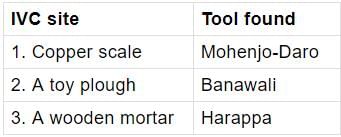
Which of the pairs given above is are correct?
Which of the pairs given above is are correct?
Detailed Solution: Question 12
Consider the following statements concerning the Indus script:
1. The script has more than two thousand signs.
2. The script was usually written left to right.
Which of the statements given above is/are correct?
1. The script has more than two thousand signs.
2. The script was usually written left to right.
Which of the statements given above is/are correct?
Detailed Solution: Question 13
In which of the following site, an example of a double burial has been discovered?
Detailed Solution: Question 14
Consider the following statements concerning the Indus valley Burial Practices:
1. A dog buried with human oval pit burials was discovered in Ropar.
2. The placing of the body in a foetal position is the hallmark of the later phase of IVC.
3. The separate burial pits for dogs were discovered in Kashmir
Which of the statements given above is/are correct?
1. A dog buried with human oval pit burials was discovered in Ropar.
2. The placing of the body in a foetal position is the hallmark of the later phase of IVC.
3. The separate burial pits for dogs were discovered in Kashmir
Which of the statements given above is/are correct?
Detailed Solution: Question 15
18 videos|561 docs|160 tests |
