
Sequences - Free MCQ Practice Test with solutions, SSC MTS/GD Quant Aptitude
MCQ Practice Test & Solutions: Test: Sequences (20 Questions)
You can prepare effectively for SSC MTS / SSC GD Quantitative Aptitude for Competitive Exams with this dedicated MCQ Practice Test (available with solutions) on the important topic of "Test: Sequences". These 20 questions have been designed by the experts with the latest curriculum of SSC MTS / SSC GD 2026, to help you master the concept.
Test Highlights:
- - Format: Multiple Choice Questions (MCQ)
- - Duration: 40 minutes
- - Number of Questions: 20
Sign up on EduRev for free to attempt this test and track your preparation progress.

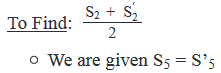
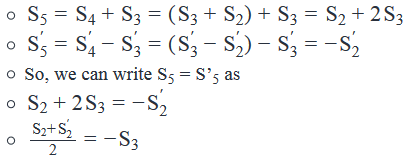
The nth term of an increasing sequence S is given by Sn = Sn-1 + Sn-2 for n > 2 and the nth term of a sequence S’ is given by S’n = S’n-1 - S’n-2 for n > 2. If S5 = S’5, what is the average (arithmetic mean) of S2 and S’2?
(1) The difference between the fourth term and the second term of sequence S is 14.
(2) The sum of the fourth term and the second term of sequence S’ is 14.
Detailed Solution: Question 1
If the sum of the first 30 positive odd integers is k, what is the sum of first 30 non-negative even integers?
Detailed Solution: Question 2

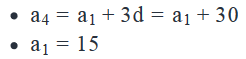
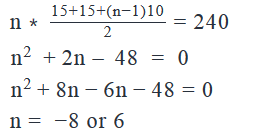
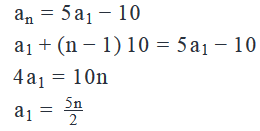
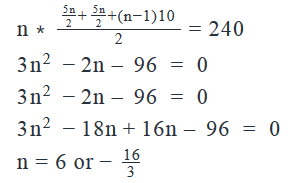
240 students are to be arranged in n rows in the assembly hall of a school. If the first row is the closest to the stage and each subsequent row has 10 more students than the row ahead of it, what is the value of n?
(1) There are 45 students in the 4th row from the stage.
(2) The number of students in the nth row is 10 less than 5 times the number of students in the first row.
Detailed Solution: Question 3
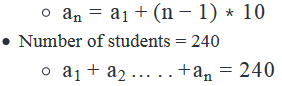
 (average of the 1st and the nth term is the average of all the terms of the sequence)

An increasing sequence P consists of 10 distinct integers. How many integers of the sequence are less than 16?
(1) The difference between any two integers of the sequence is divisible by 2 and 3.
(2) If the third term of the sequence P is removed, the magnitude of the product of the terms of the sequence remains unchanged.
Detailed Solution: Question 4

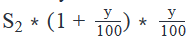
Steven and Stuart took a job in different companies at the same time. Steven’s salary increased by a fixed amount at the end of every year and Stuart’s salary increased by a fixed percentage at the end of every year. If the increase in the salary of Steven at the end of the third year was equal to the increase in the salary of Stuart at the end of the second year, what was the difference in the salaries of Steven and Stuart when they took the job?
(1) Steven’s salary after 2 years was 20% more than the salary at which he took the job
(2) The increase in the salary of Stuart at the end of the second year was 11% of the salary at which he took the job.
Detailed Solution: Question 5

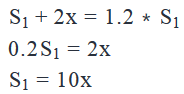
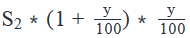
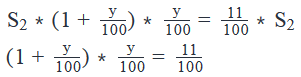


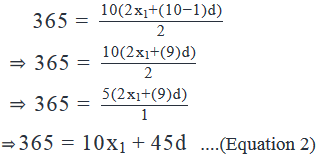
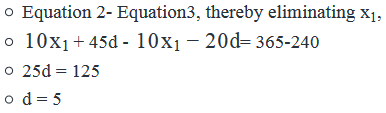
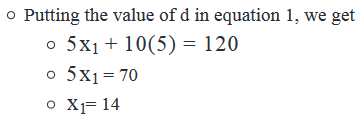
If the sum of the first five terms of an Arithmetic sequence is equal to 120 and the sum of the next five terms of the same Arithmetic Sequence is equal to 245, what is the 4th term of this Sequence?
Detailed Solution: Question 6
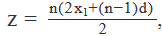 where n is the number of terms in the arithmetic sequence.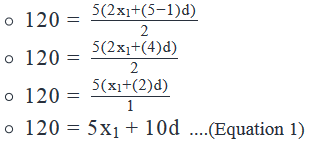
A list contains distinct integers a1, a2, …a10 arranged in ascending order. If the integers of the list lie between -19 and 19, inclusive such that the distance between any two consecutive integers is equal, is one of the terms of this list equal to zero?
(1) All the integers in the list are divisible by 2
(2) a4 = -6
Detailed Solution: Question 7
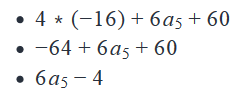
An increasing sequence consists of 4 negative integers and 6 positive integers. Is the sum of the sequence positive?
(1) The difference between any two consecutive negative integers is 5 and the difference between any two consecutive positive integers is 2
(2) The first term of the sequence is -16
Detailed Solution: Question 8
 where
where 



An increasing sequence M consists of 5 consecutive positive multiples of a positive integer. What is the remainder when the largest term of the sequence is divided by 2?
(1) The median of the sequence is even.
(2) The second term of the sequence is odd.
Detailed Solution: Question 9
Mike took 5 mock tests before appearing for the GMAT. In each mock test he scored 10 points more than the previous mock test. If he scored 760 on the GMAT and his average score for the mocks was 720, what is the difference between his last mock score and his GMAT score?
Detailed Solution: Question 10
In the sequence S, the difference between any two consecutive terms is equal. If the sum of the fourth term and the fifth term of the sequence is equal to the seventh term of the sequence, what is the value of the second term of the sequence?
Detailed Solution: Question 11
A city had 1000 migrants in the year 1999. If the number of migrants in the city has doubled every 3 years since 1999, then what was the increase in the population of migrants during the period from 2008 to 2011?
Detailed Solution: Question 12
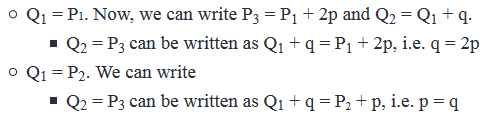
An arithmetic sequence is a sequence in which each term after the first is equal to the sum of the preceding term and a constant, which is also known as the common difference of that arithmetic sequence. The sequence S contains all the terms of two different increasing arithmetic sequences P and Q such that the number of terms in sequence S is equal to the sum of the number of terms in sequences P and Q. If each of the arithmetic sequences P and Q consists of 10 positive integral terms, how many distinct terms does sequence S have?
(1) The least common multiple of the common differences of the sequences P and Q is 6
(2) The third term of the sequence P is equal to the second term of the sequence Q
Detailed Solution: Question 13
An arithmetic sequence is a sequence in which each term after the first is equal to the sum of the preceding term and a constant, which is also known as the common difference of that arithmetic sequence. An increasing arithmetic sequence N consists of a set of distinct negative integers and an increasing arithmetic sequence P consists of a set of distinct positive integers. The sequence C contains all the terms of arithmetic sequences N and P such that the number of terms in sequence C is equal to the number of terms in arithmetic sequences N and P. Is sequence C an arithmetic sequence?
(1) The sum of the largest term of the sequence N and the smallest term of the sequence P is zero.
(2) For every integer in sequence N, there exists an integer in sequence P with the same magnitude.
Detailed Solution: Question 14
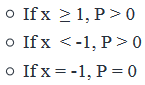
The sequence S consists of 10 terms: x, x2, x3……x10, where x is a non-zero number. If P is the sum of all the terms in the sequence S, is P3
> 0?
(1) The distance of any term of the sequence S from zero on the number line is not less than 1.
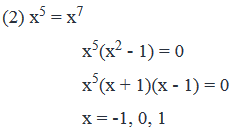
(2) x5 = x7
Detailed Solution: Question 15



A sequence S consists of 5 distinct positive integers. Are all the integers in the sequence divisible by 5?
(1) The sum of all the integers in the sequence is divisible by 5.
(2) The product of all the integers in the sequence is divisible by 5 but not by 10.
Detailed Solution: Question 16
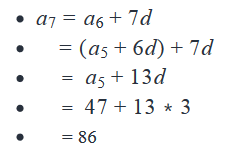
The sequence a1, a2,…an is such that an = an-1 +n*d for all n > 1, where d is a positive integer. If a3 = 20 and a5 = 47, what is the value of a7?
Detailed Solution: Question 17

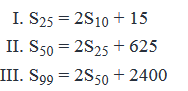
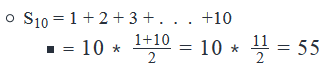
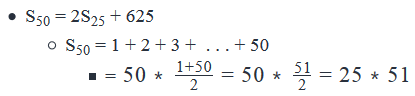
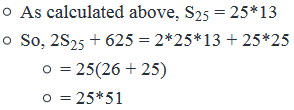
For any positive integer z, SZ denotes the sum of the first z positive integers. For example S3 = 1+2 + 3 = 6. Which of the following expressions is correct?
Detailed Solution: Question 18


Ted and Robin start from the same point at 7 AM and drive in opposite directions. Ted doubles his speed after every 90 minutes whereas Robin reduces her speed by half after every 120 minutes. If Ted starts driving at a speed of 10 kilometers/hour and Robin starts driving at a speed of 120 kilometers/hour, how far in kilometers will they be from one another at 1 PM?
Detailed Solution: Question 19


List A consists of 10 distinct integers arranged in ascending order. Is the difference between the sixth term and the fifth term of list A greater than 5?
(1) The difference between any two integers in list A is a multiple of 5.
(2) The median of the list is an integer.
Detailed Solution: Question 20
245 videos|154 docs|129 tests |
