Civil Engineering (CE) Exam  >  Civil Engineering (CE) Test  >  Fluid Mechanics for Civil Engineering  >  Test: Specific Weight & Specific Gravity - Civil Engineering (CE) MCQ

Specific Weight & Gravity - Free MCQ Practice Test with solutions, GATE


MCQ Practice Test & Solutions: Test: Specific Weight & Specific Gravity (10 Questions)

You can prepare effectively for Civil Engineering (CE) Fluid Mechanics for Civil Engineering with this dedicated MCQ Practice Test (available with solutions) on the important topic of "Test: Specific Weight & Specific Gravity". These 10 questions have been designed by the experts with the latest curriculum of Civil Engineering (CE) 2026, to help you master the concept.

Test Highlights:

  • - Format: Multiple Choice Questions (MCQ)
  • - Duration: 30 minutes
  • - Number of Questions: 10

Sign up on EduRev for free to attempt this test and track your preparation progress.

Test: Specific Weight & Specific Gravity - Question 1

One litre of water occupies a volume of:

Detailed Solution: Question 1

  • 1 litre is equal to 1 cubic decimetre.
  • That is the volume of a cube 10 centimetres × 10 centimetres × 10 centimetres.
  • 1 L ≡ 1 dm3 ≡ 1000 cm3
  • 1 L ≡ 0.001 m3 ≡ 1000 cm3

Test: Specific Weight & Specific Gravity - Question 2

Which of the following instrument is used to measure the specific gravity of liquid ?

Detailed Solution: Question 2
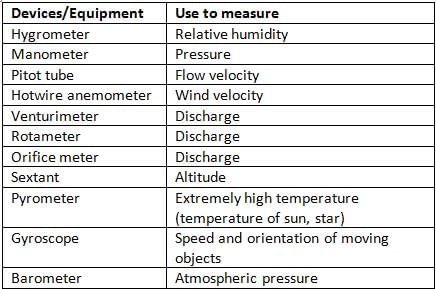
The hydrometer is a device which is used to measure specific gravity.
Various devices/equipment and their use is described in the table below:

Test: Specific Weight & Specific Gravity - Question 3

Hydrometer is an instrument for measuring 

Detailed Solution: Question 3
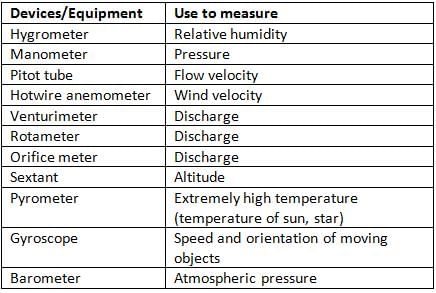
The hydrometer is a device which is used to measure specific gravity.
Various devices/equipments and their use is described in the table below:

Test: Specific Weight & Specific Gravity - Question 4

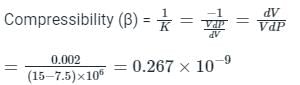
An increase in pressure of a liquid from 7.5 MPa to 15 MPa results into 0.2 percent decrease in its volume. The coefficient of compressibility of the liquid in m2/N is

Detailed Solution: Question 4
Concept:
In thermodynamics and Fluid Engineering, compressibility is a measure of the relative volume change of a fluid as a response to pressure (or mean stress) change.
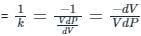
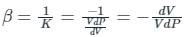
Compressibility in Fluid Engineering is expressed as follows:

where, ∂p = change of pressure, ∂v = change in the volume
K = bulk modulus
(-ve) sign indicates, there is a decrease in volume due to an increase in pressure.

Calculation:
Given:

dV = 0.2%, δP = 15 - 7.5 = 7.5 MPa 

Test: Specific Weight & Specific Gravity - Question 5

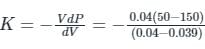
A liquid compressed in cylinder has a volume of 0.04 m3 at 50 kg/cm2 and a volume of 0.039 m3 at 150 kg/cm2. The bulk modulus of liquid is

Detailed Solution: Question 5

Concept:
When a body is submerged in a fluid, it undergoes hydraulic stress (equal in magnitude to the hydraulic pressure); This leads to a decrease in the volume of the body thus producing a strain called volume strain

  • The ratio of hydraulic stress to the corresponding hydraulic strain is called bulk modulus

Calculation:
Given:

P1 = 50 kg/cm2, P2 = 150 kg/cm2, V1 = 0.04 m3, V2 = 0.039 m3

= 4000 kg/cm2

Test: Specific Weight & Specific Gravity - Question 6

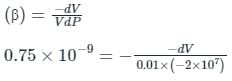
A reservoir of capacity 0.01 m3 is completely filled with a fluid of coefficient of compressibility 0.75 × 10⁻⁹ m2/N. The amount of fluid that will spill over (in m3), if pressure in the reservoir is reduced by 2 × 10⁷ N/m2 is

Detailed Solution: Question 6
Concept:
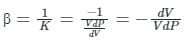
In thermodynamics and Fluid Engineering, compressibility is a measure of the relative volume change of a fluid as a response to pressure (or mean stress) change.
Compressibility in Fluid Engineering is expressed as follows:

where, ∂p = change of pressure, ∂v = change in the volume
K = bulk modulus
(-ve) sign indicates, there is a decrease in volume due to an increase in pressure.

Calculation:
Given:
β = 0.75× 10⁻⁹ m2/N, V = 0.01 m3, dP = 2 × 10⁷ Pa
Compressibility (β)


dV = 1.5 × 10⁻⁴

Test: Specific Weight & Specific Gravity - Question 7

The volume of a fluid occupied by a unit mass of the fluid is called -

Detailed Solution: Question 7

Specific Volume

  • The specific volume of the fluid is defined as the volume of the fluid occupied by a unit mass or volume per unit mass of a fluid is called a specific volume.
  • Specific volume is reciprocal of mass density.

Viscosity

  • Viscosity – the property of the fluid which offers resistance to the movement of one layer of fluid over another layer.
  • SI unit of viscosity is 
  • CGS unit of viscosity also called poise 
  • 1 poise =

Specific weight:

  • Specific weight is defined as weight per unit volume.
  • Its unit is N/m3.

Specific gravity is the ratio of the specific weight of the liquid to the specific weight of a standard fluid. In the case of liquids standard fluid is taken as water with specific gravity 1.

Test: Specific Weight & Specific Gravity - Question 8

Specific gravity of marble stone which weighs 400 N in air and 300 N in water is ________

Detailed Solution: Question 8
Concept:
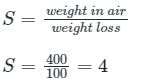
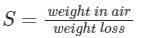
Specific gravity of the body is given by:

Calculation:
Given:
weight in air = 400 N, weight in water = 300 N
weight loss = 400 - 300 = 100 N
Specific gravity of marble stone is:

Test: Specific Weight & Specific Gravity - Question 9

Specific volume is reciprocal of:

Detailed Solution: Question 9

  • The reciprocal of the mass density is known as Specific volume.
  • The Specific volume of a material is the ratio of the volume of the material to its mass.
  • It is both the inverse of mass and the intrinsic property of matter.
  • Specific volume is defined as the number of cubic meters occupied by one kilogram of a substance.
  • The normal unit shall be the cubic meter per kilogram (m3/kg)
  • The specific volume for the ideal gas is also equal to the gas constant (R) multiplied by the temperature and then divided by the pressure multiplied by the molar mass of the ideal gas.

Test: Specific Weight & Specific Gravity - Question 10

Dimension of specific volume is:

Detailed Solution: Question 10

Dimensional Analysis:

  • The systematic procedure of identifying the variables in physical phenomena and correlating them to form a set of the dimensionless group is known as dimensional analysis.

Specific volume:

  • It is defined as the volume per unit mass.
  • Thus, L3M-1T0 is the dimensional formula of Specific volume.

54 videos|132 docs|110 tests
Information about Test: Specific Weight & Specific Gravity Page
In this test you can find the Exam questions for Test: Specific Weight & Specific Gravity solved & explained in the simplest way possible. Besides giving Questions and answers for Test: Specific Weight & Specific Gravity, EduRev gives you an ample number of Online tests for practice
Download as PDF