
Stability of complex ion, Crystal Field Theory - Free MCQ Practice Test
MCQ Practice Test & Solutions: Test: Stability of complex ion, Crystal Field Theory (20 Questions)
You can prepare effectively for JEE Chemistry for JEE Main & Advanced with this dedicated MCQ Practice Test (available with solutions) on the important topic of "Test: Stability of complex ion, Crystal Field Theory". These 20 questions have been designed by the experts with the latest curriculum of JEE 2026, to help you master the concept.
Test Highlights:
- - Format: Multiple Choice Questions (MCQ)
- - Duration: 20 minutes
- - Number of Questions: 20
Sign up on EduRev for free to attempt this test and track your preparation progress.

 , find the value of
  ?
?Detailed Solution: Question 1
 has zero oxidation state, as has zero oxidation state in the compound.
 is
is 
 has 6 valencies, as
  in this state is stable due to half-filled orbitals. Now, for 6 valencies,
  is required. Therefore,
  The compound is
  .
.Statement Type
Direction (Q. No. 25) This section is based on Statement I and Statement II. Select the correct answer from the codes given below.
Q.
Statement I : Mn(π— C3H5)(CO)4, obey effective atomic number rule.
Statement II : π-allyl ligand act as a 3e- donor.
Detailed Solution: Question 2

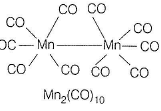
In Mn2(CO)10, the number of CO molecules in between the metal atoms are
Detailed Solution: Question 3
The correct order for wavelengths of absorption in the visible region for the following complexes will be
Detailed Solution: Question 4
 ,
, and (III)
 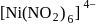 are made of
  and ligands
  and
and  respectively. The field strength order of the ligands is

 or
or 

Which will give a white precipitate with  in aqueous solution
Detailed Solution: Question 5



Detailed Solution: Question 6
 , larger the stability
 that exists in solution.
Amongst  and
and  , which are the colourless species?
(atomic number of Ti = 22, Co = 27, Cu = 29, Ni = 28)
and , which are the colourless species?(atomic number of Ti = 22, Co = 27, Cu = 29, Ni = 28)
Detailed Solution: Question 7
 and
and  and
and 
InFe(CO)s, the Fe-C bond possesses
Detailed Solution: Question 8
 metal to ligand back bonding in Fe-C bond of the organometallic compound
 So it possesses both
  and
and  characters.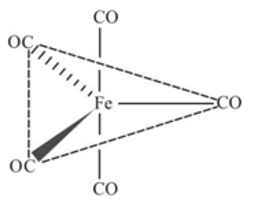
The crystal field splitting energy for octahedral  and tetrahedral
  complexes is related as
Detailed Solution: Question 9

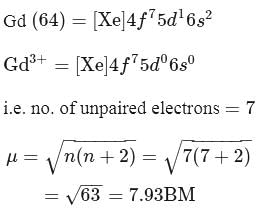
Calculate the magnetic moment of  ion
ion  .
.
ion .Detailed Solution: Question 10
For octahedral complex, which of the following  configurations of metal cation cannot exist in high spin and low spin forms?
Detailed Solution: Question 11
 and
and  octahedral complexes number of unpaired
  at central metal atom/ion never changes, therefore for such octahedral complexes terms high spin and low spin not used.
Which of the following complex ions has electrons that are symmetrically filled in both  and
and  orbitals ?
and orbitals ?Detailed Solution: Question 12
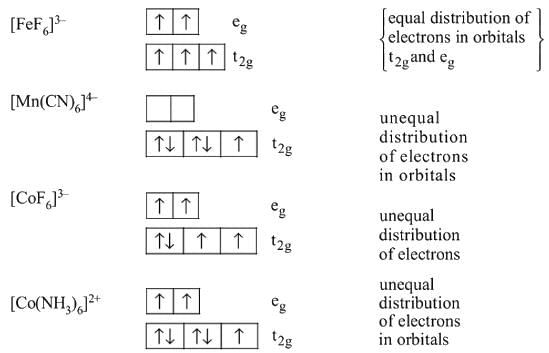
Which of the following statements related to crystal field splitting in octahedral coordination entities is incorrect?
Detailed Solution: Question 13
 is a strong field ligand and form low spin complexes thus
Among the following species the one which causes the highest  as a ligand is:
Detailed Solution: Question 14
 for the ligands.

The increasing order of crystal field splitting strength of the given ligands is
Detailed Solution: Question 15

Detailed Solution: Question 16
 Hybridization
  High or
 is an example of
  system of configuration.
Which of the following carbonyls will have the strongest  bond ?
Detailed Solution: Question 17
 orbitals of CO ligand (donation of electron density into
  orbitals of
  result in weakening of
  bond ). Hence, the
  bond would be strongest in
Which of the following does not have a metal carbon bond?
Detailed Solution: Question 18
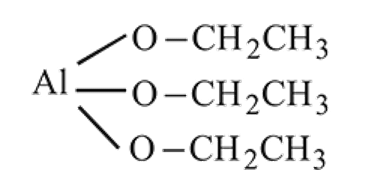
If the crystal field splitting energy of a tetrahedral complex  of the type
  is
is  , what is the crystal field splitting energy with respect to an octahedral complex,
  ?
?
Detailed Solution: Question 19

 of
of  is
is  , the CFSE of octahedral complex
  will be
  .
.The  for
for  complex is
  . The
. The  for
for  will be:
Detailed Solution: Question 20

332 videos|699 docs|300 tests |
