Electrical Engineering (EE) Exam  >  Electrical Engineering (EE) Test  >  Network Theory (Electric Circuits)  >  Test: Super Node Analysis - Electrical Engineering (EE) MCQ

Super Node Analysis - Free MCQ Practice Test with solutions, GATE EE Network


MCQ Practice Test & Solutions: Test: Super Node Analysis (10 Questions)

You can prepare effectively for Electrical Engineering (EE) Network Theory (Electric Circuits) with this dedicated MCQ Practice Test (available with solutions) on the important topic of "Test: Super Node Analysis". These 10 questions have been designed by the experts with the latest curriculum of Electrical Engineering (EE) 2026, to help you master the concept.

Test Highlights:

  • - Format: Multiple Choice Questions (MCQ)
  • - Duration: 30 minutes
  • - Number of Questions: 10

Sign up on EduRev for free to attempt this test and track your preparation progress.

Test: Super Node Analysis - Question 1

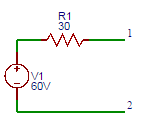
Find the value of the current (A) in the equivalent current source of the voltage source shown below.
Find the value of the current (A) in the equivalent current source of the voltage source

Detailed Solution: Question 1

The value of the current (A) in the equivalent current source of the voltage source the short circuit current at the terminals A and B is I = 60/30 = 2A.

Test: Super Node Analysis - Question 2

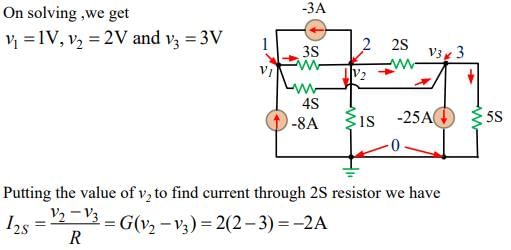
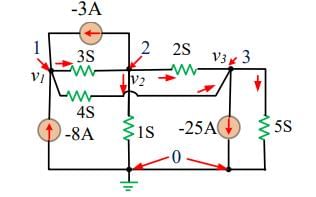
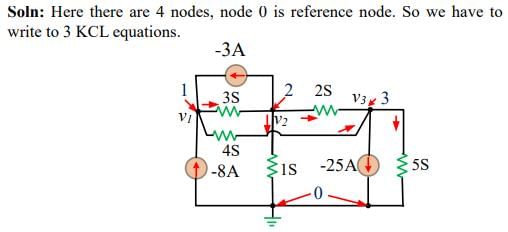
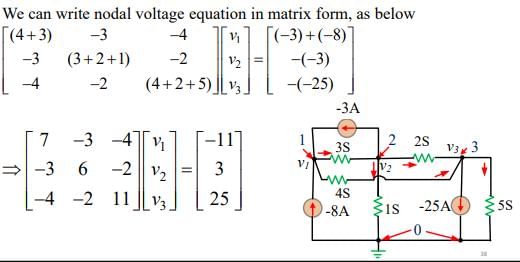
Solve the following network using the nodal analysis and determine the current through 2S resistor. (S indicates Siemens i.e. conductance)
Detailed Solution: Question 2
Test: Super Node Analysis - Question 3

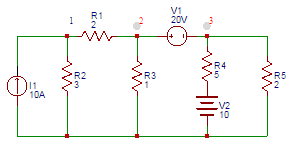
Consider the figure shown below. Find the voltage (V) at node 2.
The voltage (V) at node 1 in the given circuit is 19

Detailed Solution: Question 3

The equation at node 1 is 10 = V1/3 + (V- V2)/2
According to super Node analysis, (V- V2)/2 = V2/1 + (V- 10)/5 + V3/2V- V= 20.
On solving, we get, V= 11.5V.

Test: Super Node Analysis - Question 4

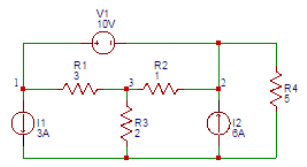
Consider the figure shown below. Find the power (W) delivered by the source 6A.
Find the voltage (V) at node 1 in the figure

Detailed Solution: Question 4

The term power is defined as the product of voltage and current and the power delivered by the source (6A) = Vx 6 = 3.72 × 6 = 22.32W.

Test: Super Node Analysis - Question 5

Consider the figure shown below. Find the voltage (V) at node 2.
Find the voltage (V) at node 1 in the figure

Detailed Solution: Question 5

Applying Super Node Analysis, the combined equation of node 1 and node 2 is (V- V3)/3 + 3 + (V- V3)/1 - 6 + V2/5 = 0.
At node 3, (V- V1)/3 + (V- V2)/1 + V3/2 = 0.
Also V- V2=10.
On solving above equations, we get V2 = 3.72V ≈ 4V.

Test: Super Node Analysis - Question 6

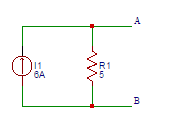
Find the value of the voltage (V) in the equivalent voltage source of the current source shown below.
Find the value of the voltage (V) in the equivalent voltage source of the current source

Detailed Solution: Question 6

The value of the voltage (V) in the equivalent voltage source of the current source the voltage across the terminals A and B is (6)(5) = 30V.

Test: Super Node Analysis - Question 7

Find the voltage (V) at node 3 in the figure shown below.
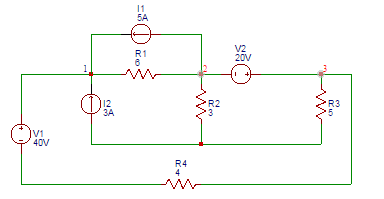
Find the voltage (V) at node 3 in the figure

Detailed Solution: Question 7

At node 1, (V- 40 - V3)/4 + (V- V2)/6 - 3 - 5 = 0.
Applying Super Node Analysis at node 2 and 3, (V- V1)/6 + 5 + V2/3 + V3/5 + (V+ 40 - V1)/4 = 0.
Also, V- V= 20.
On solving above equations, V3 = 18.11V ≈ 18V.

Test: Super Node Analysis - Question 8

Find the voltage (V) at node 1 in the circuit shown below.
The voltage (V) at node 1 in the given circuit is 19

Detailed Solution: Question 8

The equation at node 1 is 10 = V1/3+(V- V2)/2.
According to super Node analysis, (V- V2)/2 = V2/1 + (V- 10)/5 + V3/2V- V= 20.
On solving, we get, V= 19V.

Test: Super Node Analysis - Question 9

Consider the figure shown below. Find the voltage (V) at node 3.
Find the voltage (V) at node 1 in the figure

Detailed Solution: Question 9

Applying Super Node Analysis, the combined equation of node 1 and node 2 is (V- V3)/3 + 3 + (V- V3)/1 - 6 + V2/5 = 0.
At node 3, (V- V1)/3 + (V- V2)/1 + V3/2 = 0.
Also V- V= 10.
On solving above equations, we get V3 = 4.5V.

Test: Super Node Analysis - Question 10

Consider the figure shown below. Find the voltage (V) at node 1.
Find the voltage (V) at node 1 in the figure

Detailed Solution: Question 10

Applying Super Node Analysis, the combined equation of node 1 and node 2 is (V- V3)/3 + 3 + (V- V3)/1 - 6 + V2/5 = 0.
At node 3, (V- V1)/3 + (V- V2)/1 + V3/2 = 0.
Also V- V= 10.
On solving above equations, we get V1 = 13.72V ≈ 14V.

74 videos|151 docs|62 tests
Information about Test: Super Node Analysis Page
In this test you can find the Exam questions for Test: Super Node Analysis solved & explained in the simplest way possible. Besides giving Questions and answers for Test: Super Node Analysis, EduRev gives you an ample number of Online tests for practice
Download as PDF