
GATE Electrical Engineering (EE) Test: Synchronous Machine of Machines
MCQ Practice Test & Solutions: Test: Synchronous Machine of Electrical Machines (10 Questions)
You can prepare effectively for Electrical Engineering (EE) GATE Electrical Engineering (EE) Mock Test Series 2027 with this dedicated MCQ Practice Test (available with solutions) on the important topic of "Test: Synchronous Machine of Electrical Machines". These 10 questions have been designed by the experts with the latest curriculum of Electrical Engineering (EE) 2026, to help you master the concept.
Test Highlights:
- - Format: Multiple Choice Questions (MCQ)
- - Duration: 30 minutes
- - Number of Questions: 10
Sign up on EduRev for free to attempt this test and track your preparation progress.

Match List-I (Name of test) with List-II (Result) and select the correct code given below the lists:
List-I
A. Open Circuit and short circuit test
B. Open circuit and zero power factor test
C. Slip test
D. Maximum lagging current test
List-II
1. Leakage reactance
2. Direct axis synchronous reactance
3. Quadrature axis synchronous reactance
4. Ratio of direct axis synchronous reactance to quadrature axis synchronous reactance
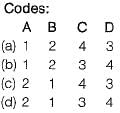
List-I
A. Open Circuit and short circuit test
B. Open circuit and zero power factor test
C. Slip test
D. Maximum lagging current test
List-II
1. Leakage reactance
2. Direct axis synchronous reactance
3. Quadrature axis synchronous reactance
4. Ratio of direct axis synchronous reactance to quadrature axis synchronous reactance
The phasor diagram of a synchronous machine connected to an infinite bus is shown below. The machine is acting as a
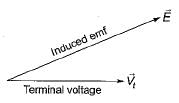
Detailed Solution: Question 2
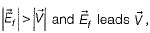 therefore machine is acting as a generator and operating at lagging Pf.
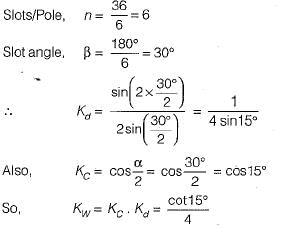
A 6-pole alternator with 36 slots carries a 3-phase distributed winding. Each coil is short-pitched by one slot. The winding factor is given by
Detailed Solution: Question 3

A winding is distributed in the slots along the air-gap periphery
1. to add mechanical strength to the winding.
2. to reduce the amount of conductor material required.
3. to reduce the harmonics in the generated emf.
4. to reduce the size of the machine.
5. for full utilization of iron and conductor materials.
From these, the correct answer is
1. to add mechanical strength to the winding.
2. to reduce the amount of conductor material required.
3. to reduce the harmonics in the generated emf.
4. to reduce the size of the machine.
5. for full utilization of iron and conductor materials.
From these, the correct answer is
Which of the following graphs represents the speed-torque characteristic of a synchronous motor?
Detailed Solution: Question 5
In figure the characteristic that corresponds to the variation of synchronous reactances of synchronous machine with the field current is
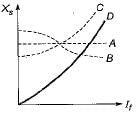
The four methods of calculating voltage regulation of a 3-phase alternator are:
1. Emf method
2. Saturated synchronous reactance method
3. New ASA method
4. Mmf method
The correct sequence in the ascending order of the values of regulation obtained by these methods is
1. Emf method
2. Saturated synchronous reactance method
3. New ASA method
4. Mmf method
The correct sequence in the ascending order of the values of regulation obtained by these methods is
The flux per pole in a synchronous motor with the field circuit ON and the stator disconnected from the supply is found to be 25 mWb. When the stator is connected to the rated supply with the field excitation unchanged, the flux per pole in the machine is found to be 20 mWb while the motor is running on no-load. Assuming no-load losses to be zero, the no-load current drawn by the motor from the supply
Detailed Solution: Question 8
Which of the following method would give a lower than actual value of regulation of an alternator?
Detailed Solution: Question 9
A synchronous motor is operating on no-load at unity power factor. If the field current is increased, the pf will become
Detailed Solution: Question 10
26 docs|247 tests |
