Civil Engineering (CE) Exam  >  Civil Engineering (CE) Test  >  Foundation Engineering  >  Test: Terzaghi’s Analysis - Civil Engineering (CE) MCQ

Terzaghi’s Analysis - Free MCQ Practice Test with solutions, GATE Civil


MCQ Practice Test & Solutions: Test: Terzaghi’s Analysis (10 Questions)

You can prepare effectively for Civil Engineering (CE) Foundation Engineering with this dedicated MCQ Practice Test (available with solutions) on the important topic of "Test: Terzaghi’s Analysis". These 10 questions have been designed by the experts with the latest curriculum of Civil Engineering (CE) 2026, to help you master the concept.

Test Highlights:

  • - Format: Multiple Choice Questions (MCQ)
  • - Duration: 30 minutes
  • - Number of Questions: 10

Sign up on EduRev for free to attempt this test and track your preparation progress.

Test: Terzaghi’s Analysis - Question 1

An analysis of the condition of complete bearing capacity failure is usually termed as ___________

Detailed Solution: Question 1

An analysis of the condition of complete bearing capacity failure is termed as a general shear failure, can be made by assuming that the soil behaves like an ideally plastic failure.

Test: Terzaghi’s Analysis - Question 2

In Terzaghi's bearing capacity analysis, the soil wedge immediately below the footing remains in state of

Detailed Solution: Question 2
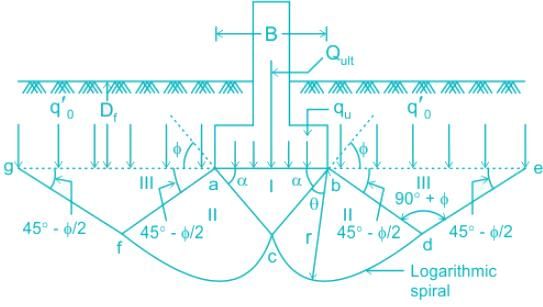
Mechanism of Failure:
The shapes of the failure surface under ultimate loading conditions.
The zones of plastic equilibrium represented in this figure by the area may be subdivided into three zones:
1. Zone I of elastic equilibrium
2. Zones II of radial shear state
3. Zones III of Rankine passive state

When load qu per unit area acting on the base of the footing of width B with a rough base is transmitted into the soil, the tendency of the soil located within zone I is to spread but this is counteracted by friction and adhesion between the soil and the base of the footing.
Due to the existence of this resistance against lateral spreading, the soil located immediately beneath the base remains permanently in a state of elastic equilibrium, and the soil located within this central Zone I behaves as if it were a part of the footing and sinks with the footing under the superimposed load

Test: Terzaghi’s Analysis - Question 3

The concept of analysis of bearing capacity failure was first developed by ___________

Detailed Solution: Question 3

The concept of failure analysis was first developed by Prandtl, and later extended by Terzaghi, Meyerhof and others.

Test: Terzaghi’s Analysis - Question 4

The parameters Nc, Nq, Nγ in the equations of bearing capacity failure are known as _________

Detailed Solution: Question 4

The parameters Nc, Nq, Nγ are the dimensionless numbers, known as bearing capacity factors depending only on the angle of shearing resistance of the soil.

Test: Terzaghi’s Analysis - Question 5

Which of the following is a limitation, of assumption in Terzaghi’s analysis?

Detailed Solution: Question 5

As the soil compress, φ changes; slight downward movement of footing may not develop fully the plastic planes.

Test: Terzaghi’s Analysis - Question 6

Which of the following are original Terzaghi values for Nγ?

Detailed Solution: Question 6

The values of Nγ for φ of 34° and 48° are the original Terzaghi values which were used by Bowles to back compute Kpγ.

Test: Terzaghi’s Analysis - Question 7

According to the assumptions in Terzaghi’s analysis, the soil is _____

Detailed Solution: Question 7

In Terzaghi’s analysis the soil is homogeneous and isotropic and its shear strength is represented by Coulomb’s equation.

Test: Terzaghi’s Analysis - Question 8

Local shear failure generally occurs in ____

Detailed Solution: Question 8

Local shear failure generally occurs in loose sand while general shear failure occurs in dense sand.

Test: Terzaghi’s Analysis - Question 9

The curve for Nq and Nγ for the transition state from φ = 28° and φ = 38° was given by __________

Detailed Solution: Question 9

Peck, Hansen, and Thorn burn gave curves for Nq and Nγ for the transition state from φ = 28° and φ = 38°, in which they assumed general shear failure when φ > 28°.

Test: Terzaghi’s Analysis - Question 10

Terzaghi’s bearing capacity equation is not applicable for ____________

Detailed Solution: Question 10

Terzaghi assumed the value of angle ψ = φ, which is not true. Since footings are normally rough, ψ has been found close to 45° + φ/2 than to φ, thus Terzaghi’s bearing capacity equations do not have provision for including depth effects, inclination factors, etc.

18 videos|57 docs|27 tests
Information about Test: Terzaghi’s Analysis Page
In this test you can find the Exam questions for Test: Terzaghi’s Analysis solved & explained in the simplest way possible. Besides giving Questions and answers for Test: Terzaghi’s Analysis, EduRev gives you an ample number of Online tests for practice
18 videos|57 docs|27 tests
Download as PDF