JEE Exam  >  JEE Test  >  Chapter-wise Tests Main & Advanced  >  Test: The Solid State (Old NCERT) - JEE MCQ

The Solid State (Old NCERT) - Free MCQ Practice Test with solutions, JEE


MCQ Practice Test & Solutions: Test: The Solid State (Old NCERT) (25 Questions)

You can prepare effectively for JEE Chapter-wise Tests for JEE Main & Advanced with this dedicated MCQ Practice Test (available with solutions) on the important topic of "Test: The Solid State (Old NCERT)". These 25 questions have been designed by the experts with the latest curriculum of JEE 2026, to help you master the concept.

Test Highlights:

  • - Format: Multiple Choice Questions (MCQ)
  • - Duration: 35 minutes
  • - Number of Questions: 25

Sign up on EduRev for free to attempt this test and track your preparation progress.

Test: The Solid State (Old NCERT) - Question 1

Substances that are strongly attracted by applied magnetic field and can be permanently magnetized are

Detailed Solution: Question 1

Ferromagnetic substance get permanently magnetised in applied Magnetic Field.

Test: The Solid State (Old NCERT) - Question 2

Which type of solid conduct electricity in molten state but not in solid state?

Detailed Solution: Question 2

In molten state ions can exist so they can conduct electricity

Test: The Solid State (Old NCERT) - Question 3

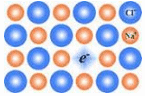
Yellow colour of NaCl crystals in sodium vapour is due to

Detailed Solution: Question 3

  • This yellow colour is due to metal excess defect of anionic valency.
  • Na+ion deposited on the surface of crystal of NaCl . The Cl-ion diffused to form NaCl. This happens by loss of electron from Na to Na+.
  • The released electro diffused into the crystal and occupy anionic site called F center which imparts yellow colour to NaCl.

Test: The Solid State (Old NCERT) - Question 4

Dislocation defect is also known as

Detailed Solution: Question 4

In frenkel defect cation gets dislocated from its position.

Test: The Solid State (Old NCERT) - Question 5

Defects in solids can be studied using

Detailed Solution: Question 5

All of the above mentioned methods are used to detect the basic structure of the sample, hence can easily detect the defects present in a sample.

Test: The Solid State (Old NCERT) - Question 6

Point defect is also known as

Detailed Solution: Question 6

Point defects are zero dimensional defects as they cannot extend in any direction in space. Point defects occur where an atom is missing or misplaced in a crystal lattice. The limit of the size of point defect is not defined.

Test: The Solid State (Old NCERT) - Question 7

Solid X is a very hard electrical insulator in solid as well as in molten state. It melts at extremely high temperature. Solid X is a

Detailed Solution: Question 7

Covalent solid doesnot conduct electricity in molten and solid state.

Test: The Solid State (Old NCERT) - Question 8

Nature of binding forces present in carbondioxide molecules in solid state are?

Detailed Solution: Question 8

O=C=O<−>−O−C+=O

Test: The Solid State (Old NCERT) - Question 9

What type of interaction hold the molecules together in a polar molecular solid?

Detailed Solution: Question 9

Polar molecule will act as a dipole.

Test: The Solid State (Old NCERT) - Question 10

An atom located at the body center of a cubic unit cell is shared by

Detailed Solution: Question 10

In body centred cubic cell, an atom at the body-centre is shared by 1 unit cell. Thus, this atom contributes one atom to the unit cell.

Test: The Solid State (Old NCERT) - Question 11

Ionization enthalpy is lowest in

Detailed Solution: Question 11

Metals have low ionization energy because of there tendency to lose electrons.

Test: The Solid State (Old NCERT) - Question 12

The coordination number of AB having rock salt geometry is

Detailed Solution: Question 12

NaCl has rock salt structure. Coordination No. is 6.

Test: The Solid State (Old NCERT) - Question 13

MgO has the structure of NaCl. The coordination number of the ions in MgO is

Detailed Solution: Question 13

Coordination No. in NaCl is 6.

Test: The Solid State (Old NCERT) - Question 14

Type of stoichiometric defect shown by ZnS is

Detailed Solution: Question 14

ZnS shows Frenkel defect.

Test: The Solid State (Old NCERT) - Question 15

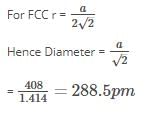
A metal crystallizes with a face-centered cubic lattice. The edge of the unit cell is 408 pm. The diameter of the metal atom is

Detailed Solution: Question 15
Test: The Solid State (Old NCERT) - Question 16

An element forms a cubic unit cell with edge length 405 pm. Molar mass of this element is 2.7 X 10⁻² Kg/mol and its density is given as 2.7 X 10Kg/m3. How many atoms of this elements are present per unit cell.

Detailed Solution: Question 16

Test: The Solid State (Old NCERT) - Question 17

A group of 14 element is converted into n – type semiconductor by dopping it with

Detailed Solution: Question 17

Group 15 doping on group 14 element forms n type semiconductor due to excess electrons.

Test: The Solid State (Old NCERT) - Question 18

Group 14 element is converted to p – type semiconductor by dopping it with

Detailed Solution: Question 18

Doping of group 14 elements with group 13 forms p type semiconductor.

Test: The Solid State (Old NCERT) - Question 19

Giant ionic structures is also name given to

Detailed Solution: Question 19

  • An ionic compound is a giant structure of ions.
  • The ions have a regular, repeating arrangement called an ionic lattice .
  • The lattice is formed because the ions attract each other and form a regular pattern with oppositely charged ions next to each other.

Test: The Solid State (Old NCERT) - Question 20

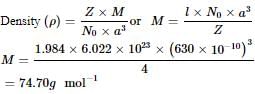
A substance forms face centered cubic crystals. Its density is 1.984 g/cm3 and the length of the edge of the unit cell is 630 pm. Calculate the molar mass in g/mol?

Detailed Solution: Question 20

Test: The Solid State (Old NCERT) - Question 21

The hardest substance among the following is

Detailed Solution: Question 21

It has network Structure.

Test: The Solid State (Old NCERT) - Question 22

The following diagram shows :

Detailed Solution: Question 22

Extra electron is present at anionic site.

Test: The Solid State (Old NCERT) - Question 23

In n – type semiconductor current is carried by

Detailed Solution: Question 23
N type semiconductors have excess electrons.

Test: The Solid State (Old NCERT) - Question 24

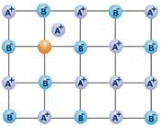
The following diagram shows

Detailed Solution: Question 24

A Frenkel defect or dislocation defect is a type of point defect in crystalline solids named after its discoverer Yakov Frenkel. The defect forms when an atom or smaller ion (usually cation) leaves its place in the lattice, creating a vacancy, and becomes an interstitial by lodging in a nearby location.

Test: The Solid State (Old NCERT) - Question 25

Which transition metal oxide has appearance and conductivity like that of copper?

Detailed Solution: Question 25

Rhenium oxide and cooper oxide have same appearance and conductivity.

446 docs|929 tests
Information about Test: The Solid State (Old NCERT) Page
In this test you can find the Exam questions for Test: The Solid State (Old NCERT) solved & explained in the simplest way possible. Besides giving Questions and answers for Test: The Solid State (Old NCERT), EduRev gives you an ample number of Online tests for practice
Download as PDF