
GATE Civil Engineering (CE) 2027 Test: Transportation Engineering- 2 Free
MCQ Practice Test & Solutions: Test: Transportation Engineering- 2 (20 Questions)
You can prepare effectively for Civil Engineering (CE) GATE Civil Engineering (CE) 2027 Mock Test Series with this dedicated MCQ Practice Test (available with solutions) on the important topic of "Test: Transportation Engineering- 2". These 20 questions have been designed by the experts with the latest curriculum of Civil Engineering (CE) 2026, to help you master the concept.
Test Highlights:
- - Format: Multiple Choice Questions (MCQ)
- - Duration: 60 minutes
- - Number of Questions: 20
Sign up on EduRev for free to attempt this test and track your preparation progress.

For carrying out bituminous patch work during the rainy season, the most suitable binder is
Detailed Solution: Question 1
Bituminous materials are commonly used in highway construction because of their good
Detailed Solution: Question 2

In cement concrete pavements, tie bars are installed in
The following general statement may be made about the penetration value and softening point of bitumen
Detailed Solution: Question 4
The minimum length of the overtaking zone should be
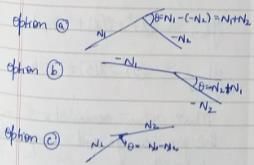
In case of the valley curves or sag curves the maximum possible deviation angle is obtained when
Detailed Solution: Question 6
The bitumen with viscosity reduced by volatile diluents is known as
Detailed Solution: Question 7
On hill roads, the necessity to ease the gradient at horizontal curves by an amount to offset the extra tractive effort involved at curves is known as
According to IRC guidelines, the maximum volume of traffic that a rotary can efficiently handle is
The maximum number of passenger cars that can pass a given point on a lane or roadway during one hour under ideal roadway and traffic conditions is known as
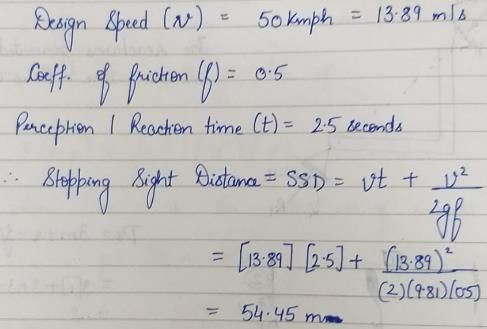
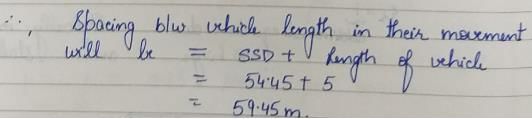
For a highway with the design speed of 50 km/h, coefficient of friction 0.5, perception-brake reaction time of 2.5 s, and average vehicle length 5 m, the spacing between the vehicle length in their movement will be
Detailed Solution: Question 11
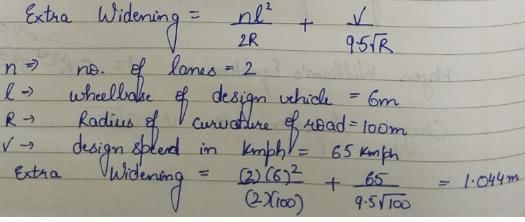
For a two-lane pavement with radius of curve of 100 m, with design speed of 65 km/h & wheelbase of design vehicle of 6 m, the extra widening necessary will be
Detailed Solution: Question 12
Consider the following factors:
1. Reaction time 2. Speed
3. Coefficient of the longitudinal friction
4. Gradients
Which of these factors are taken into account for computing braking distance?
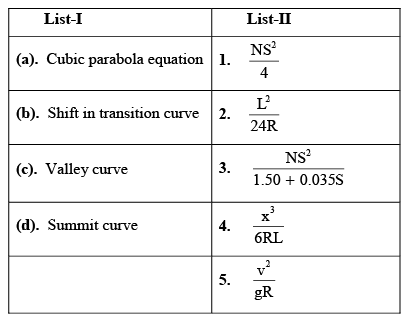
Match List-I with List-II and select the correct answer using the codes given below the lists:
Which one of the following represents the basic capacity of a single lane road? Where, V = speed in km/h, s = average centre to centre spacing of vehicle in m, and h = average time headway between two vehicle in seconds
Consider the following parameters related to a rotary intersection:
1. Width of the weaving section
2. Length of the weaving section
3. Proportion of weaving traffic
4. Weaving angle
5. Width of the carriageway at entry
Capacity is generally expressed in terms of
2. Length of the weaving section
3. Proportion of weaving traffic
4. Weaving angle
5. Width of the carriageway at entry
Detailed Solution: Question 16
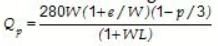 w is width of weaving section e is average of entry e1 and width of nonweaving section e2 for the range e/W = 0.4 to 1.0 L is the length of the weaving section P is proportion of weaving traffic
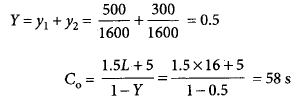
If the normal flows on two approach roads at an intersection are respectively 500 PCU/h and 300 PCU/h, the saturation flows are 1600 PCU/h on each road and the total lost time per single cycle is 16 s, then the optimum cycle time by Webster’s method is
Detailed Solution: Question 17
When two roads with two-lane, two-way traffic, cross at an uncontrolled intersection, the total number of potential major conflict points would be __________.
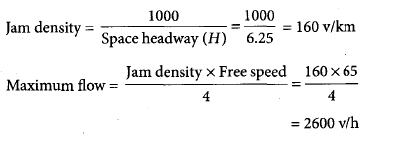
On a road the free speed was 65 km/h and the space headway at jam density was 6.25 vpkm. What is the maximum flow which could be expected on this road?
Detailed Solution: Question 19
In which type of transportation survey, the vehicles are stopped on a sampling basis and information is collected on the type of vehicle, origin, destination, trip purpose, etc?
Detailed Solution: Question 20
33 docs|280 tests |
