NEET PG Exam  >  NEET PG Test  >  Topic Wise MCQs  >  Test: WPW and Brugada Syndrome & JVP - NEET PG MCQ

WPW and Brugada Syndrome & JVP - Free MCQ Practice Test with solutions,


MCQ Practice Test & Solutions: Test: WPW and Brugada Syndrome & JVP (10 Questions)

You can prepare effectively for NEET PG Topic Wise MCQs for NEET PG with this dedicated MCQ Practice Test (available with solutions) on the important topic of "Test: WPW and Brugada Syndrome & JVP". These 10 questions have been designed by the experts with the latest curriculum of NEET PG 2026, to help you master the concept.

Test Highlights:

  • - Format: Multiple Choice Questions (MCQ)
  • - Duration: 10 minutes
  • - Number of Questions: 10

Sign up on EduRev for free to attempt this test and track your preparation progress.

Test: WPW and Brugada Syndrome & JVP - Question 1

Digoxin is not used in the management of? (Recent Question 2016-17)

Detailed Solution: Question 1

Individuals experiencing symptomatic Wolff-Parkinson-White (WPW) syndrome should avoid treatment with calcium channel blockers or digoxin due to the risk of:

  • Increased rapid ventricular rates
  • Development of atrial fibrillation or atrial flutter

These conditions can lead to significant hemodynamic collapse.

Test: WPW and Brugada Syndrome & JVP - Question 2

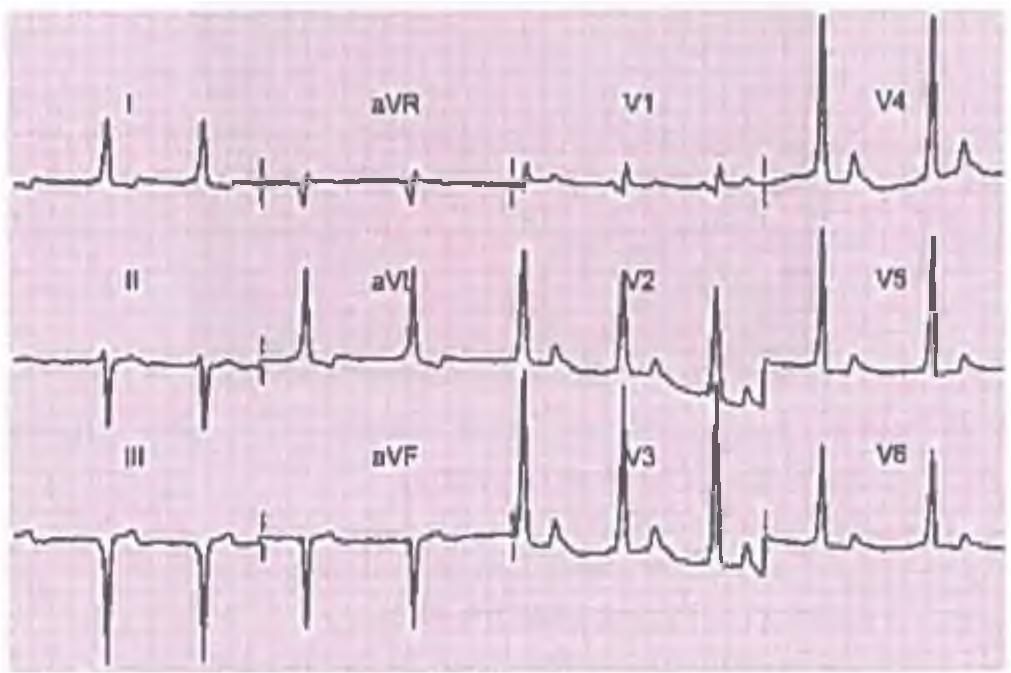
A 16-year old boy has history of recurrent episodes of fainting in-school assembly. ECG was done. What is incorrect about the condition?
Detailed Solution: Question 2
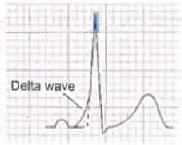
The ECG displays a normal sinus rhythm accompanied by left axis deviation. There is a brief PR interval with a broad QRS complex indicating a prolonged upstroke of the QRS (delta wave).

  • The prolonged upstroke, with a slight alteration in slope, is evident in leads V3 and V4.
  • The presence of an accessory pathway, known as the Bundle of Kent, can account for these irregularities, and the boy is diagnosed with Wolf-Parkinson-White syndrome.

In cases with a positive family history of sudden death or recurrent syncope episodes, the preferred treatment is an implantable cardioverter defibrillator. This device can administer a DC shock to terminate a life-threatening arrhythmia.

Test: WPW and Brugada Syndrome & JVP - Question 3

An 18-year-old boy is asymptomatic. On ECG he has a short PR interval with delta waves. Which of the following is not required for these patients? (AIIMS May 2013)

Detailed Solution: Question 3

The clinical diagnosis for the patient is Wolff-Parkinson-White syndrome. Patients with this condition possess a bypass tract that facilitates the conduction of impulses directly from the atria to the ventricles, circumventing the decremental properties of the AV node.

  • An invasive electrophysiological study is advisable to determine if the pathway results in rapid ventricular rates.
  • During the same procedure, a curative catheter ablation can be performed.
  • B-blockers and vagal manoeuvres may be applied at the onset of an episode.

Exercise on a treadmill can induce sympathetic stimulation, which may trigger arrhythmias; hence, it is not recommended for patients with W.P.W. Rapid pre-excited tachycardia should be managed with electrical cardioversion or by administering intravenous procainamide or ibutilide.

Test: WPW and Brugada Syndrome & JVP - Question 4

What is incorrect about Brugada syndrome? (Recent Pattern 2014-15)

Detailed Solution: Question 4

The primary clinical characteristics of Brugada syndrome encompass visible, transient, or hidden ST segment elevation in leads V1 to V3, which can often be triggered by sodium channel-blocking medications such as ajmaline, flecainide, and procainamide, alongside a risk of polymorphic ventricular arrhythmias.
  • The condition arises from a reduced inward sodium current in the epicardium of the right ventricle (RV) outflow tract.
  • A decrease in the action potential dome in the RV epicardium, caused by the unopposed ITo potassium outward current, leads to a significant shortening of the action potential.
  • The substantial potential difference between the normal endocardium and the rapidly depolarised RV outflow epicardium results in ST-segment elevation in V1-V3 during sinus rhythm, which increases the likelihood of local ventricular reentry.
Most of the genetic defects linked to the syndrome remain unidentified; however, approximately 20% of patients have been found to carry mutations in the SCN5A gene.
  • This syndrome has been observed in individuals of all genders and ethnic backgrounds, following an autosomal dominant inheritance pattern.
  • It is most prevalent in young males (~75%) and is suspected to contribute to the Sudden and Unexpected Nocturnal Death Syndrome (SUDS) noted in Southeast Asian men.
  • The ventricular arrhythmia typically manifests at rest or during sleep.
  • Fever and other sodium channel-blocking agents can also trigger ventricular arrhythmias.
For patients experiencing syncopal episodes, an implantable cardioverter defibrillator (ICD) is employed, as a pacemaker cannot deliver a DC shock to terminate the arrhythmias that may develop in these individuals.

Test: WPW and Brugada Syndrome & JVP - Question 5

Brugada Syndrome is associated with: (AIIMS 2013)

Detailed Solution: Question 5

Brugada syndrome is a genetically inherited channelopathy and follows an autosomal dominant inheritance pattern. The issue is associated with the transmembrane sodium current, which influences the right ventricular endocardium in a manner distinct from the epicardium. This can result in a blockage pattern observable in an ECG.

Test: WPW and Brugada Syndrome & JVP - Question 6

'a' wave in JVP indicates: (AIIMS May 2018)

Detailed Solution: Question 6

'a' wave in JVP indicates Atrial contraction.

Test: WPW and Brugada Syndrome & JVP - Question 7

In a patient of lung cancer with full neck veins and low BP, which of the following is incorrect? (Recent Pattern Questions)

Detailed Solution: Question 7

  • Lung cancer can exhibit metastasis to heart leading to development of pericardial effusion.
  • As more fluid would have accumulated, patient developed cardiac tamponade leading to hypotension and full neck veins.
  • Y descent is absent in cardiac tamponade.
  • Due to swinging motion of heart in a sac of fluid, Electrical alternans is seen.
  • Kussmaul sign is a paradoxical rise of JVP on inspiration. But in tamponade, due to extreme magnitude of pressure in pericardial space, Kussmaul sign becomes absent.

Test: WPW and Brugada Syndrome & JVP - Question 8

Internal jugular vein pressure determines pressure of: (Recent Question 2015-16)

Detailed Solution: Question 8

Normal JVP is between 5 and 8 cm of water. An increased JVP suggests right-sided CHF. The Kussmaul sign is observed in constrictive pericarditis, but it is absent in cardiac tamponade. Canon a waves are present in cases of AV dissociation, ventricular tachycardia, or junctional tachycardia.

Test: WPW and Brugada Syndrome & JVP - Question 9

Canon A wave is seen in:

Detailed Solution: Question 9

The a wave indicates the contraction of the right atrium just after the P wave on an electrocardiogram, occurring before the first heart sound (S1).

  • The a wave is absent in cases of atrial fibrillation.
  • A canonical a wave is observed with atrioventricular (AV) dissociation or complete heart block, resulting from right atrial contraction against a closed tricuspid valve.
  • Conditions such as wide complex tachycardia, including ventricular tachycardia, can also affect the a wave.
  • A pronounced a wave is typically noted in patients with diminished right ventricular compliance, such as those experiencing right ventricular failure.

Test: WPW and Brugada Syndrome & JVP - Question 10

A wave in JVP is absent in:  (Recent Question 2015-16)

Detailed Solution: Question 10

A wave in JVP results from atrial contraction.

  • In atrial fibrillation, the atria are twitching, which diminishes their power to a point where a wave is absent.
  • Heart block will present with large a waves.
  • Tricuspid Regurgitation is characterised by absent x waves and large v waves.
  • Constrictive Pericarditis displays a prominent y descent.

327 tests
Information about Test: WPW and Brugada Syndrome & JVP Page
In this test you can find the Exam questions for Test: WPW and Brugada Syndrome & JVP solved & explained in the simplest way possible. Besides giving Questions and answers for Test: WPW and Brugada Syndrome & JVP, EduRev gives you an ample number of Online tests for practice
Download as PDF