NEET Exam  >  NEET Test  >  NCERT Based Tests  >  Test: d & f-Block Elements - 2 - NEET MCQ

d & f-Block Elements - 2 - Free MCQ Practice Test with solutions, NEET


MCQ Practice Test & Solutions: Test: d & f-Block Elements - 2 (30 Questions)

You can prepare effectively for NEET NCERT Based Tests for NEET with this dedicated MCQ Practice Test (available with solutions) on the important topic of "Test: d & f-Block Elements - 2". These 30 questions have been designed by the experts with the latest curriculum of NEET 2026, to help you master the concept.

Test Highlights:

  • - Format: Multiple Choice Questions (MCQ)
  • - Duration: 45 minutes
  • - Number of Questions: 30

Sign up on EduRev for free to attempt this test and track your preparation progress.

Test: d & f-Block Elements - 2 - Question 1

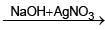
(T) imparts violet colour (V) Red gas (W) Red ppt.

(W) Red ppt.  white ppt.

(U)  gas (gives white fumes with HCl)

sublimes on heating Identify (T) to (Z).

Detailed Solution: Question 1

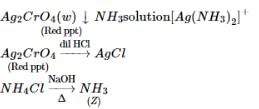
The correct answer is option B

Test: d & f-Block Elements - 2 - Question 2

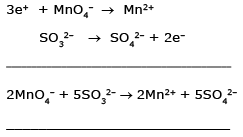
The number of moles of acidified KMnO4 required to convert one mole of sulphite ion into sulphate ion is-

Detailed Solution: Question 2
Test: d & f-Block Elements - 2 - Question 3

N2(g) + 3H2 (g)  2NH3(g) ; Haber's process, Mo is used as -

Detailed Solution: Question 3

MO is catalytic promoter & it improves catalytic properties as catalyst

*Multiple options can be correct
Test: d & f-Block Elements - 2 - Question 4

Potash alum is a double salt, its aqueous solution shows the characteristics of-

Detailed Solution: Question 4

K2SO4 .Al2(SO4)3.24 H2O + H2O

*Multiple options can be correct
Test: d & f-Block Elements - 2 - Question 5

Cr2O72-  2CrO42-, X and Y are respectively-

Detailed Solution: Question 5

*Multiple options can be correct
Test: d & f-Block Elements - 2 - Question 6

Addition of non-metals like B and C to the interstitial sites of a transition metal results the metal-

Detailed Solution: Question 6

Interstitial compound results in
(A) hardness increses
(B) Malleability (decreases)
(C) Ductality (decreases)

*Multiple options can be correct
Test: d & f-Block Elements - 2 - Question 7

Mercury is a liquid at 0°C because of-

Detailed Solution: Question 7

Weak metallic bond as due to poor shielding of d & f orbital its ionisation energy became high & kernel formation becomes  difficult.

*Multiple options can be correct
Test: d & f-Block Elements - 2 - Question 8

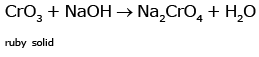
CrO3 dissolves in aqueous NaOH to give-

Detailed Solution: Question 8

*Multiple options can be correct
Test: d & f-Block Elements - 2 - Question 9

The correct statement(s) about transition elements is/are-

Detailed Solution: Question 9

All statements are comeet
[Ni(CO)4], [Fe(CO)5] [Cr(CO)5]

*Multiple options can be correct
Test: d & f-Block Elements - 2 - Question 10

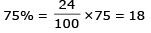
An ornament of gold having 75% of gold, it is of .............. carat.

Detailed Solution: Question 10

100% – 24 carat

*Multiple options can be correct
Test: d & f-Block Elements - 2 - Question 11

Solution of MnO4- is purple-coloured due to-

Detailed Solution: Question 11

MnO4 has purple colour due to change transfer

*Multiple options can be correct
Test: d & f-Block Elements - 2 - Question 12

The ionisation energies of transition elements are-

Detailed Solution: Question 12

Ionisation energies are between s & p-block.

*Multiple options can be correct
Test: d & f-Block Elements - 2 - Question 13

Transition elements having more tendency to form complex than representative elements (s and p-block elements) due to-

Detailed Solution: Question 13

Complex pormation α (Zeff = Z –σ) tendency

*Multiple options can be correct
Test: d & f-Block Elements - 2 - Question 14

During estimation of oxalic acid Vs KMnO4, self indicator is-

Detailed Solution: Question 14

KMnO4 acts as self indicator.

*Multiple options can be correct
Test: d & f-Block Elements - 2 - Question 15

The metal(s) which does/do not form amalgam is/are-

Detailed Solution: Question 15

Fe, Pt  Refer metallurgy

*Multiple options can be correct
Test: d & f-Block Elements - 2 - Question 16

Which of the following statements concern with transition metals ?

Detailed Solution: Question 16

O.S. different by 1 unit

*Multiple options can be correct
Test: d & f-Block Elements - 2 - Question 17

Correct statement(s) is/are-

Detailed Solution: Question 17


exothermic reaction
(volcanic reaction)

*Multiple options can be correct
Test: d & f-Block Elements - 2 - Question 18

The highest oxidation state among transition elements is-

Detailed Solution: Question 18

O5 (Xe)4f14 sd6 6s2
O58+(Xe) 4f4

*Multiple options can be correct
Test: d & f-Block Elements - 2 - Question 19

A compound of mercury used in cosmetics, in Ayurvedic and Yunani medicines and known as Vermilon is-

Detailed Solution: Question 19

Vermilon cantain floulsmelly HgS.

*Multiple options can be correct
Test: d & f-Block Elements - 2 - Question 20

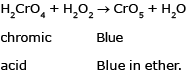
Acidified chromic acid

X and Y are - (blue colour)

Detailed Solution: Question 20

*Multiple options can be correct
Test: d & f-Block Elements - 2 - Question 21

X(Blue colour ),X and Y are

Detailed Solution: Question 21


CuSO4 + dilH2SO4 → [Cu(H2O)4]SO4

*Multiple options can be correct
Test: d & f-Block Elements - 2 - Question 22

Transition elements are usually characterised by variable oxidation states but Zn does not show this property because of-

Detailed Solution: Question 22

Fully pilled d-subshell
Zn →Zn2+ + 2e- 
3d104s2 3d10

*Multiple options can be correct
Test: d & f-Block Elements - 2 - Question 23

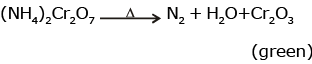
(NH4)2Cr2O7 (Ammonium dichromate) is used in fire works. The green coloured powder blown in air is-

Detailed Solution: Question 23
*Multiple options can be correct
Test: d & f-Block Elements - 2 - Question 24

The d-block element which is a liquid at room temperature, having high specific heat, less reactivity than hydrogen and its chloride (MX2) is volatile on heating is-

Detailed Solution: Question 24

HgCl2 is volatile is reffered as corrosive sublimate.

*Multiple options can be correct
Test: d & f-Block Elements - 2 - Question 25

Coinage metals show the properties of-

Detailed Solution: Question 25

Cu, Ag, Au, are coinage metal used in coin in older days.

Test: d & f-Block Elements - 2 - Question 26

Iron becomes passive by..................due to formation of ................

Detailed Solution: Question 26

Fe + HNO3 → Fe2O3 + NO2 + H2O    
80%

Test: d & f-Block Elements - 2 - Question 27

Bayer's reagent used to detect olifinic double bond is-

Detailed Solution: Question 27

Cold dilute alkaline KMnO4 is Bayer’s neagent.

*Multiple options can be correct
Test: d & f-Block Elements - 2 - Question 28

Amphoteric oxide(s) is/are-

Detailed Solution: Question 28

oxide of Be, Al, Zn, Cr, Pb, Sn, As, are amphoteric

*Multiple options can be correct
Test: d & f-Block Elements - 2 - Question 29

Interstitial compounds are formed by-

Detailed Solution: Question 29

Transition element froms intershtial compound.

*Multiple options can be correct
Test: d & f-Block Elements - 2 - Question 30

The transition metal used in X-rays tube is-

Detailed Solution: Question 30

Mo is used become of its high melting point.

677 tests
Information about Test: d & f-Block Elements - 2 Page
In this test you can find the Exam questions for Test: d & f-Block Elements - 2 solved & explained in the simplest way possible. Besides giving Questions and answers for Test: d & f-Block Elements - 2, EduRev gives you an ample number of Online tests for practice
Download as PDF