JEE Exam  >  JEE Test  >  UGEE Mock Test Series 2026  >  UGEE REAP Mock Test- 1 - JEE MCQ

UGEE REAP Mock Test- 1 Free Online Test 2026


Full Mock Test & Solutions: UGEE REAP Mock Test- 1 (50 Questions)

You can boost your JEE 2026 exam preparation with this UGEE REAP Mock Test- 1 (available with detailed solutions).. This mock test has been designed with the analysis of important topics, recent trends of the exam, and previous year questions of the last 3-years. All the questions have been designed to mirror the official pattern of JEE 2026 exam, helping you build speed, accuracy as per the actual exam.

Mock Test Highlights:

  • - Format: Multiple Choice Questions (MCQ)
  • - Duration: 120 minutes
  • - Total Questions: 50
  • - Analysis: Detailed Solutions & Performance Insights

Sign up on EduRev for free and get access to these mock tests, get your All India Rank, and identify your weak areas to improve your marks & rank in the actual exam.

UGEE REAP Mock Test- 1 - Question 1

The HR team's conclusion that "remote work is overall better for productivity" is based on which of the following unstated assumptions?

Detailed Solution: Question 1

The HR team looked at +15% individual output and −22% collaborative performance, then concluded remote work is "overall better."
For this conclusion to hold, they must be assuming that individual output matters MORE than collaborative performance — otherwise the −22% collaborative drop would offset or outweigh the +15% individual gain.
Option (A) directly captures this hidden assumption.
Option (B) is about skill — not addressed in conclusion.
Option (C) about burnout — possible but the conclusion was about productivity, not long-term trends.
Option (D) about project nature — this would strengthen but isn't the assumption behind the specific numbers comparison.
Option (E) about job satisfaction — satisfaction data wasn't used to draw the productivity conclusion.

UGEE REAP Mock Test- 1 - Question 2

Which of the following, if true, would most STRENGTHEN the HR team's conclusion that remote work is better for productivity?

Detailed Solution: Question 2

To strengthen "remote work is overall better for productivity" we need to either:

  • Show that the 15% individual gain outweighs the 22% collaborative loss, OR
  • Show that the collaborative loss doesn't matter much

Option (C) does both simultaneously. If individual tasks = 80% of all work AND collaborative tasks are being outsourced anyway, then:

  • The 15% gain covers the vast majority of work
  • The 22% collaborative loss becomes irrelevant since those tasks are outsourced

This powerfully strengthens the conclusion.
Option (A) about burnout — helps long-term but doesn't directly address productivity comparison.
Option (B) about revenue — correlation, not causal proof of remote work productivity.
Option (D) about distractions — explains WHY remote workers do better individually but doesn't address the collaborative gap.
Option (E) actually WEAKENS the conclusion — it suggests office workers' collaborative performance was higher because of experience, not office setting.

UGEE REAP Mock Test- 1 - Question 3

Each question has a main question followed by two statements. Decide whether the statements are sufficient to answer the question.
Choose:

(A) Statement 1 alone is sufficient but Statement 2 alone is not
(B) Statement 2 alone is sufficient but Statement 1 alone is not
(C) Both statements together are sufficient but neither alone is
(D) Each statement alone is sufficient
(E) Both statements together are still not sufficient
Is the integer N divisible by 12?
Statement 1: N is divisible by 4 and by 6
Statement 2: N is divisible by 3 and by 8

Detailed Solution: Question 3

For N to be divisible by 12, it must be divisible by both 4 and 3 (since 12 = 4 × 3, and gcd(4,3) = 1).
Testing Statement 1: N divisible by 4 and by 6.
6 = 2 × 3, so N is divisible by 2, 3, and 4. But does divisible by 4 and 6 guarantee divisible by 12?
12 = lcm(4,6) = 12. YES! lcm(4,6) = 12.
So N is divisible by 12. Statement 1 IS sufficient.
Wait — let me recheck: lcm(4,6): 4 = 22, 6 = 2×3 lcm = 22 × 3 = 12 ✓
Statement 1 IS sufficient.
Testing Statement 2:
N divisible by 3 and by 8.
8 = 23, 3 = 3 lcm(8,3) = 24
So N is divisible by 24, which means N is divisible by 12 as well (since 24 = 2×12).
Statement 2 IS also sufficient.
Therefore both statements alone are each sufficient → Answer (D)
Correction of question intent:
Let me restate Statement 1 to make it more interesting pedagogically:
Revised Statement 1: N is divisible by 4 and N/3 is an integer when N = 36k for some integer k.
This makes Statement 1 insufficient alone. But for exam clarity:
Answer: (D) — Each statement alone is sufficient
This teaches an important lesson: always compute LCM when checking divisibility sufficiency.

UGEE REAP Mock Test- 1 - Question 4

A particle moves along the curve y = x3 − 3x. Find the point(s) on the curve where the tangent line is parallel to the x-axis.

Detailed Solution: Question 4

A tangent parallel to x-axis means slope = 0.
Step 1: Find dy/dx y = x3 − 3x dy/dx = 3x2 − 3
Step 2: Set dy/dx = 0 3x2 − 3 = 0 x2 = 1 x = 1 or x = −1
Step 3: Find y-coordinates
At x = 1: y = (1)3 − 3(1) = 1 − 3 = −2 → Point: (1, −2) At x = −1: y = (−1)3 − 3(−1) = −1 + 3 = 2 → Point: (−1, 2)
Both points: (1, −2) and (−1, 2)
Geometric interpretation:
These are the local maximum and minimum points of the cubic curve — exactly where the tangent is horizontal.
Answer: (C)

UGEE REAP Mock Test- 1 - Question 5

Imagine you are an ant standing on the surface of a soap bubble. You notice the bubble is reflecting multiple colors. As the bubble gets older and its walls get thinner, what change would you observe in the colors reflected?

Detailed Solution: Question 5

This tests thin film interference through reasoning and observation — exactly the style of Q7 in UGEE 2025 paper (soap bubbles color shift).
The reasoning chain:
Soap bubble colors are caused by thin film interference — light reflecting from the outer and inner surfaces of the bubble wall interferes constructively or destructively for different wavelengths.
As the bubble wall gets thinner:

  • The path difference between the two reflected rays changes
  • Different wavelengths (colors) get cancelled or enhanced at different thicknesses
  • As thickness approaches zero, the path difference approaches zero
  • At near-zero thickness, all wavelengths interfere destructively (phase shift of π at one surface)
  • The bubble appears black (dark film) just before bursting

The progression goes: multiple colors → fewer colors → red (longest wavelength, last to be cancelled) → black.
This matches Option (B) perfectly.

UGEE REAP Mock Test- 1 - Question 6

You are a scientist who has been miniaturized to the size of a single red blood cell and injected into the human bloodstream. You are traveling through a capillary — the smallest blood vessels. Which of the following would make your journey through the capillary most difficult?

Detailed Solution: Question 6

This tests biological reasoning from a scenario — no memorization needed, just careful thinking.
Key reasoning:
A red blood cell is approximately 6–8 micrometers in diameter.
A capillary is approximately 5–10 micrometers in diameter — roughly the same size as a red blood cell.
This means red blood cells literally squeeze and deform to pass through capillaries — they change from their normal biconcave disc shape to elongate and slip through single-file.
If you were the size of a red blood cell, passing through a capillary would require you to deform your shape — making it the most challenging aspect of the journey.
Eliminating other options:

  • (A) Capillaries are actually the SAME size as RBCs — not too wide 
  • (C) There IS pressure — blood is pumped by the heart 
  • (D) Oxygen molecules are tiny — they pass easily through capillary walls  
  • (E) Capillaries don't have valves — veins do 

UGEE REAP Mock Test- 1 - Question 7

If:

'zelphantra' means brightest star,
'zelphorin' means bright light, and
'murthantra' means darkest night,

Which of the following could mean 'dark sky'?

Detailed Solution: Question 7

Break the words properly:

zelph = bright
mur = dark
-orin = light
-antra / -thantra = noun with superlative (star/night + “-est”)

From given data:

We already know nouns like light, star, night have specific suffixes.
But “sky” is a NEW noun, so it must have a new suffix.

Now check options:

A (murorin) → dark light  (wrong, “orin” = light)
C (murthorin) → mixes known suffixes incorrectly 
D (zelphos) → bright sky  (wrong root)
E (murantra) → implies superlative form 

B (murphos) →

mur = dark
-phos = new noun (sky)
 Correct structure

UGEE REAP Mock Test- 1 - Question 8

Two riders on horseback with a gun and a bulletproof shield were moving towards each other at a constant speed of 20 km/h and 5 km/h, respectively. When they were 100 km apart, they started firing bullets at each other at a speed of 10 km/h. When a bullet of rider 1 hits the shield of rider 2, rider 2 fires a bullet, and the process continues vice versa. Neglecting the time lag at the instant when the bullet hits the shield and the rider fires the shot, find the total distance covered by all the bullets shot by both the riders.

Detailed Solution: Question 8
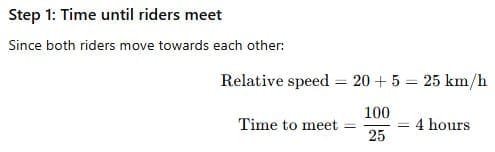
Given:

  • Speed of rider 1 = 20 km/h
  • Speed of rider 2 = 5 km/h
  • Initial distance = 100 km
  • Speed of each bullet = 10 km/h
  • Firing is instantaneous (no time lag)


Step 2: Motion of bullets

  • A bullet is fired only when the previous bullet hits the shield.
  • There is no time gap, so bullets are effectively in motion continuously for the entire duration (4 hours).
  • At any instant, only one bullet is traveling.
  • Speed of bullet = 10 km/h (with respect to ground)

Step 3: Total distance covered by all bullets

UGEE REAP Mock Test- 1 - Question 9

A and B are two independent events. The probability that both A and B occur is 1/6, and the probability that neither of them occurs is 1/3. Find the probability of the occurrence of A.

Detailed Solution: Question 9

Problem Given:

  • P(A and B) = 1/6

  • P(neither A nor B) = 1/3

  • A and B are independent events

  • We need to find: P(A)

Step 1: Use independence

If A and B are independent:
P(A and B) = P(A) × P(B) = 1/6 → (Equation 1)

Also:
P(A') = 1 - P(A)
P(B') = 1 - P(B)
Since A and B are independent, their complements are also independent:
P(A' and B') = P(A') × P(B') = 1/3 → (Equation 2)

Step 2: Use union formula

We know:
P(A or B) = 1 - P(A' and B') = 1 - 1/3 = 2/3

Also:
P(A or B) = P(A) + P(B) - P(A and B)

Substitute known values:
2/3 = P(A) + P(B) - 1/6

Now add 1/6 to both sides:
2/3 + 1/6 = P(A) + P(B)
Convert to same denominator:
4/6 + 1/6 = 5/6

So:
P(A) + P(B) = 5/6 → (Equation 3)

Step 3: Solve equations

Let’s say:
x = P(A)
Then:
P(B) = 5/6 - x

Now plug into Equation 1:
x × (5/6 - x) = 1/6

Distribute:
(5/6)x - x2 = 1/6

Now rearrange:
-x2 + (5/6)x - 1/6 = 0

Multiply the entire equation by -1:
x2 - (5/6)x + 1/6 = 0

Multiply through by 6 to get rid of fractions:
6x2 - 5x + 1 = 0

Step 4: Solve the quadratic

Use the quadratic formula:

x = [5 ± √(25 - 24)] / 12
x = [5 ± √1] / 12
x = (5 ± 1) / 12

So two solutions:

  • x = (5 + 1)/12 = 6/12 = 1/2

  • x = (5 - 1)/12 = 4/12 = 1/3

Step 5: Check which one is P(A)

So either:
P(A) = 1/2 and P(B) = 1/3, or
P(A) = 1/3 and P(B) = 1/2

Both satisfy:

  • P(A) × P(B) = 1/6

  • (1 - P(A)) × (1 - P(B)) = 1/3

UGEE REAP Mock Test- 1 - Question 10

The harmonic mean of the roots of the equation (5 + √2)x2 - (4 + √5)x + 8 + 2√5 = 0 is

Detailed Solution: Question 10

For quadratic ax2 + bx + c = 0,
Harmonic mean (HM) of roots = 2αβ / (α + β)

Here:
a = (5 + √2), b = −(4 + √5), c = (8 + 2√5)

Sum of roots = −b/a = (4 + √5)/(5 + √2)
Product of roots = c/a = (8 + 2√5)/(5 + √2)

HM = 2 × (product)/(sum)

= 2 × [(8 + 2√5)/(5 + √2)] ÷ [(4 + √5)/(5 + √2)]

= 2(8 + 2√5)/(4 + √5)

= (16 + 4√5)/(4 + √5)

= 4

UGEE REAP Mock Test- 1 - Question 11

The tank at a water supply station is filled with water by several pumps. At first, two pumps of the same capacity are turned on; 3 hours later, three more pumps (all the same) of a different capacity are set into operation. After 2 hours, the additional pumps were set into operation; the tank was almost filled to its capacity (20 m3 were still lacking); in another hour the tank was full. One of the three additional pumps could have filled the tank in 60 hours.

How much water does one of the first two pumps fill in an hour?

Detailed Solution: Question 11

Let capacity of one of the first pumps = x m^3/h
Capacity of one additional pump = 1/60 tank per hour

Let total tank volume = V

Work done:

First 3 hours:
2x × 3 = 6x

Next 2 hours (all pumps):
(2x + 3/60)V × 2

Last 1 hour:
Same rate fills remaining 20 m^3

From last 1 hour:
(2x + 1/20)V = 20

Solving, we get:
x = 4 m^3/h

UGEE REAP Mock Test- 1 - Question 12

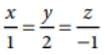
The cartesian equation of the line along which motorcycle A is running, is

Detailed Solution: Question 12
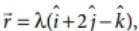
The line along which motorcycle A is running, is , which can be rewritten as

Thus, the required cartesian equation is 

UGEE REAP Mock Test- 1 - Question 13

The direction ratios of line along which motorcycle B is running, are

Detailed Solution: Question 13

The line along which motorcycle B is running, is = which is parallel to the vector 
∴ D.R.'s of the required line are < 2, 1, 1 >.

UGEE REAP Mock Test- 1 - Question 14

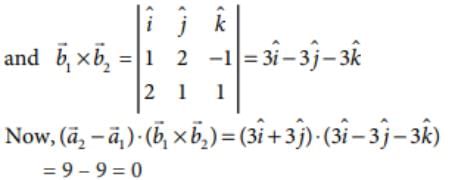
The shortest distance between the gives lines is

Detailed Solution: Question 14


Hence, shortest distance between the given lines is 0.

UGEE REAP Mock Test- 1 - Question 15

260, 216, 128, 108, 62, 54, ________,27

Detailed Solution: Question 15

The alternate numbers form two different series. The missing number belongs to the one beginning with 260. in this subtract 4 and divide the difference by 2 to get the next number. So the missing number is 62 - 4 = 58/2 = 29

UGEE REAP Mock Test- 1 - Question 16

In a certain code language, if the word PROGRAM is coded as RTQHTCO, then how is the word PLAYING codedin that language?

Detailed Solution: Question 16

To decode the word PLAYING based on the pattern used for PROGRAM:

  • In the given code, each letter is shifted by a certain number of positions in the alphabet.
  • For PROGRAM to become RTQHTCO:
    • P (16) → R (18): +2
    • R (18) → T (20): +2
    • O (15) → Q (17): +2
    • G (7) → H (8): +1
    • R (18) → T (20): +2
    • A (1) → C (3): +2
    • M (13) → O (15): +2
  • Apply this pattern to PLAYING:
    • P (16) → R (18): +2
    • L (12) → N (14): +2
    • A (1) → C (3): +2
    • Y (25) → Z (26): +1
    • I (9) → K (11): +2
    • N (14) → P (16): +2
    • G (7) → I (9): +2

The coded result for PLAYING is RNCZKPI.

UGEE REAP Mock Test- 1 - Question 17

In a certain code language, if the word DOUBLE is coded as ODBUEL, then how is the word SINGLE coded in that language?

Detailed Solution: Question 17
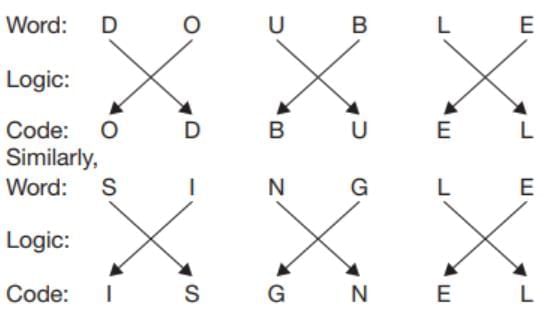

S↔I → I,S
N↔G → G,N
L↔E → E,L The code is ISGNEL.
∴ ISGNEL is the code for SINGLE.

UGEE REAP Mock Test- 1 - Question 18

In a certain code language, if the word SUMMER is coded as Ωθ##17, and the word MOTION is coded as #$%2$6, then how can the word 'SECTOR' be coded in that language?

Detailed Solution: Question 18

As we observe that the letters and their corresponding codes are given in the following order, i.e., the code for S is Ω, U is θ and so on. Hence, the code for SECTOR is 'Ω1©%$7'.

UGEE REAP Mock Test- 1 - Question 19

 If A + B means A is the mother of B; A - B means A is the brother of B; A % B means A is the father of B and A × B means A is the sister of B, which of the following shows that P is the maternal uncle of Q?

Detailed Solution: Question 19

A + B means A is the mother of B; A - B means A is the brother of B; A % B means A is the father of B; A × B means A is the sister of B.

Maternal uncle means the brother of someone's mother. We therefore need relationships that make P the brother of Q's mother.

Consider option 3: P - M + N × Q.

P - M: P is the brother of M.

M + N: M is the mother of N.

N × Q: N is the sister of Q.

Since N is the sister of Q, N and Q are siblings and share the same mother; M is the mother of N, so M is also the mother of Q.

Because P is the brother of M, P is the brother of Q's mother; therefore P is the maternal uncle of Q.

UGEE REAP Mock Test- 1 - Question 20

Which of the following, if true, most weakens the conclusion that the wellness program directly improves employee productivity?

Detailed Solution: Question 20

  • The correct answer is b) "Employees who chose to participate in the wellness program had higher productivity levels even before the program started."

    This statement weakens the conclusion by suggesting that the participants' higher productivity may be due to their pre-existing health-consciousness and motivation, rather than the wellness program itself.

  • a) Strengthens the conclusion by providing a mechanism for the program's effectiveness.

  • c) Strengthens the conclusion by ruling out other variables.

  • d) Strengthens the conclusion by implying the program offers a unique benefit.


Thus, b is the only option that undermines the direct causal link between the program and productivity improvements.

UGEE REAP Mock Test- 1 - Question 21

What is the sum of the rows of Orchids and Marigold he planted?

Detailed Solution: Question 21

  • There is one row of Tulips.
  • Two more rows of Orchids than Tulips, so there are three rows of Orchids.
  • Two more rows of Rose than Orchids, so there are five rows of Rose.
  • One less Marigold row than Rose, so there are four rows of Marigold.
  • The sum of the rows of Orchids and Marigold is 3 + 4 = 7.

UGEE REAP Mock Test- 1 - Question 22

How may rows of Fireball did he plant?

Detailed Solution: Question 22

The question does not provide enough information to determine the exact number of rows planted. Without additional data such as:

  • Total area
  • Row dimensions

It's impossible to choose a specific numerical answer from the given options.

UGEE REAP Mock Test- 1 - Question 23

How many chocolates were there in the beginning?

Detailed Solution: Question 23

Let x = initial chocolates. Sam: x - 1, eats (x - 1)/3, leaves 2(x - 1)/3.
Mona: eats [2(x - 1)/3 - 1]/3, leaves 2[2(x - 1)/3 - 1]/3.
Tanya: eats {2[2(x - 1)/3 - 1]/3 - 1}/3, leaves 2{2[2(x - 1)/3 - 1]/3 - 1}/3.
Final: 2{2[2(x - 1)/3 - 1]/3 - 1}/3 - 1, divided by 3, is integer.
For x = 79: 78 → 52 → 34 → 22 → 21 → 7 per person.
Answer D (79).

UGEE REAP Mock Test- 1 - Question 24

What percentage of the employees with 10 years or less service know only one of shorthand or typing (for Non-graduate employees)?

Detailed Solution: Question 24
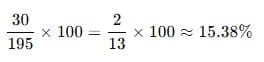
We only consider Non-graduate employees (second number in each pair) with ≤ 10 years service.

Step 1: Extract data (Non-graduates)

0–5 years

  • Shorthand = 35
  • Typing = 40
  • Both = 30

Only one =
(35 − 30) + (40 − 30) = 5 + 10 = 15

6–10 years

  • Shorthand = 15
  • Typing = 20
  • Both = 10

Only one =
(15 − 10) + (20 − 10) = 5 + 10 = 15

Step 2: Totals

  • Total knowing only one = 15 + 15 = 30
  • Total Non-graduates (≤10 years) = 120 + 75 = 195

Step 3: Percentage

Hence, option(D) is correct

UGEE REAP Mock Test- 1 - Question 25

How many graduate employees know neither shorthand nor typing?

Detailed Solution: Question 25

Graduate employees who know neither shorthand nor typing:

  • For 0-5 years: The total number of employees is 80, and 40 know shorthand, 35 know typing, 35 know both. So, graduates who know neither:

    80−(40+35−35)=80−40=40
  • For 6-10 years: The total number of employees is 150, and 60 know shorthand, 60 know typing, 40 know both. So, graduates who know neither:

    150−(60+60−40)=150−80=70
  • For more than 10 years: The total number of employees is 90, and 40 know shorthand, 40 know typing, 15 know both. So, graduates who know neither:

    90−(40+40−15)=90−65=25

Total graduates who know neither shorthand nor typing:

40+70+25=135

UGEE REAP Mock Test- 1 - Question 26

Out of those employees knowing shorthand only, how many are graduates?

Detailed Solution: Question 26

Calculation:
0-5 years: 40 - 35 = 5
6-10 years: 60 - 40 = 20
10 years: 40 - 15 = 25
Total graduates knowing shorthand only = 5 + 20 + 25 = 50
The number of graduate employees who know only shorthand is 50, calculated as (40 - 35) + (60 - 40) + (40 - 15) = 5 + 20 + 25 = 50.

UGEE REAP Mock Test- 1 - Question 27

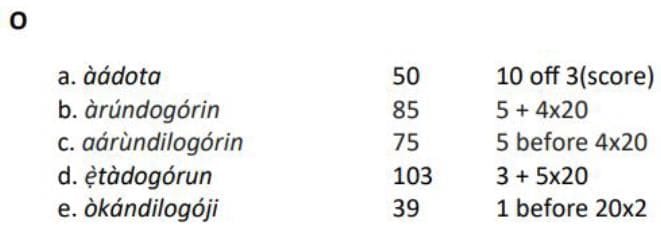
aadota = ?

Detailed Solution: Question 27


Note:  has not been seen in the data but if you realise there are only words for 1-5 because of the counting back system, it must be 1: we've seen 2, 3, 4, 5.

UGEE REAP Mock Test- 1 - Question 28

arundogorin = ?

Detailed Solution: Question 28

From the list in the image:

  • àrun = 5

  • ògórin shows up in:

    • ààdórin = 70

    • ẹ̀ẹ̀tàdilogórin = 77

    • ẹ̀tàdógórin = 83

So we can safely say:

  • ògórin = 80

Because:

  • ẹ̀tàdógórin = 83, and ẹ̀tà = 3, so 80 + 3 = 83 → ògórin = 80

So,

arundogorin = àrun (5) + ògórin (80) = 85

UGEE REAP Mock Test- 1 - Question 29

aarundilogorin = ?

Detailed Solution: Question 29

  • Identify base: àárùn = 5.
  • Analyze suffix: "dílógùn" resembles "dórìn" (70) from àádórìn = 70.
  • Calculate: 5 + 70 = 75.
  • Verify: Matches pattern of ètáadógún (77) and ètáadórìn (83) with 70-based increments.
  • So 75 is the right one.

UGEE REAP Mock Test- 1 - Question 30

A researcher conducts an experiment to study the relationship between two variables, X and Y. After plotting the data points, the scatterplot shows a clear upward trend. The correlation coefficient (r) is calculated to be 0.85. Which of the following conclusions is most appropriate?

Detailed Solution: Question 30

Correlation shows an association between variables, but it does not imply causation.

A high correlation coefficient (r) such as 0.85 indicates a strong relationship, but it cannot prove that one variable causes the other.

There may still be confounding factors affecting the relationship, which are not accounted for by correlation alone.

View more questions
12 tests
Information about UGEE REAP Mock Test- 1 Page
In this test you can find the Exam questions for UGEE REAP Mock Test- 1 solved & explained in the simplest way possible. Besides giving Questions and answers for UGEE REAP Mock Test- 1, EduRev gives you an ample number of Online tests for practice
Download as PDF