
UGEE SUPR Mock Test- 6 Free Online Test 2026
Full Mock Test & Solutions: UGEE SUPR Mock Test- 6 (40 Questions)
You can boost your JEE 2026 exam preparation with this UGEE SUPR Mock Test- 6 (available with detailed solutions).. This mock test has been designed with the analysis of important topics, recent trends of the exam, and previous year questions of the last 3-years. All the questions have been designed to mirror the official pattern of JEE 2026 exam, helping you build speed, accuracy as per the actual exam.
Mock Test Highlights:
- - Format: Multiple Choice Questions (MCQ)
- - Duration: 60 minutes
- - Total Questions: 40
- - Analysis: Detailed Solutions & Performance Insights
Sign up on EduRev for free and get access to these mock tests, get your All India Rank, and identify your weak areas to improve your marks & rank in the actual exam.

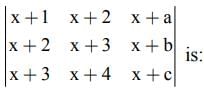
Detailed Solution: Question 1
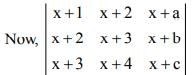
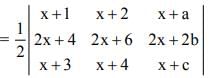
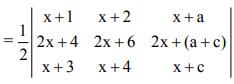
The equation y2 + 3 = 2(2x+y) represents a parabola with the vertex at
Detailed Solution: Question 2
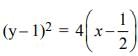 which is a parabola
 , axis along the line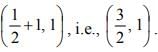

Detailed Solution: Question 3

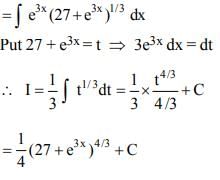
The conic represented by x = 2(cos t + sin t), y = 5(cos t − sin t) is
Detailed Solution: Question 4
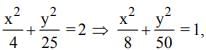 which is an ellipse.
The work done in ergs for the reversible expansion of one mole of an ideal gas from a volume of 10 litres to 20 litres at 25°C is
Detailed Solution: Question 5
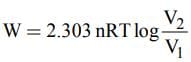


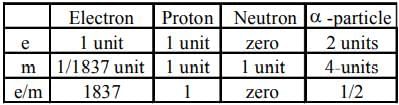
Arrange the following particles in increasing order of values of e/m ratio: electron (e), proton (p), neutron (n) and α-particle (α) -
Detailed Solution: Question 6
For the reaction N2 + 3H2 → 2NH3
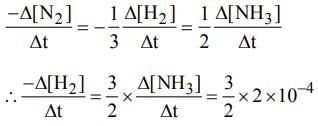
if 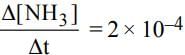 mol L−1 s−1, then value of
  would be
if
mol L−1 s−1, then value of would beDetailed Solution: Question 7
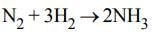

The value of Kc for the reaction:
A + 3B ⇌ 2C at 400∘C is 0.5. Calculate the value of Kp
A + 3B ⇌ 2C at 400∘C is 0.5. Calculate the value of Kp
Detailed Solution: Question 8
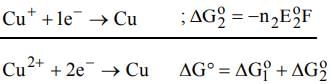
The electrode potentials for
Cu²⁺(aq) + e⁻ → Cu⁺(aq)
and Cu⁺(aq) + e⁻ → Cu(s)
are +0.15 V and +0.50 V, respectively.
The value of E°Cu²⁺/Cu will be:
Cu²⁺(aq) + e⁻ → Cu⁺(aq)
and Cu⁺(aq) + e⁻ → Cu(s)
are +0.15 V and +0.50 V, respectively.
The value of E°Cu²⁺/Cu will be:
Detailed Solution: Question 9




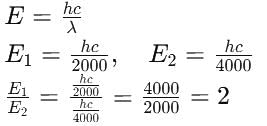
The wavelengths of two photons are 2000Å and 4000Å respectively. What is the ratio of their energies?
Detailed Solution: Question 10
Detailed Solution: Question 11
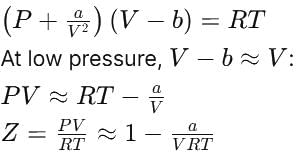
A direct current of 2A and an alternating current having a maximum value of 2A flow through two identical resistances. The ratio of heat produced in the two resistances will be
Detailed Solution: Question 12
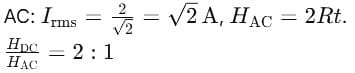
A particle of mass m is under a potential v(x) = (1/2)k1x2 for x > 0 and v(x) = k1x2 for x < 0. When disturbed a little from the position x = 0, it will
Detailed Solution: Question 13
A far-sighted person can see clearly object beyond 100 cm distance. If he wants to see clearly an object at 40 cm distance, then the power of the lens he shall require is
Detailed Solution: Question 14
A hydrogen atom emits green light when it changes from n = 4 energy level to the n = 2 level. Which colour of light would the atom emit when it changes from n = 5 level to the n = 2 level?
Detailed Solution: Question 15



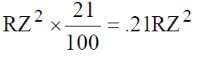
A 20 cm long capillary tube is dipped in water. The water rises up to 8 cm. If the entire arrangement is put in a freely falling elevator the length of water column in the capillary tube will be ______ cm.
Detailed Solution: Question 16
How many degree of freedom the gas molecules have if under STP the gas density ρ = 1.3 kg/m3 and the velocity of sound propagation in it is 330 m/sec?
Detailed Solution: Question 17

The work function of a metallic surface is 5.01 eV. Photoelectrons are emitted when light of wavelength 2000 Å falls on it. What is the minimum potential difference required to stop the fastest photoelectrons? (h = 4.14 × 10⁻¹⁵ eV·s)
Detailed Solution: Question 18
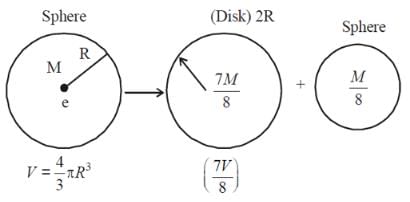
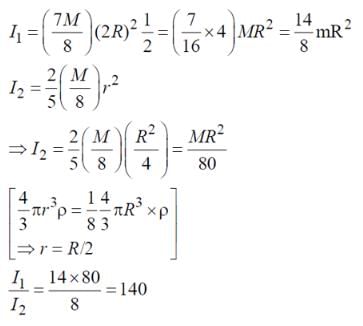
A solid sphere of mass M and radius R is divided into two unequal parts. The first part has a mass of 7M/8 and is converted into a uniform disc of radius 2R. The second part is converted into a uniform solid sphere. Let I1 be the moment of inertia of the new sphere about its axis. The ratio I1/I2 is 140/x. Find the value of x.
Note: I1 is the inertia of the disk & I2 is the inertia of the new sphere about the diameter.
Note: I1 is the inertia of the disk & I2 is the inertia of the new sphere about the diameter.
Detailed Solution: Question 19
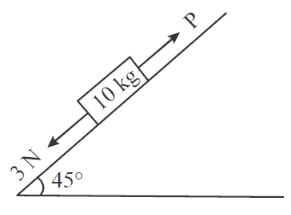
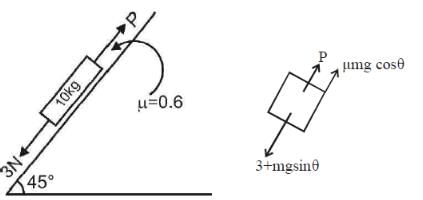
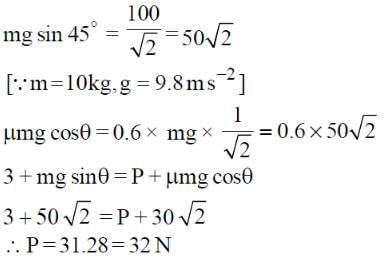
A block of mass 10 kg is kept on a rough inclined plane as shown in the figure. A force of 3 N is applied on the block. The coefficient of static friction between the plane and the block is 0.6. What should be the minimum value of force P (in newton), such that the block does not move downward? (Take g = 10 m/s2)
Detailed Solution: Question 20
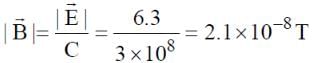
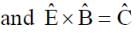
A plane electromagnetic wave of frequency 50 MHz travels in free space along the positive x-direction. At a particular point in space and time, 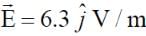 . The corresponding magnetic field
  , at that point is
  . Find the value of x.
. The corresponding magnetic field , at that point is . Find the value of x.Detailed Solution: Question 21
 [ ∵ EM wave travels along + (ve) x-direction]
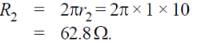
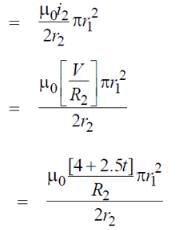
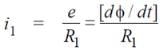
Two concentric coplanar circular loops made of wire, with resistance per unit length 10 Ω/m have diameters 0.2 m and 2 m. A time varying potential difference (4 + 2.5 t) volt is applied to the larger loop. Calculate the current (in A) in the smaller loop.
Detailed Solution: Question 22

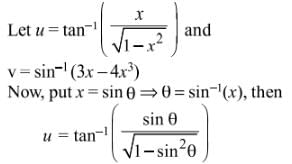
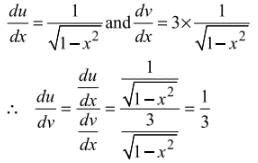
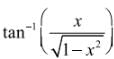 with respect to sin-1(3x - 4x3) is
Detailed Solution: Question 23

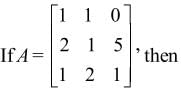
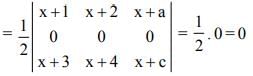
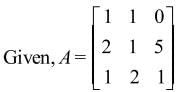
a11A21 + a12A22 + a13A23 is equal to
Note: axy represents element whereas Axy represents Cofactor matrix.
a11A21 + a12A22 + a13A23 is equal to
Note: axy represents element whereas Axy represents Cofactor matrix.
Detailed Solution: Question 24
If Rolle's theorem for
f(x) = ex (sin x − cos x) is verified on [ then the value of c is
f(x) = ex (sin x − cos x) is verified on [
then the value of c isDetailed Solution: Question 25


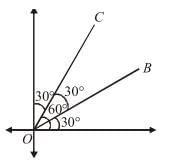
The joint equation of lines passing through the origin and trisecting the first quadrant is:
Detailed Solution: Question 26
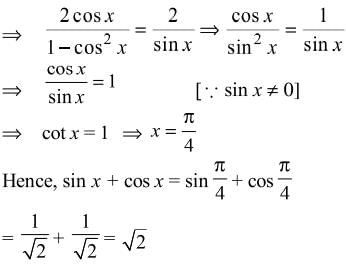
If 2 tan-1(cos x) = tan-1(2 cosec x), then sin x + cos x is equal to:
Detailed Solution: Question 27
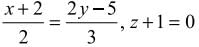
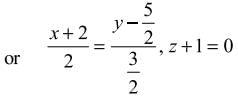
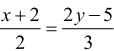 , z = -1 are
Detailed Solution: Question 28



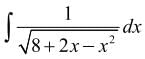 is equal to
 Detailed Solution: Question 29
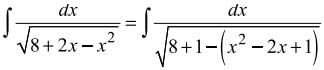
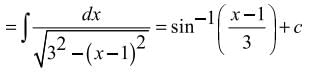
The approximate value of f(x) = x3 + 5x2 - 7x + 9at x = 1.1 is
Detailed Solution: Question 30
