JEE Exam  >  JEE Test  >  VITEEE: Subject Wise and Full Length MOCK Tests  >  VITEEE PCME Mock Test - 7 - JEE MCQ

VITEEE: Subject Wise and Full Length VITEEE PCME Mock Test - 7 Free Online


Full Mock Test & Solutions: VITEEE PCME Mock Test - 7 (125 Questions)

You can boost your JEE 2026 exam preparation with this VITEEE PCME Mock Test - 7 (available with detailed solutions).. This mock test has been designed with the analysis of important topics, recent trends of the exam, and previous year questions of the last 3-years. All the questions have been designed to mirror the official pattern of JEE 2026 exam, helping you build speed, accuracy as per the actual exam.

Mock Test Highlights:

  • - Format: Multiple Choice Questions (MCQ)
  • - Duration: 150 minutes
  • - Total Questions: 125
  • - Analysis: Detailed Solutions & Performance Insights
  • - Sections covered: Mathematics, Physics, Chemistry, English, Aptitude

Sign up on EduRev for free and get access to these mock tests, get your All India Rank, and identify your weak areas to improve your marks & rank in the actual exam.

VITEEE PCME Mock Test - 7 - Question 1

The heights of two towers are 20 m and 80 m. The foot of each tower is joined to the top of the other. Find the height of the intersection point from the horizontal plane.

Detailed Solution: Question 1
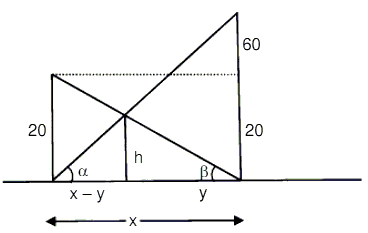
Option C is correct.

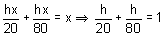
Let the heights be h₁ = 20 m and h₂ = 80 m, and place their bases at x = 0 and x = d on a horizontal axis.

The line from the top of the first tower to the foot of the second has equation y = h₁(1 - x/d).

The line from the top of the second tower to the foot of the first has equation y = h₂(x/d).

At intersection set them equal: h₁(1 - x/d) = h₂(x/d). Solving gives x = d·h₁/(h₁ + h₂).

Substitute into y = h₂(x/d) to obtain y = h₁·h₂/(h₁ + h₂).

Numerically, y = (20 × 80)/(20 + 80) = 1600/100 = 16 m. Hence the height of intersection is 16 m.


VITEEE PCME Mock Test - 7 - Question 2

Let X have the Poisson distribution with parameter λ, such that P(X = k + 1) = r(k) P(X = k). The value r(k) is

Detailed Solution: Question 2

P(X = k) =
Now, P(X = k + 1) = r(k) P(X = k)

r(k) = λ/(k+1)

VITEEE PCME Mock Test - 7 - Question 3

The solution of the differential equation 2x (dy/dx) - y = 3 represents :

Detailed Solution: Question 3
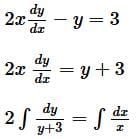

2log(y + 3) = logx + logc 
(y + 3)2 = xc, which is parabola.

VITEEE PCME Mock Test - 7 - Question 4

In a binomial distribution, the mean is 4 and variance is 3. Then, its mode is

Detailed Solution: Question 4
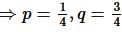
Given, Mean = 4, Variance = 3
np = 4, npq = 3

Mode is an integer x such that

⇒ 3.25 < x < 4.25
∴ x = 4

VITEEE PCME Mock Test - 7 - Question 5

If the ratio of the roots of the equation x² + bx + c = 0 is the same as that of x² + qx + r = 0, then:

Detailed Solution: Question 5

Let α, β be the roots of x² + bx + c = 0, and γ, δ be the roots of x² + qx + r = 0.

For the first equation: α + β = -b, αβ = c

For the second equation: γ + δ = -q, γδ = r

Given that αβ = γδ (i.e., c = r), we can proceed with the following relationship:

(α - β)²(α + β)² = (γ - δ)²(γ + δ)²
(Squaring both sides and applying components and division)

Then, αβ(α + β)² = γδ(γ + δ)²
(After subtracting -1 from both sides)

This simplifies to:
c * b² = r * q²

Hence, the correct answer is D) b²r = q²c.

VITEEE PCME Mock Test - 7 - Question 6

Let A₀, A₁, A₂, A₃, A₄, and A₅ be the consecutive vertices of a regular hexagon inscribed in a unit circle. The product of the lengths of A₀A₁, A₀A₂, and A₀A₄ is:

Detailed Solution: Question 6
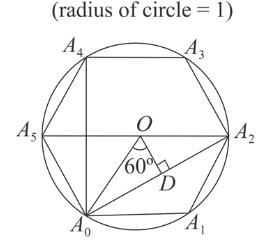

Let O be the center of the circle.

Since the hexagon is regular, we have:
∠A₀OA₁ = 360° / 6 = 60°

Thus, △A₀OA₁ is an equilateral triangle. From the unit circle, A₀O = 1.

Hence, A₀A₁ = 1.

Also, A₀A₂ = A₀A₄.

We know that a perpendicular drawn from the center bisects the chord, so:

A₀A₂ = A₀A₄ = 2 × A₀D
= 2 (OA₀ sin 60°)
= 2 × (1) × (√3/2) = √3

Thus,
(A₀A₁) × (A₀A₂) × (A₀A₄) = (1) × (√3) × (√3) = 3

VITEEE PCME Mock Test - 7 - Question 7

If a man and his wife enter in a bus, in which five seats are vacant, then the number of different ways in which they can be seated, is

Detailed Solution: Question 7
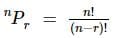
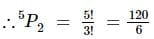
THEOREM : Number of permutations (arrangements) of 'n' dissimilar things taken 'r' at a time, when repetition of things is not allowed is given by

Here we have 5 seats and two people 

= 20

VITEEE PCME Mock Test - 7 - Question 8

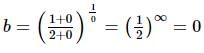
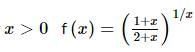
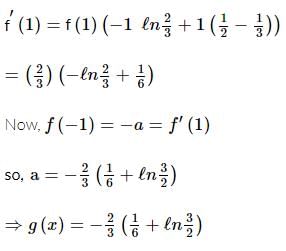
Let g(x) be a polynomial of degree one & f(x) be defined by  such that  f(x) is continuous f′(1) = f(−1), then g(x) is
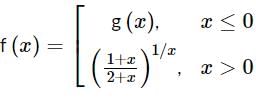
Detailed Solution: Question 8

Let, g(x) = ax + b

Now at x = 0, equating both L.H.L and R.H.L we get

now for

Taking log both side we get,

VITEEE PCME Mock Test - 7 - Question 9

The locus of the point z satisfying arg  is a/an

Detailed Solution: Question 9

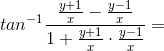
arg = arg(z + i) - arg(z - i) = tan-1- tan-1 = tan-1 = , i.e. x2 + y2 - 2x = 1 is the equation of a circle.

VITEEE PCME Mock Test - 7 - Question 10

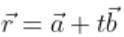
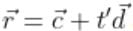
The lines whose vector equations are  and are coplanar, if

Detailed Solution: Question 10

The given lines are coplanar if the normal to the plane containing these lines is perpendicular to both of them.
Since the given lines are parallel to the vectors and ,
so, the normal to the plane is parallel to , which is perpendicular to the line joining the points on the plane with position vectors and
, which is the required condition for the given lines to be coplanar.

VITEEE PCME Mock Test - 7 - Question 11

A solenoid has fixed N number of turns and fixed radius 'a'. Its length is given by '' which can be varied. Its self–inductance is proportional to

Detailed Solution: Question 11

Self–inductance, L


VITEEE PCME Mock Test - 7 - Question 12

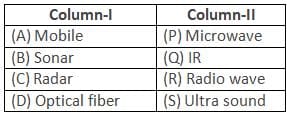
Some devices and electromagnetic wave are given in Column-I and Column-II, match the devices with electromagnetic wave work:
Detailed Solution: Question 12

Correct answer: Option B

  • Mobile uses radio waves for cellular communication; mobile networks operate in radio-frequency bands.
  • Sonar uses ultrasound (mechanical sound waves above 20 kHz) for underwater detection; this is not an electromagnetic wave.
  • Radar uses microwaves (high-frequency radio waves in the GHz range) to detect the position and speed of objects.
  • Optical fibre transmits signals using light, commonly in the infrared region for telecommunication (near-infrared wavelengths are typically used).

The resulting matching is (A → R), (B → S), (C → P), (D → Q), which corresponds to Option B.

VITEEE PCME Mock Test - 7 - Question 13

An alternating voltage is applied across a circuit. As a result, flows in it. The power consumed per cycle is

Detailed Solution: Question 13

The phase angle between voltage V and current I is π/2.
Power factor,

Hence, the power consumed is zero.

VITEEE PCME Mock Test - 7 - Question 14

The current i and voltage V graphs for a given metallic wire at two different temperatures T1 and T2 are shown in the figure. It is concluded that

Detailed Solution: Question 14

Slope of the graph will give us the reciprocal of resistance.

Here, resistance at temperature T1 is greater than that at T2.
Since the resistance of metallic wire is more at higher temperatures than at lower temperatures, therefore T1 > T2.

VITEEE PCME Mock Test - 7 - Question 15

Masses of two isobars 29Cu64 and 30Zn64 are 63.9298 u and 63.9292 u respectively. It can be concluded from these data that :

Detailed Solution: Question 15
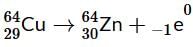
In beta decay, atomic number increases by 1 whereas the mass number remains the same. Therefore, following equation can be possible.

VITEEE PCME Mock Test - 7 - Question 16

Which of the following lens is converging?

Detailed Solution: Question 16

D is the converging lens.

1/f = (μ - 1) (1/R1 - 1/R2)

Here μ is the refractive index of the lens material relative to the surrounding medium, i.e. μ = n_lens / n_medium. Use the sign convention: radii of curvature are taken positive if the centre of curvature lies to the right of the surface (light assumed to travel left → right).

For a thin lens the sign of 1/f (and hence whether the lens is converging or diverging) depends on the signs of both (μ - 1) and (1/R1 - 1/R2).

Option D: the diagram shows a lens that is thicker at the centre (biconvex shape). From the figure the lens material has n_lens = 1.5 and the surrounding medium has n_medium = 1.3, so μ = 1.5/1.3 ≈ 1.154 > 1. For a biconvex lens with light left → right, we take R1 > 0 and R2 < 0, so (1/R1 - 1/R2) > 0. Therefore 1/f > 0, so the focal length is positive and the lens is converging.

Options A, B and C: in each of these the combination of shape and refractive-index arrangement makes the product (μ - 1)(1/R1 - 1/R2) negative, so 1/f < 0 and the lens behaves as diverging. Briefly:

• Option A: although the lens material is optically denser than the outside medium (μ > 1), the geometry is such that (1/R1 - 1/R2) < 0 (the lens is effectively thinner at the centre for the chosen light direction), giving f < 0.

• Option B: the surrounding medium is air (n = 1.0) and the drawn shape is double-concave (thinner at centre); with μ > 1 but (1/R1 - 1/R2) < 0, the net focal length is negative.

• Option C: although numerical values of refractive indices differ on the two sides, the diagram shows a shape that produces (1/R1 - 1/R2) < 0 for the indicated light direction and so the net power is negative.

Hence only option D gives a positive focal length and is the converging lens.

VITEEE PCME Mock Test - 7 - Question 17

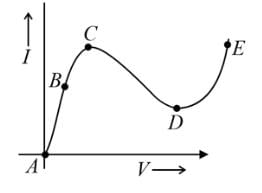
From the graph between current (I) and voltage (V) shown, identify the portion corresponding to negative resistance:
Detailed Solution: Question 17

The slope of the (I-V) graph is given by 1/R. In the CD region, the slope of the I-V curve is negative, meaning R is negative. Therefore, the portion corresponding to negative resistance is the CD region.

VITEEE PCME Mock Test - 7 - Question 18

A convex lens has a mean focal length of 20 cm. The dispersive power of the material of the lens is 0.02. The longitudinal chromatic aberration for an object at infinity is:

Detailed Solution: Question 18

The separation between the images formed by extreme wavelengths of the visible range is called the longitudinal chromatic aberration.

It is given by the formula:

Longitudinal chromatic aberration = Dispersive power (ω) × Mean focal length (fy)

Given:

  • Dispersive power (ω) = 0.02
  • Mean focal length (fy) = 20 cm

Substituting the values:

Longitudinal chromatic aberration = 0.02 × 20 = 0.40 cm

VITEEE PCME Mock Test - 7 - Question 19

Image formed by a convex lens is virtual and erect when the object is placed

Detailed Solution: Question 19

When object is placed between F and pole of a convex lens then a virtual, erect and magnified image will be formed on the same side behind the object.

VITEEE PCME Mock Test - 7 - Question 20

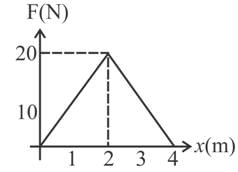
The graph between the resistive force F acting on a body and the distance covered by the body is shown in the figure. The mass of the body is 25 kg and initial velocity is 2 m s−1. When the distance covered by the body is 4 m, its kinetic energy would be,
Detailed Solution: Question 20

Given,

m = 25 kg,
vinitial = 2 m/s.

So, the initial kinetic energy of the body:

KEinitial = (1/2) m v²
KEinitial = (1/2) × 25 × 4 = 50 J.

Here, work done = area of F−x graph.

⇒ W = area of triangle

⇒ W = (1/2) × base × height
⇒ W = (1/2) × 4 × 20 = 40 J.
Since the force is resistive, W = −40 J.

By the work-energy theorem,
Work done = change in kinetic energy.

W = KEfinal − KEinitial
−40 = KEfinal − 50
KEfinal = 10 J.

VITEEE PCME Mock Test - 7 - Question 21

Given: pK1 = 2.0, pK2 = 9.9 and pK3 = 3.9
From the information, calculate the isoelectric pH (pI) of aspartic acid.

Detailed Solution: Question 21

For polyfunctional acids, pI is also the pH midway between the pKa values on either side of the isoionic species. For example, the pI of aspartic acid is 2.95.
pI = (pK1 + pK3)/2 = (2.0 + 3.9)/2 = 2.95

VITEEE PCME Mock Test - 7 - Question 22

The Haber's process for the manufacture of ammonia is usually carried out at 450–500°C. If the temperature of 250°C was used instead of 450–500°C, then

Detailed Solution: Question 22

Although formation of NH3 by Haber's process is an exothermic reaction and is favoured at low temperatures, yet the required temperature for the combination of N2 and H2 should be 450–500°C in order to provide the activation energy for the process. If the temperature is 250°C, then the rate of formation of NH3 would be too slow and above 500°C, and the equilibrium will shift towards the left.

VITEEE PCME Mock Test - 7 - Question 23

The correct order of ionic radii of Yb3+, La3+, Eu3+ and Lu3+ is:

Detailed Solution: Question 23

In the lanthanide series, there is a regular decrease in the atomic as well as ionic radii with the increase in the atomic number. This is referred to as the lanthanide contraction.
Although the atomic radii do show some irregularities in the trend, the ionic radii of the trivalent ions (M3+) decrease with the increase in the atomic number, i.e. from La+3 (106 pm) to Lu3+ (86 pm).

VITEEE PCME Mock Test - 7 - Question 24

Directions: The following question has four choices out of which ONLY ONE is correct.
In Haber process, 30 L of dihydrogen and 30 L of dinitrogen were taken for reaction which yielded only 50% of the expected product. What would be the composition of gaseous mixture under the aforesaid condition in the end?

Detailed Solution: Question 24
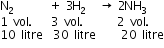

Since only 50% of the expected product is obtained:
5 L of N2 reacts with 15 L of H2 to form 10 L of NH3.
used = 5 L, left = 30 - 5 = 25 L
used = 15 L, left = 30 - 15 = 15 L
NH3 formed: 10 L

VITEEE PCME Mock Test - 7 - Question 25

The two functional groups present in a typical carbohydrate are:

Detailed Solution: Question 25

Carbohydrates are polyhydroxy aldehydes or polyhydroxy ketones. >C=O and −OH are functional groups of typical ketose, while −CHO and −OH are functional groups of typical aldose. Both aldose and ketose contain a carbonyl group. Carbohydrates are polyhydroxy aldehydes or polyhydroxy ketones, which give aldehydic as well as ketonic groups upon hydrolysis.

VITEEE PCME Mock Test - 7 - Question 26

Directions: Fill in the blank with the most appropriate preposition from the given options.
To know the reality, you have to dig _____ her past.

Detailed Solution: Question 26

'Dig into' means to find out her past to know the reality.

VITEEE PCME Mock Test - 7 - Question 27

Choose the correct option to replace the word(s) given in brackets:
(Smoke) is injurious to health.

Detailed Solution: Question 27

We cannot use 'Smoke' as a subject to the verb. The correct way to use it as a noun/subject is by converting it to a gerund.
Gerund is a verb form which functions as a noun. Thus, 'smoke' will get converted to 'smoking.'

VITEEE PCME Mock Test - 7 - Question 28

Direction: In the question given below, a part of the sentence is underlined. Below are given alternatives to the underlined part which may improve the sentence. Choose the correct alternative. In case no improvement is needed your answer is 'No improvement'.

My opinion for the film is that it will bag the national award.

Detailed Solution: Question 28

In the given sentence, we have to find what will be best suited in place of the underlined part in the sentence.
My opinion for the film is that it will bag the national award.
Here, ''opinion for'' should be replaced with ''opinion about''. ''Opinion about'' means ''any judgement or view about something or place or person''. In this sentence, it is about the National award.
Hence, 'opinion about' is the correct answer. 

VITEEE PCME Mock Test - 7 - Question 29

Study the table and answer the question.
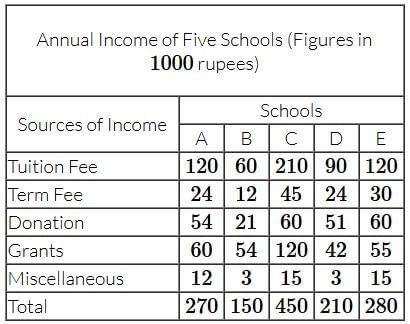
Which school has the lowest ratio of income by way of grants and tuition fees?

Detailed Solution: Question 29

As per the given above table, we see

In school A, income from grants = ₹60 thousands.

Income from tuition fee = ₹120 thousands.

School A = 60/120 = 0.5

In school B, income from grants = ₹54 thousands.

Income from tuition fee = ₹60 thousands.

School B = 54/60 = 0.9
In school C, income from grants = ₹120 thousands.

Income from tuition fee = ₹210 thousands.

School C = 120/210 = 0.57

In school D, income from grants =₹42 thousands.

Income from tuition fee =₹90  thousands.

School D = 42/90 = 0.47

In school E, income from grants = ₹55 thousands.

Income from tuition fee = ₹120 thousands.

School E = 55/120 = 0.46 lowest ratio income)

Therefore, school E has the lowest ratio of income by way of grants and tuition fees.

VITEEE PCME Mock Test - 7 - Question 30

ABC is a triangle in which ∠A = 90°. Let P be any point on side AC. If BC = 10 cm, AC = 8 cm, and BP = 9 cm, then AP is equal to:

Detailed Solution: Question 30
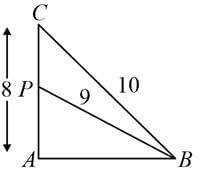

Given that ∠A = 90° in △ABC and P is a point on side AC, we use the Pythagoras' theorem to find AB:

AB² = BC² - AC²
AB² = 10² - 8²
AB² = 100 - 64
AB² = 36
AB = 6 cm

Now, applying Pythagoras' theorem in △ABP:

AP² = BP² - AB²
AP² = 9² - 6²
AP² = 81 - 36
AP² = 45
AP = √45 = 3√5 cm

Final Answer:
AP = 3√5 cm (Option D).

View more questions
1 videos|7 docs|63 tests
Information about VITEEE PCME Mock Test - 7 Page
In this test you can find the Exam questions for VITEEE PCME Mock Test - 7 solved & explained in the simplest way possible. Besides giving Questions and answers for VITEEE PCME Mock Test - 7, EduRev gives you an ample number of Online tests for practice
Download as PDF