JEE Exam  >  JEE Test  >  Chemistry Main & Advanced  >  Test: Addition & Condensation Polymers (Old NCERT) - JEE MCQ

Addition & Condensation Polymers (Old NCERT) - Free MCQ Practice Test


MCQ Practice Test & Solutions: Test: Addition & Condensation Polymers (Old NCERT) (10 Questions)

You can prepare effectively for JEE Chemistry for JEE Main & Advanced with this dedicated MCQ Practice Test (available with solutions) on the important topic of "Test: Addition & Condensation Polymers (Old NCERT)". These 10 questions have been designed by the experts with the latest curriculum of JEE 2026, to help you master the concept.

Test Highlights:

  • - Format: Multiple Choice Questions (MCQ)
  • - Duration: 15 minutes
  • - Number of Questions: 10

Sign up on EduRev for free to attempt this test and track your preparation progress.

Test: Addition & Condensation Polymers (Old NCERT) - Question 1

Buna-S is a copolymer of:

Detailed Solution: Question 1

Styrene-butadiene or styrene-butadiene rubber (SBR) describe families of synthetic rubbers derived from styrene and butadiene (the version developed by Goodyear is called Neolite). These materials have good abrasion resistance and good aging stability when protected by additives.

Test: Addition & Condensation Polymers (Old NCERT) - Question 2

A synthetic polymer which resembles natural rubber is:

Detailed Solution: Question 2
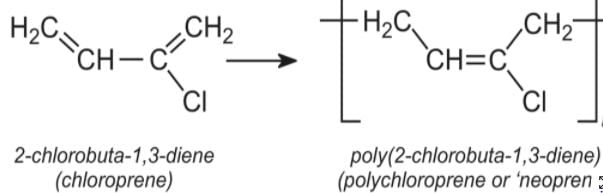
Synthetic polymer that resembles natural rubber is Neoprene. It is made from monomer chloroprene (2-chlorobuta-1,3-diene) as shown in the above reaction.

Test: Addition & Condensation Polymers (Old NCERT) - Question 3

Which type of polymer will be formed if the susbstituent group is –C6H5

Detailed Solution: Question 3

Polystyrene will be formed if the susbstituent group is –C6H5. It is a synthetic aromatic polymer made from the monomer styrene. Polystyrene can be solid or foamed.

Test: Addition & Condensation Polymers (Old NCERT) - Question 4

Vulcanisation is used in processing of:

Detailed Solution: Question 4

The correct answer is option A
Vulcanization is a chemical process in which the rubber is heated with sulphur, accelerator and activator at 140–160°C. The process involves the formation of cross-links between long rubber molecules so as to achieve improved elasticity, resilience, tensile strength, viscosity, hardness and weather resistance.

Test: Addition & Condensation Polymers (Old NCERT) - Question 5

Name the monomer of nylon-6:

Detailed Solution: Question 5

The correct answer is Option C.
Nylon 6 is synthesized by ring-opening polymerization of caprolactam. Caprolactam has 6 carbons, hence Nylon 6.

Test: Addition & Condensation Polymers (Old NCERT) - Question 6

Isoprene is the monomer of:

Detailed Solution: Question 6

The correct answer is option D
Isoprene (2-methyl-1,3-butadiene) is the monomer of natural rubber and a building block for many natural compounds. C. G. Williams first isolated it in 1860 by pyrolyzing rubber. Many methods have been developed for its commercial manufacture for the production of synthetic rubber and other polymers.

Test: Addition & Condensation Polymers (Old NCERT) - Question 7

Which intermolecular force is present in Nylon 6,6?

Detailed Solution: Question 7
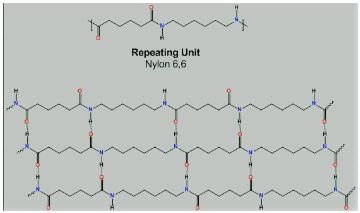
The correct answer is Option B.

Van der Waals forces include attraction and repulsions between atoms, molecules, and surfaces.
Hydrogen bonding is a special type of attraction between a hydrogen atom covalently bonded to a very electronegative atom such as  N, O, or F atom and another very electronegative atom.
Dipole-dipole interactions occur when the partial charges formed within one molecule are attracted to an opposite partial charge in a nearby molecule.

From the picture of Nylon-6,6, we can see there is hydrogen bonding between oxygen and hydrogen atom.
Though hydrogen bonds are also one type of dipole-dipole attraction, here, a more appropriate answer will be - The intermolecular forces present in nylon-6,6 are hydrogen bonding.
 

Test: Addition & Condensation Polymers (Old NCERT) - Question 8

Polymers having ester linkage are called:

Detailed Solution: Question 8

Polyesters are polymers in which component monomers are bonded via ester linkages. These ester linkages are generally easy to hydrolyze and hence a number of synthetic polyesters are biodegradable. Therefore, bacterial polyesters (polyhydroxyalkanoates, PHAs) have been used to make biodegradable plastics.

Test: Addition & Condensation Polymers (Old NCERT) - Question 9

PAN is prepared from:

Detailed Solution: Question 9

The correct answer is option  D

Polyacrylonitrile (PAN), a synthetic resin prepared by the polymerization of acrylonitrile. A member of the important family of acrylic resins, it is a hard, rigid thermoplastic material that is resistant to most solvents and chemicals, slow to burn, and of low permeability to gases.

Test: Addition & Condensation Polymers (Old NCERT) - Question 10

Condensation polymerisation of ethylene glycol and terepthalic acid gives:

Detailed Solution: Question 10
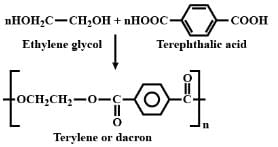
The correct answer is option D
Terylene or Dacron is obtained by the condensation polymerisation of ethylene glycol and terephthalic acid.
It is an example of polyester. The balanced equation is as shown.

335 videos|699 docs|300 tests
Information about Test: Addition & Condensation Polymers (Old NCERT) Page
In this test you can find the Exam questions for Test: Addition & Condensation Polymers (Old NCERT) solved & explained in the simplest way possible. Besides giving Questions and answers for Test: Addition & Condensation Polymers (Old NCERT), EduRev gives you an ample number of Online tests for practice
Download as PDF