
JEE Main & Advanced Chemistry Test- 8 Free Online Test 2026
MCQ Practice Test & Solutions: JEE Main Chemistry Test- 8 (25 Questions)
You can prepare effectively for JEE JEE Main & Advanced Mock Test Series 2026 with this dedicated MCQ Practice Test (available with solutions) on the important topic of "JEE Main Chemistry Test- 8". These 25 questions have been designed by the experts with the latest curriculum of JEE 2026, to help you master the concept.
Test Highlights:
- - Format: Multiple Choice Questions (MCQ)
- - Duration: 60 minutes
- - Number of Questions: 25
Sign up on EduRev for free to attempt this test and track your preparation progress.

The molal depression constant for water is 1.86. The depression constant for 100g  is
is
Detailed Solution: Question 1

Urea is added to 2 litre of water to such an extent that  becomes equal to 1/100. The weight of urea added is

The moleucular weight of NaCl (degree of dissociation=x) determined by the osmotic pressure method, is found to be different from its actual molecular wieght (M).Which of the following relationship is correct ?
Detailed Solution: Question 3
The osmotic pressure of glucose solution (400mm),on dilution, decreased to 100 mm. The extent of dilution is
At what temperature does an aqueous solution containing  molecules of a noneelectrolyte substance in 250g of water freeze ?
The vapour pressure of a solvent decreased by 10mmHg when a nonvolatile solute was added to the solvent. The mole fraction of the solute in the solution
is 0.2. What would be the mole fraction of the solvent if the decrease in the vapour pressure is to be 20 mmHg
Detailed Solution: Question 6
A metal crystallizes with a face-centered cubic lattice. The edge of the unit cell is 408 pm. The diameter of the metal atom is
Detailed Solution: Question 8
Alkene R–CH–CH =  reacts with
  in the presence of
  to give
The order of reactivity of the following alcohols towards conc. HCl is
i.  ii.
ii. 
iii.  iv.
iv. 
Detailed Solution: Question 11
Increasing order of acid strength among tertiary butanol,isopropanol and ehanol is
 the order of reactivity is
  gives
gives 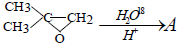 the product (A) has the structure
Propene is allowed to react with HI. The product (A) is then treated with 
to give a new product (B)

The final product (B) is
 is an example of
 The utility of the polymers in various fields is due to their mechanical properties like tensile strength,elasticity, toughness etc.These properties mainly depend upon intermolecular forces like van der Waal’s forces and hydrogen bonding operating in polymer molecules. Polymers have been classified on this
basis,e.g.(1) Elastomers (2) Thermoplacstics (4) Thermosetting. Hence
The molecular forces of attraction are weakest in
The utility of the polymers in various fields is due to their mechanical properties like tensile strength,elasticity, toughness etc.These properties mainly depend upon intermolecular forces like van der Waal’s forces and hydrogen bonding operating in polymer molecules. Polymers have been classified on this
basis,e.g.(1) Elastomers (2) Thermoplacstics (4)Thermosetting. Hence
Which of the following have usually a linear structure
Given length of side of HCP is 100/√2 pm. The volume of HCP unit cell is (in pm3) x × 106 then x will be–
Detailed Solution: Question 21
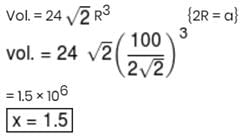
The radius of A+ in ionic compound AB is .225Å If AB has ZnS structure, the ideal radius of B– will be (in PM)
Detailed Solution: Question 22

K[Co(CO)4], K3[Co(CN)6] Find the difference between oxidation number of central metal in the given complexes.
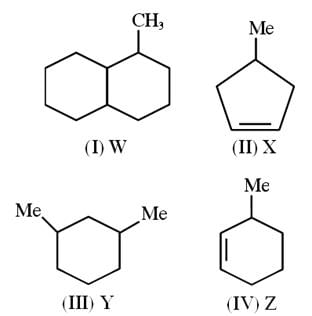
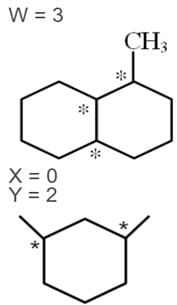
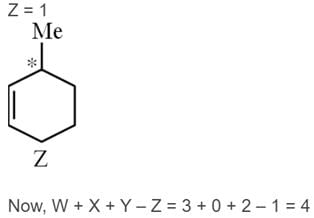
Number of chiral carbon atoms in the given compounds are W, X, Y and Z respectively then Calculate the I, II, III & IV value of W + X + Y– Z.
Detailed Solution: Question 25
1 videos|238 docs|217 tests |
