UPSC Exam  >  UPSC Test  >  Science & Technology CSE  >  Test: Electricity - 1 - UPSC MCQ

Electricity - 1 - Free MCQ Practice Test with solutions, UPSC Sci & Tech


MCQ Practice Test & Solutions: Test: Electricity - 1 (10 Questions)

You can prepare effectively for UPSC Science & Technology for UPSC CSE with this dedicated MCQ Practice Test (available with solutions) on the important topic of "Test: Electricity - 1". These 10 questions have been designed by the experts with the latest curriculum of UPSC 2026, to help you master the concept.

Test Highlights:

  • - Format: Multiple Choice Questions (MCQ)
  • - Duration: 10 minutes
  • - Number of Questions: 10

Sign up on EduRev for free to attempt this test and track your preparation progress.

Test: Electricity - 1 - Question 1

All elements of an electric circuit are connected in series except :

Detailed Solution: Question 1

In an electric circuit all other elements are connected in series but a voltmeter is connected in parallel.

Test: Electricity - 1 - Question 2

According to Ohm’s law, what is the relationship between voltage (V), current (I), and resistance (R)?

Detailed Solution: Question 2

Ohm's law states that the voltage (V) across a conductor is directly proportional to the current (I) flowing through it, with resistance (R) being the constant of proportionality, expressed as V = IR.

Test: Electricity - 1 - Question 3

Which factor does affect the resistance of a conductor?

Detailed Solution: Question 3

it's  one of the three primary factors (length, cross-sectional area, and nature of material) directly used in calculating resistance using the formula R = ρL/A.

Test: Electricity - 1 - Question 4

The least resistance obtained by using 2Ω , 4Ω, 1Ω and 100Ω is

Detailed Solution: Question 4
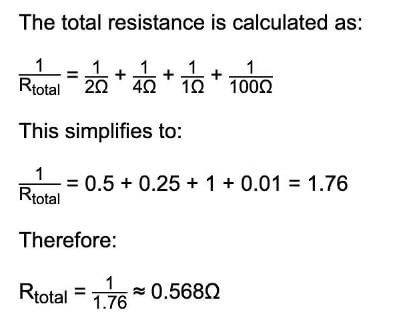
In parallel combination, the equivalent resistance is smaller than the least resistance used in the circuit.

Test: Electricity - 1 - Question 5

Two devices are connected between two points say A and B in parallel. The physical quantity that will remain the same between the two points is

Detailed Solution: Question 5

In a parallel circuit, the voltage across each device connected between points A and B remains the same because:

  • All devices share the same potential difference.

Therefore, the correct answer is voltage.

Test: Electricity - 1 - Question 6

The resistance of an alloy :

Detailed Solution: Question 6

Electrical resistance depends on how easily electrons can move through a material. In conductors like pure metals, when temperature increases, the atoms of the metal vibrate more. These increased vibrations cause more collisions with moving electrons, which increases resistance.

Alloys are made by mixing two or more metals or a metal with a non-metal (for example, nichrome is an alloy of nickel and chromium). In alloys, the atoms are already irregularly arranged. This irregular structure creates obstruction to the flow of electrons even at normal temperature.

Alloys have a very low temperature coefficient of resistance. When the temperature of an alloy is increased, the increase in atomic vibrations does not significantly increase the obstruction to electron flow. As a result, the change in resistance is very small.

Hence, the resistance of an alloy is considered nearly constant with rise in temperature.

So, Correct Option: A

Test: Electricity - 1 - Question 7

To get 2Ω resistance using only 6Ω resistors, the number of them required is

Detailed Solution: Question 7

Three resistors of 2Ω is required to get 6Ω because resultant is more than individual so they all must be connected in parallel.

Test: Electricity - 1 - Question 8

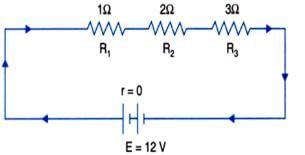
Three resistors of 1Ω, 2 Ω and 3 Ω are connected in series with a battery of 12 V as shown in figure. Values of potential differences V1, V2, V3 across the three resistors have respective values :
Detailed Solution: Question 8
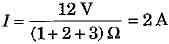
In series grouping current I is same throughout and potential differences are directly proportional to respective resistances.
In given circuit 
∴ V1 = IR= 2 A x 1Ω = 2V,

V2 = IR2 = 2 A x 2 Ω = 4 V and

V3 = IR3 = 2 A x 3 Ω = 6 V.

Test: Electricity - 1 - Question 9

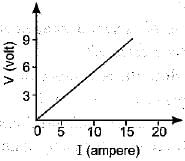
The resistance whose V - I graph is given below is

Detailed Solution: Question 9

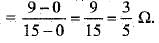
Resistance = slope line of V-I graph

Test: Electricity - 1 - Question 10

The diagram shows a network of four resistors which is connected to an electric source. Identify the resistors which are connected in series in this network :
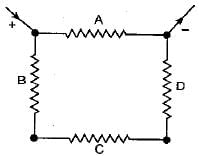
Detailed Solution: Question 10

In the circuit shown, the resistors B, C and D are connected in series.

The key points regarding resistors in series are:

  • Resistors are said to be in series when they are connected end to end.
  • The total resistance in a series circuit is the sum of the individual resistances.
  • In this case, the resistors B, C, and D form a single path for the current to flow.
  • The current remains the same through all resistors in series.

Thus, the resistors B, C, and D are the ones connected in series in this network.

67 videos|481 docs|166 tests
Information about Test: Electricity - 1 Page
In this test you can find the Exam questions for Test: Electricity - 1 solved & explained in the simplest way possible. Besides giving Questions and answers for Test: Electricity - 1, EduRev gives you an ample number of Online tests for practice
Download as PDF