
Enthalpy of Neutralisation & Solution - Free MCQ Practice Test with solutions,
MCQ Practice Test & Solutions: Test: Enthalpy of Neutralisation & Solution (19 Questions)
You can prepare effectively for NEET NCERT Based Tests for NEET with this dedicated MCQ Practice Test (available with solutions) on the important topic of "Test: Enthalpy of Neutralisation & Solution". These 19 questions have been designed by the experts with the latest curriculum of NEET 2026, to help you master the concept.
Test Highlights:
- - Format: Multiple Choice Questions (MCQ)
- - Duration: 30 minutes
- - Number of Questions: 19
Sign up on EduRev for free to attempt this test and track your preparation progress.

Direction (Q. Nos. 1-13) This section contains 13 multiple choice questions. Each question has four choices (a), (b), (c) and (d), out of which ONLY ONE option is correct.
Q. If the enthalpy of HCI (g) and Cl- (aq) are - 92.30 kJ mol-1 and - 167.44 kJ mol-1 respectively, then ΔrH° for the following reaction is
HCI (g) + aq → H+ (aq) + Cl- (aq)
Detailed Solution: Question 1
The enthalpy of neutralisation of HS- (aq) is - 5.1 kJ mol-1. Thus, second ionisation energy of H2S is
Detailed Solution: Question 2

Given, ΔfH° of HCI (g) is - 22 . 10 kcal mol-1 and ΔSolutionH° (heat of solution) of HCI (g) is - 17.9 kcal mol-1. Thus, ΔfH ° of Cl- (aq) is
Detailed Solution: Question 3
Enthalpy of neutralisation of a weak dibasic acid by NaOH is - 24.0 kcal. Thus, enthalpy of ionisation of dibasic acid is
Detailed Solution: Question 4
Consider the following reaction,
30 mL of 0.10 MNaOH (aq) + 10 mL of 0.10 M HCI (aq), enthalpy change is  .
.
On further adding 20 mL of 0.10 M HCI (aq), enthalpy change is  . Thus, these values are
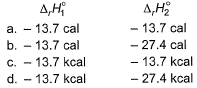
.On further adding 20 mL of 0.10 M HCI (aq), enthalpy change is
. Thus, these values areIn the following reactions,
I. 30 mL of 0.1 M Ba(OH)2(aq) + 30 mL of 0.1 M H2SO4 (aq), rise intemperature = ΔT1
II. 90 mL of 0.1 M Ba(OH)2(aq) + 90 mL of 0.1 M H2SO4 (aq), rise intemperature = ΔT2. Thus,
II. 90 mL of 0.1 M Ba(OH)2(aq) + 90 mL of 0.1 M H2SO4 (aq), rise intemperature = ΔT2. Thus,
Given, CH3COOH(aq) → CH3COO- (aq) + H+ (aq), ΔrH° = 0.005 kcal g-1
Enthalpy change when 1 mole of Ca(OH)2, a strong base, is completely neutralised by CH3COOH (aq) in dilute solution is
Detailed Solution: Question 7


Detailed Solution: Question 8


Thus, heat of neutralisation of H2C2O4 (aq) is
Detailed Solution: Question 9

Given,

Thus, for the reaction,

ΔrH° is
Thus, for the reaction,
Detailed Solution: Question 10

Hydration energies of Li+ and Cl- ions are - 499 and - 382 kJ mol-1 respectively. If lattice energy of LiCI is - 840 kJ mol-1 then heat of solution of LiCI is
Detailed Solution: Question 11
Enthalpy change on mixing 100 mL of 1 M Ca(OH)2 with 100 mL of 1 M H2SO4 is
Detailed Solution: Question 12
Taking each reactant in 1:1 molar ratio, enthalpy changes are  and
and  in the following reactions.

 and
and  are (in kcal)
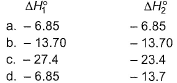
and in the following reactions. and are (in kcal) Detailed Solution: Question 13
Direction (Q. Nos. 14) This sectionis based on statement I and Statement II. Select the correct answer from the code given below.
Q. Statement I : Based on the following thermochemical reactions :

Ionisation of HF(aq)is an exothermic reaction.

Statement II : Enthalpy decrease in hydration of H+ (aq) and F- (aq) exceeds the ionisation energy of HF.
Q. Statement I : Based on the following thermochemical reactions :
Ionisation of HF(aq)is an exothermic reaction.
Statement II : Enthalpy decrease in hydration of H+ (aq) and F- (aq) exceeds the ionisation energy of HF.
Detailed Solution: Question 14
 On (I) - (II), we have
Direction (Q. Nos. 15-16) This section contains a paragraph, wach describing theory, experiments, data etc. three Questions related to paragraph have been given.Each question have only one correct answer among the four given ptions (a),(b),(c),(d).
A quantity of 100 mL of 0.5 HCI is mixed with the 100 mL of 0.5 NaOH in a constant pressure calorimeter that has a heat capacity of 335 JK-1. Temperature of the mixture increased by 2.40 K. Density of the solution = 1g mL-1.
Q. Heat of solution due to mixing is
A quantity of 100 mL of 0.5 HCI is mixed with the 100 mL of 0.5 NaOH in a constant pressure calorimeter that has a heat capacity of 335 JK-1. Temperature of the mixture increased by 2.40 K. Density of the solution = 1g mL-1.
Q. Heat of neutralisation per mole of each reactant is
Direction (Q. Nos. 17 - 19) This section contains 3 questions. when worked out will result in an integer from 0 to 9 (both inclusive).
Q. Lattice energy of NaCI (s) is - 788.0 kJ mol-1 and enthalpy of hydration is - 784.0 kJ mol-1. What is enthalpy change for the following reaction in kJ mol-1?

When 4.0 mL of 2.0 N solution of weak acid is neutralised by a dilute aqueous solution of sodium hydroxide, 64 cal of heat is liberated. What is the heat of neutralisation in cal/milliequivalent?
Detailed Solution: Question 18
Heat of neutralisation of a polybasic acid by a strong base is - 54.8 kcal mol-1? What is basicity of the acid?
Detailed Solution: Question 19
