Chemistry Exam  >  Chemistry Test  >  Inorganic   >  Test: Periodic Properties- 2 - Chemistry MCQ

Periodic Properties- 2 - Free MCQ Practice Test with solutions, Chemistry


MCQ Practice Test & Solutions: Test: Periodic Properties- 2 (30 Questions)

You can prepare effectively for Chemistry Inorganic Chemistry with this dedicated MCQ Practice Test (available with solutions) on the important topic of "Test: Periodic Properties- 2". These 30 questions have been designed by the experts with the latest curriculum of Chemistry 2026, to help you master the concept.

Test Highlights:

  • - Format: Multiple Choice Questions (MCQ)
  • - Duration: 90 minutes
  • - Number of Questions: 30

Sign up on EduRev for free to attempt this test and track your preparation progress.

Test: Periodic Properties- 2 - Question 1

Incorrect order of ionic size is:

Detailed Solution: Question 1

In a given lanthanide series , ionic radii decreases due to lanthanoid contraction . So size of Eu3+ should be larger than Gadolinium ion Gd3+

Hence option A is the answer.

Test: Periodic Properties- 2 - Question 2

Among NaF , NaCl , NaBr and Nal , the NaF has highest melting point because

Test: Periodic Properties- 2 - Question 3

Consider the following changes:
M (s) → M (g)     ........(1)
M (s) → M2+ (g) + 2e-   .......(2)
M (g) → M+ (g) + 2e-   .......(3)
M+ (g) → M2+ (g) + e-  .......(4)
M (g) → M2+ (g) + 2e- .......(5)
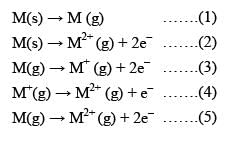
The second ionization energy of M could be calculated from the energy values associated with:

Detailed Solution: Question 3

M (s) → M (g)     ........(1)
M (s) → M2+ (g) + 2e-   .......(2)
M (g) → M+ (g) + 2e-   .......(3)
M+ (g) → M2+ (g) + e-  .......(4)
M (g) → M2+ (g) + 2e- .......(5)

As we are interested in 2nd I.E.
i.e. Energy required to form M2+ (g) from M+ (g)
∴ 4 is correct.
but this option doesn't exist.
⇒ 1 + 3 + 4 is also wrong
1 + 5 gives total energy for M(g) → M2+ (g)
∴ it is also wrong.
3rd reaction is wrong,
∴ 2 - 1 + 3 also dismised.
⇒ (d) is correct

Test: Periodic Properties- 2 - Question 4

The correct order of second I. E. of C, N, O and F are in the order:

Test: Periodic Properties- 2 - Question 5

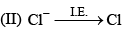
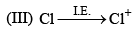
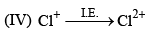
Which is the correct order of ionization energies?

Detailed Solution: Question 5

The correct order of ionization energies is:

b) F > Cl > Cl⁻ > F⁻

Explanation:

  1. Ionization energy (IE): The energy required to remove an electron from a neutral atom or ion in its gaseous state.

  2. Neutral atoms vs. ions:

    • Neutral atoms like F and Cl have higher ionization energies than their corresponding anions (F⁻ and Cl⁻) because:
      • Removing an electron from a negatively charged ion (anion) is easier due to the electron-electron repulsion.
    • Fluorine (F) has a higher ionization energy than chlorine (Cl) because:
      • Fluorine has a smaller atomic radius and a stronger effective nuclear charge, making it harder to remove an electron.
  3. Anions:

    • Among anions, F⁻ has a higher ionization energy than Cl⁻ because fluorine is smaller, and the electron is held more tightly.

Thus, the correct order reflects:

  • Neutral fluorine (F) > Neutral chlorine (Cl) > Chloride ion (Cl⁻) > Fluoride ion (F⁻).

Test: Periodic Properties- 2 - Question 6

Which of the following statements is incorrect:

Test: Periodic Properties- 2 - Question 7

First ionization energy is the lowest with:

Detailed Solution: Question 7

Ionization energy decreases down the group. As charge density is minimum for tin so first ionization energy is lowest for tin.

Test: Periodic Properties- 2 - Question 8

The incorrect statement among the following is:

Detailed Solution: Question 8

I.E.2 of Na is higher than that of Mg because in case in Na, the second e has to be removed from the noble gas core while in case of magnesium removal of second e- electron gives a noble gas core. Mg has higher first ionization potential than Na because of its stable ns2 configuration.

Test: Periodic Properties- 2 - Question 9

The correct values of ionization enthalpies (in kJ mol–1) of Si, P, Cl and S respectively are:

Test: Periodic Properties- 2 - Question 10

The third ionization energy is maximum for:

Detailed Solution: Question 10

Boron has highest third ionization energy due to charge density and also after losing 3 electrons boron attains noble gas configuration. Ionization energy decreases down the group.

Test: Periodic Properties- 2 - Question 11

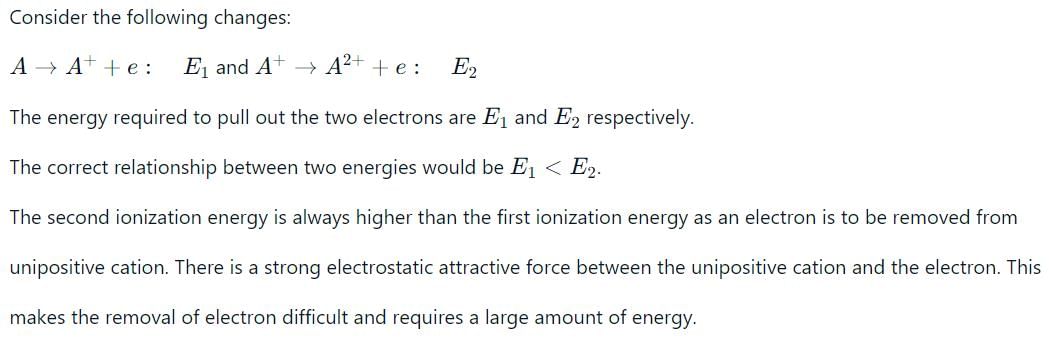
Consider the following changes
A → A+ + e- : E1
and A+ → A2+ + e- ; E2
The energy required to pull out the two electrons are E1 and E2 respectively. The correct relationship between two energies would be... 

Detailed Solution: Question 11
Test: Periodic Properties- 2 - Question 12

The incorrect statement is:

Test: Periodic Properties- 2 - Question 13

First the ionization energies (in kJ/mol) of three representative elements are given below:
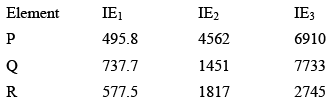
Then incorrect option is:

Test: Periodic Properties- 2 - Question 14

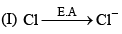
Which of the following statement is correct regarding following process:


Test: Periodic Properties- 2 - Question 15

The correct order of increasing electron affinity of the following elements is:

Detailed Solution: Question 15

Electron affinity generally becomes more negative on moving from left to right along a period. It is because on moving across a period, the atomic size decreases.

 As a result, the force of attraction exerted by the nucleus on the electron increases.

Consequently, the atom has a greater tendency to gain an electron. Hence, electron gain enthalpy becomes more negative.

Cl has more negative electron gain enthalpy than fluorine because in it the added electron goes to the smaller energy shell(n=2) and hence suffers significant repulsion from the electrons already present in this shell. And fluorine also possesses high charge density.

Test: Periodic Properties- 2 - Question 16

The second electron gain enthalpies (in kJ mol–1) of oxygen and sulphur respectively are:

Test: Periodic Properties- 2 - Question 17

Which of the following statements is correct:

Test: Periodic Properties- 2 - Question 18

Which one of the following statements is incorrect:

Detailed Solution: Question 18

The incorrect statement is:
Electron gain enthalpy decreases from fluorine to iodine in the group.
Explanation:
Electron gain enthalpy is the energy released when an electron is added to an isolated gaseous atom. In general, electron gain enthalpy becomes more negative (i.e., more energy is released) as we move across a period from left to right and up a group from bottom to top in the periodic table. This is due to the increasing effective nuclear charge and decreasing atomic size, which makes it easier for the atom to attract and hold an additional electron.
However, statement 3 is incorrect because electron gain enthalpy actually increases (becomes less negative or more positive) as we move down a group, such as from fluorine to iodine. This is because, as we move down a group, the atomic size increases and the effective nuclear charge experienced by the incoming electron decreases. This makes it less favorable for the atom to gain an electron, resulting in a less negative (or more positive) electron gain enthalpy.

Test: Periodic Properties- 2 - Question 19

The formation of the oxide ion O2–(g) requires first an exothermic and then an endothermic step as shown below:

This is because:

Test: Periodic Properties- 2 - Question 20

 Identify the wrong sequence of the elements in a group        

Test: Periodic Properties- 2 - Question 21

The electron affinity of the following elements can be arranged:

Detailed Solution: Question 21
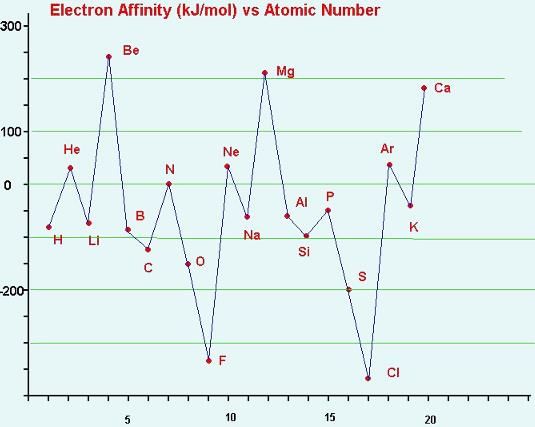
Electron affinity represents tendency of an atom to accept an electron. Electron affinity increases from left to right and decreases down the group. The images attached compares the electron affinity values of elements.

Test: Periodic Properties- 2 - Question 22

In which of the following arrangements, the order is not correct according to the property indicated against it:

Test: Periodic Properties- 2 - Question 23

Which of the following statements is/are wrong:

Detailed Solution: Question 23

All isoelectronic ions belong to the same period of the periodic table, is a wrong statement as F− and Na+ are isoelectronic but they belong to different periods.

Test: Periodic Properties- 2 - Question 24

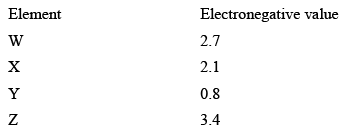
Consider the following conversions:



That according to given informat ion the incorrect statement is:
Test: Periodic Properties- 2 - Question 25

The incorrect statement regarding given information is

Test: Periodic Properties- 2 - Question 26

In the compound M—O—H, the M—O bond will be broken if:

Test: Periodic Properties- 2 - Question 27

An element has an atomic number of 15 with which of the following elements will it show similar chemical properties.        

Test: Periodic Properties- 2 - Question 28

If the ionization and electron gain enthalpy of an element are 275 and 86 Kcalmol−1 respectively, then the electronegativity of the element on the Mulliken scale is:

Detailed Solution: Question 28

Test: Periodic Properties- 2 - Question 29

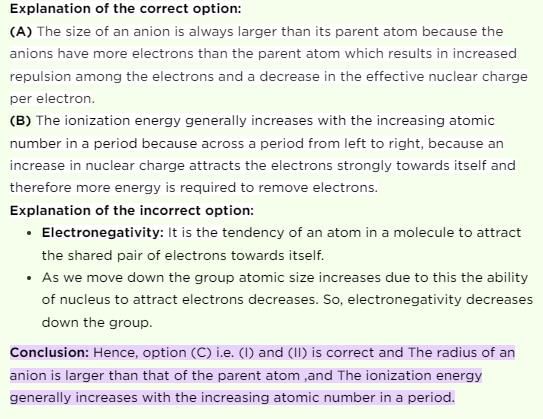
Consider the following statements: (I) The radius of an anion is larger than that of the parent atom. (II) The ionization energy generally increases with increasing atomic number in a period (III) The electronegativity of an element is the tendency of an isolated atom to attract an electron.Which of the above statements is/are correct:

Detailed Solution: Question 29
Test: Periodic Properties- 2 - Question 30

Which of the following order is correct for the property ment ioned in brackets:

Detailed Solution: Question 30

The answer is option (b) C<N<F<O (2nd Ionisation energy).

41 videos|93 docs|41 tests
Information about Test: Periodic Properties- 2 Page
In this test you can find the Exam questions for Test: Periodic Properties- 2 solved & explained in the simplest way possible. Besides giving Questions and answers for Test: Periodic Properties- 2, EduRev gives you an ample number of Online tests for practice
41 videos|93 docs|41 tests
Download as PDF