CBSE Class 10  >  Class 10 Test  >  Olympiad Preparation  >  Science Olympiad Test: Electricity- 2 - Class 10 MCQ

Science Olympiad Test: Electricity- 2 - Free MCQ with solutions Class 10


MCQ Practice Test & Solutions: Science Olympiad Test: Electricity- 2 (15 Questions)

You can prepare effectively for Class 10 Olympiad Preparation for Class 10 with this dedicated MCQ Practice Test (available with solutions) on the important topic of "Science Olympiad Test: Electricity- 2". These 15 questions have been designed by the experts with the latest curriculum of Class 10 2026, to help you master the concept.

Test Highlights:

  • - Format: Multiple Choice Questions (MCQ)
  • - Duration: 15 minutes
  • - Number of Questions: 15

Sign up on EduRev for free to attempt this test and track your preparation progress.

Science Olympiad Test: Electricity- 2 - Question 1

A multimeter is used to measure

Detailed Solution: Question 1

  • A multimeter can measure voltage, current, and resistance.
  • It can also be used to generate square wave and for checking shorts in a circuit.
  • An ammeter is an instrument for measuring electric current in amperes while Voltmeter is an instrument for measuring electric potential in volts.
  • An ohmmeter is an electrical instrument that measures electrical resistance.

Science Olympiad Test: Electricity- 2 - Question 2

Which of the following circuit set-ups shows the dependence current on potential difference across a resistor (as per Ohm’s Law)

Detailed Solution: Question 2

The voltmeter should be connected parallel to the resistor and the ammeter should be in series with the resistor.

Science Olympiad Test: Electricity- 2 - Question 3

The resistivity of a wire depends on its

Detailed Solution: Question 3

From Resistance,

Where R = resistance, l = length, A = area of cross-section and ρ = resistivity
If l = 1 m and A = 1 m2, then
R = ρ i.e.

  • Resistivity is numerically equal to the resistance of a substance having unit area of cross-section and unit length.
  • Resistivity is the intrinsic property of the substance. It is independent of shape and size of the body i.e. on length and area. Hence, option 1 and 2 is incorrect.
  • Formula of resistivity is 
    Where, m = mass of electron, n = Number of electron per unit volume of the conductor, τ = relaxation time.
  • Therefore, the resistivity of a wire depends on its material (n)
  • For different substances their resistivity is also different as ‘n’ will be different.
  • Resistivity depends on the temperature.

Science Olympiad Test: Electricity- 2 - Question 4

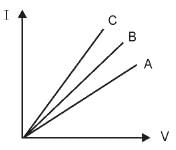
The V-I graph of three resistors A, B and C are as shown in the figure given below. Which resistors has the maximum resistance?
Detailed Solution: Question 4

By Ohm’s Law V = IR
⇒ R= V/I = slope of V-I graph 
Therefore, the slope of the V-I graph represents the effective resistance. 
Now in series combination of the resistance all the resistances get summed up 
Req = R1 + R2 + R3+ ………….+ Rn. 
Therefore, the series combination will have the maximum resistance than the other resistors.
Hence the line with maximum slope (line C) will give the series combination of the other two resistors.

Science Olympiad Test: Electricity- 2 - Question 5

If a wire of resistance R is stretched to double of its length, then new resistance will be:

Detailed Solution: Question 5
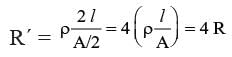
When length (l) of a wire doubled (2 l), its cross-sectional area (A) is reduced to half (A/2) as the volume of the wire is constant.
Now resistance of the wire

Science Olympiad Test: Electricity- 2 - Question 6

A 60 W bulb carries a current of 0.5A. The charge that passes through it in 2 hours is

Detailed Solution: Question 6

Q = I t = 0.5 × (2 × 60 min × 60 sec) = 3600 seconds
Note: Wattage of the bulb does not affect the flow of charge in this case

Science Olympiad Test: Electricity- 2 - Question 7

A wire of resistance 1 Ω is divided into two halves and both halves are connected in parallel. The new resistance will be

Detailed Solution: Question 7
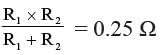
Resistance of each half = 1Ω/2 = 0.5 Ω (R ∝ l) Since these two halves are in parallel, Resultant resistance = 

Science Olympiad Test: Electricity- 2 - Question 8

The number of electrons constituting one coulomb of charge is

Detailed Solution: Question 8

The charge on one electron, e = 1.6 × 10⁻¹⁹ C
Number of electrons constituting 1 coulomb is given by n = Q/e

Science Olympiad Test: Electricity- 2 - Question 9

100 J of heat is produced each second in a 4 Ω resistance. The potential difference across the resistor is

Detailed Solution: Question 9
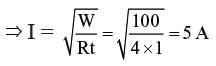
V = W/Q = W/ I t and V = I R (work done is equal to heat generated)
⇒ W = VI W = I2 R t

V = I R = 5 A × 4 Ω = 20 V

Science Olympiad Test: Electricity- 2 - Question 10

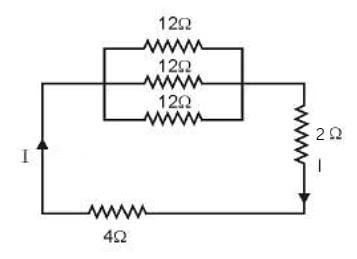
Find out the equivalent resistance of the circuit given below:
Detailed Solution: Question 10
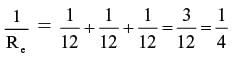
Three resistors of 12 Ω each in parallel have effective resistance Re, as

This effective Re is in series with two other resistors of 2 Ω and 4 Ω. Thus, overall resistance of whole circuit is
Rc = Re + R1 + R2 = 4 + 2 + 4 = 10 Ω

Science Olympiad Test: Electricity- 2 - Question 11

If two copper wires of length l and 2l, area A and 2A are taken, then

Detailed Solution: Question 11

Science Olympiad Test: Electricity- 2 - Question 12

Find the amount of the energy given to 5 coulombs of charge passing through a 10 volt battery.

Detailed Solution: Question 12

W = QV = 5 × 10 = 50 J 

Science Olympiad Test: Electricity- 2 - Question 13

If equal resistances of 5 Ω each are connected in parallel with a battery, then

Detailed Solution: Question 13

Consider the wire of resistance 'R' is cut into five equal parts
Thus, Resistance of each part will be R/5
Equivalent resistance R' will be given by,
1/R' = 5/R + 5/R + 5/R + 5/R + 5/R  ...( resistances connected in parallel)
Thus, equivalent resistance R' = R/25.

Science Olympiad Test: Electricity- 2 - Question 14

If the potential difference across the ends of a conductor is doubled, what will be the effect on the current flowing through it?

Detailed Solution: Question 14

The current flowing in a conductor is halved if the resistance of the conductor is doubled keeping the potential difference across it the same.
By ohm's law,
Voltage, V = current(I) * resistance (R)
V = IR
I = V/R
when voltage doubled,
new voltage is V(2)
V(2)=2V
V(2) = I(2) * R
substituting V(2) as 2V,
2V = I(2) * R
hence new current, I(2)
I(2) = 2V/R
but V/R = I
Hence, I(2) = 2V/I= 2I.
Hence current also doubles.

Science Olympiad Test: Electricity- 2 - Question 15

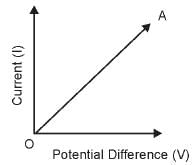
What does this graph with straight line OA represents?
Detailed Solution: Question 15

Ohm's law: The current flowing through a conductor is directly proportional to the voltage applied across the conductor means I ∝ V.

70 videos|236 docs|187 tests
Information about Science Olympiad Test: Electricity- 2 Page
In this test you can find the Exam questions for Science Olympiad Test: Electricity- 2 solved & explained in the simplest way possible. Besides giving Questions and answers for Science Olympiad Test: Electricity- 2, EduRev gives you an ample number of Online tests for practice
Download as PDF