Electrical Engineering (EE) Exam  >  Electrical Engineering (EE) Test  >  Power Systems  >  Tes: Newton Raphson Method - Electrical Engineering (EE) MCQ

Tes: Newton Raphson Method - Free MCQ Test with solutions for GATE EE Power


MCQ Practice Test & Solutions: Tes: Newton Raphson Method (10 Questions)

You can prepare effectively for Electrical Engineering (EE) Power Systems with this dedicated MCQ Practice Test (available with solutions) on the important topic of "Tes: Newton Raphson Method". These 10 questions have been designed by the experts with the latest curriculum of Electrical Engineering (EE) 2026, to help you master the concept.

Test Highlights:

  • - Format: Multiple Choice Questions (MCQ)
  • - Duration: 30 minutes
  • - Number of Questions: 10

Sign up on EduRev for free to attempt this test and track your preparation progress.

Tes: Newton Raphson Method - Question 1

Which method is used as an advanced iterative method for generating appropriate solution steps to a real solution of a given nonlinear equation?

Detailed Solution: Question 1
Newton Raphson Method:

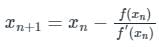
  • The Newton-Raphson method is an advanced iterative method for generating appropriate solution steps to a real solution of a given nonlinear equation.
  • The iterative formula used in the NR method is:

Tes: Newton Raphson Method - Question 2

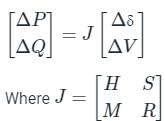
Consider a power system consisting of N number of buses. Buses in this power system are categorized into slack bus, PV buses and PQ buses for load flow study. The number of PQ buses is NL. The balanced Newton-Raphson method is used to carry out load flow study in polar form. H, S, M, and R are sub-matrices of the Jacobian matrix J as shown below:
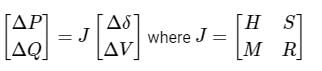
The dimension of the sub-matrix M is

Detailed Solution: Question 2
Number of buses in the system = N
Number of PQ buses = NL
Number of slack buses = 1
Number of PV buses = N - 1 - NL
Newton Raphson method for load flow study in polar form


The submatrix M relates between [ΔQ] and [Δδ]
Number of elements in ΔQ vector = Number of known Q 
Number of elements in ΔQ vector = Number of PQ buses = NL
Number of elements in Δδ vector = Number of unknown δ = N - 1
Size of matrix M = NL × (N - 1)
Size of other sub-matrix:
H = (N - 1) × (N - 1)
S = (N - 1) ×  NL
R = NL × NL 

Tes: Newton Raphson Method - Question 3

Newton Raphson method is used to solve

Detailed Solution: Question 3

  • Load flow study determines the operating state of the system for a given loading.
  • Load flow solves a set of simultaneous non-linear algebraic power equations for the two unknown variables (|V| and ∠δ) at each node in a system.
  • The output of the load flow analysis is the voltage and phase angle, real and reactive power (both sides in each line), line losses, and slack bus power.
  • Gauss seidel, Newton Raphson, and Fast decoupled load flow method are the different load flow methods.
  • The fast decoupled load flow method gives an approximate load flow solution because it uses several assumptions. Accuracy depends on the power mismatch vector tolerance.
  • The fast decoupled load flow method is an extension of the Newton-Raphson method formulated in polar coordinates with certain approximations, which results in a fast algorithm for load flow solution.
  • The fast decoupled method requires a greater number of iterations than the Newton-Raphson method.

Tes: Newton Raphson Method - Question 4

In a 100 bus power system, there are 10 generators. In a particular iteration of Newton Raphson load flow technique (in polar coordinates), two of the PV buses are converted to PQ type. In this iteration,

Detailed Solution: Question 4

A bus in a power system is a line at which the several components of the power system like generators, loads, and feeders, etc., are connected.
The buses in a power system are associated with four quantities, these quantities are the following:
The magnitude of the voltage

  • Phase angle
  • Active power
  • Reactive power

In the load flow studies, two variable are known, and the other two is to determined.
Depends on the quantity to be specified the buses are classified into three categories as follow:

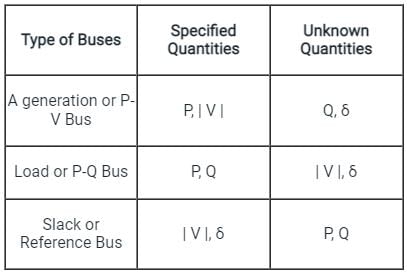
The table shown below shows the types of buses and the associated known and unknown value.

Generation Bus  or Voltage Control Bus:

  • This bus is also called the P-V bus.
  • on this bus, the voltage magnitude corresponding to generate voltage and true or active power P corresponding to its rating are specified.
  • Voltage magnitude is maintained constant at a specified value by injection of reactive power.
  • The reactive power generation Q and phase angle δ of the voltage is to be computed.

Load Bus:

  • This is also called the P-Q bus
  • at this bus, the active and reactive power is injected into the network.
  • The magnitude and phase angle of the voltage is to be computed.
  • Here the active power P and reactive power Q are specified, and the load bus voltage can be permitted within a tolerable value, i.e., 5 %.
  • The phase angle of the voltage, i.e.δ is not very important for the load.

Slack, Swing, or Reference Bus:

  • Slack bus in a power system absorbs or emits active or reactive power from the power system.
  • The slack bus does not carry any load.
  • At this bus, the magnitude and phase angle of the voltage is specified.
  • The phase angle of the voltage is usually set equal to zero.

Tes: Newton Raphson Method - Question 5

A power system has 100 buses including 10 generator buses. For the load flow analysis using Newton-Raphson method in polar coordinates, the size of the Jacobian is

Detailed Solution: Question 5

Number of buses (n) = 100
Generator busses (m) = 10
Order of Jacobian matrix =(2n − 1 − m) × (2n − 1 − m)
 = (200 − 1 − 10) × (200 − 1 − 10)
= 189 × 189

Tes: Newton Raphson Method - Question 6

The load-flow solution is always assured in case of

Detailed Solution: Question 6

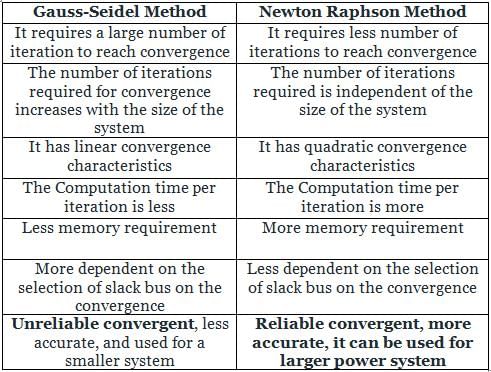
Difference between the Gauss-Seidel method and Newton-Raphson method:

As accuracy is more Newton-Raphson method have assured load flow solution

Tes: Newton Raphson Method - Question 7

Determine the order of the Jacobian matrix (with one slack bus) for a 10 bus power system? (Assume 2 buses as voltage-controlled bus)

Detailed Solution: Question 7

Concept:
The order of the Jacobian matrix (with one slack bus) = (2n – 2 – m) × (2n – 2 – m)
Where n = number of buses
m = number of buses whose voltage magnitude is specified

Calculation:
Given that,
n = 10, m = 2
The order of the Jacobian matrix (with one slack bus) = (20 – 2 – 2) × (20 – 2 – 2) = 16 × 16

*Answer can only contain numeric values
Tes: Newton Raphson Method - Question 8

In a load flow problem solved by Newton-Raphson method with polar coordinates, the size of the Jacobian is 100 × 100. If there are 20 PV buses in addition to PQ Buses and a slack bus, the total number of buses in the system is _________.


Detailed Solution: Question 8

Size of Jacobian matrix = (2n – m – 2) × (2n – m - 2)
Where n = number of buses
m = number of pv buses
Given that,
Size of Jacobian matrix = 100 × 100
Number of PV buses (m) = 20
⇒ (2n – m - 2) = 100
⇒ 2n – 20 – 2 = 100
⇒ n = 61

*Answer can only contain numeric values
Tes: Newton Raphson Method - Question 9

A 183 – bus power system has 150 PQ buses and 32 PV buses. In the general case, to obtain the load flow solution using Newton – Raphson method in polar coordinates, the minimum number of simultaneous equations to be solved is_________.


Detailed Solution: Question 9

Concept:
The minimum number of simultaneous equations will be
E = (2 × number of Load bus) + number of Generator buses
Calculation:
Given,
The number of load buses = 150
The number of generator buses = 32
Minimum no. of simultaneous equations
E = (2 × 150) + 32 = 332

*Answer can only contain numeric values
Tes: Newton Raphson Method - Question 10

A 10-bus power system consists of four generator buses indexed as G1, G2, G3, G4 and six load buses indexed as L1, L2, L3, L4, L5, L6. The generator-bus G1 is considered as slack bus, and the load buses L3 and L4 are voltage-controlled buses. The generator at bus G2 cannot supply the required reactive power demand, and hence it is operating at its maximum reactive power limit. The number of non-linear equations required for solving the load flow problem using Newton-Raphson method in polar form is ___________.


Detailed Solution: Question 10

Total number of bases (n) = 10
Number of slack bases = 1 (G1)
G3, G4 are generator bases.
Number of voltage controlled load bases = 2 (L3, L4)
G2 acts as load bas
Number of load bases = 4 (L1, L2, L5, L6)
The number of non-linear equations required = 2 × number of bases - (number of load bases) - (number of voltage controlled load bases)
= 2n - 2 - 4
= 2 (10) - 2 - 4 = 20 - 2 - 4 = 14

21 videos|112 docs|45 tests
Information about Tes: Newton Raphson Method Page
In this test you can find the Exam questions for Tes: Newton Raphson Method solved & explained in the simplest way possible. Besides giving Questions and answers for Tes: Newton Raphson Method, EduRev gives you an ample number of Online tests for practice
21 videos|112 docs|45 tests
Download as PDF