NEET Exam  >  NEET Test  >  Biology Class 12  >  Test: Biodiversity & Conservation - 1 - NEET MCQ

Biodiversity & Conservation - 1 - Free MCQ Practice Test with solutions,


MCQ Practice Test & Solutions: Test: Biodiversity & Conservation - 1 (20 Questions)

You can prepare effectively for NEET Biology Class 12 with this dedicated MCQ Practice Test (available with solutions) on the important topic of "Test: Biodiversity & Conservation - 1". These 20 questions have been designed by the experts with the latest curriculum of NEET 2026, to help you master the concept.

Test Highlights:

  • - Format: Multiple Choice Questions (MCQ)
  • - Duration: 20 minutes
  • - Number of Questions: 20

Sign up on EduRev for free to attempt this test and track your preparation progress.

Test: Biodiversity & Conservation - 1 - Question 1

What is the protection and conservation of species outside their natural habitat called?

Detailed Solution: Question 1

The off-site or the protection and conservation of species (genetic resources) outside their natural habitat (populations of plant or animal species) is known as ex-situ conservation. Areas such as botanical gardens, zoos, Gene banks, Tissue culture banks are the places were ex-situ conservation is done.

Test: Biodiversity & Conservation - 1 - Question 2

If all the members of a host species die then all its unique parasites also die off, representing:

Detailed Solution: Question 2

If all members fo a host species die the parasite that obtain their food from the particular host also die off due to lack of food. This represent co-existence of species.

Test: Biodiversity & Conservation - 1 - Question 3

When we will move away from the equator towards poles, we will find:

Detailed Solution: Question 3

When we will move away from the equator towards poles there is a gradual decrease in the species diversity. This is because climatic condition becomes gradually adverse as we move from equator to poles.

Test: Biodiversity & Conservation - 1 - Question 4

In a wetland the primary factor controlling the environment and the associated plant and animal life will be:

Detailed Solution: Question 4

Wetlands are areas where water is the primary factor controlling the environment and the associated plant and animal life. They occur where the water table is at or near the surface of the land, or where the land is covered by water.

Test: Biodiversity & Conservation - 1 - Question 5

If we say, India has about 50,000 type of rice and 1000 types of varieties of mango what level of diversity it indicates:

Detailed Solution: Question 5

India has about 50,000 type of rice and 1000 types of varieties of mango. This thigh level of diversity indicates very high genetic diversity and one of the largest in the world.

Test: Biodiversity & Conservation - 1 - Question 6

Alexander Von Humbolt described for the first time 

Detailed Solution: Question 6

Species area relationship is the relationship between the area and the particular habitat. It is dependent on immigration, extinction and clustering etc. It was first studied by Alexander Von Humbolt.

Test: Biodiversity & Conservation - 1 - Question 7

What are the species called whose number of individuals is greatly reduced to a critical level?

Detailed Solution: Question 7

Those species whose number of individuals is greatly reduced to a critical level and are at a high risk of extinction in the wild are known as endangered species. Some examples of endangered species are Brown spider monkey, Bengal tiger, Ganga river dolphin, Indian Rhino, Black buck, etc.

Test: Biodiversity & Conservation - 1 - Question 8

How many hotspots of biodiversity in the world have been identified till date?

Detailed Solution: Question 8

NCERT line: Initially 25 biodiversity hotspots were identified but subsequently nine more have been added to the list, bringing the total number of biodiversity hotspots in the world to 34.

Test: Biodiversity & Conservation - 1 - Question 9

When we compare the relationship between species richness and area for wide variety of taxa, the graph appears to be a :

Detailed Solution: Question 9

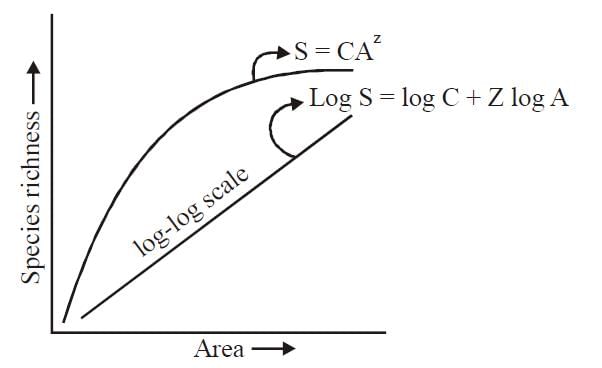
When a graph is drawn to compare the relationship between species richness and area for wide variety of texa, the graph appears to be a rectangular hyperbola.

Test: Biodiversity & Conservation - 1 - Question 10

To preserve seeds that rapidly lose viability, can’t survive dessication and plants which are propagated vegetatively, method employed is :

Detailed Solution: Question 10

Cryopreservation is the method of preserving living organisms or their parts at extremely low temperature. To preserve seeds that rapidly lose viability and cannot survive desiccation are preserved by this method.

NCERT Line: Now gametes of threatened species can be preserved in viable and fertile condition for long periods using cryopreservation techniques, eggs can be fertilised in vitro, and plants can be propagated using tissue culture methods.

Test: Biodiversity & Conservation - 1 - Question 11

Introducing exotic species into new areas will:
i) increase competition for food & space.
ii) introduce diseases
iii) improve habitat
iv) lead to extinction of native species

Detailed Solution: Question 11

The impacts of introducing a non-native or invasive species to an ecosystem will vary depending on a number of factors.

In some instances, the introduced species may not survive. If there is no ecological niche for the species to fill or the species cannot adapt to fill a different ecological niche, the species will likely go extinct relatively quickly at the local level.

However, if the species is a generalist, or a species able to thrive in a variety of environments and consume many food sources, that species will likely do well. If the ecosystem has reached its stable state, this means that the invasive species will have to replace a native species. No two species can share the same ecological niche, thus one will be better adapted and survive. If the invasive species is better adapted, it will out compete the native species.

If the species reproduces quickly, it is also more likely to thrive in a new ecosystem. If it can reproduce and grow faster than its competitor, it will eventually out compete that species.

Typically, invasive species harm an ecosystem. For example, the Burmese python is found in the US but it isn't supposed to be here. These snakes were likely released by humans and were pets at one time. The environment is suitable for them and they have adapted to the area.

Introducing a new species can also introduce any diseases that species has. These new diseases can spread to other native species and negatively affect them.

Introducing exotic species into new areas will increase competition for food and space. Sometimes, exotic species brings disease along with them. Exotic species in new area do not lead to extinction of native species.

Test: Biodiversity & Conservation - 1 - Question 12

How many species in the world are facing threat of extinction?

Detailed Solution: Question 12

NCERT Line: Adding to the grim scenario of extinctions is the fact that more than 15,500 species world-wide are facing the threat of extinction. Presently, 12 per cent of all bird species, 23 per cent of all mammal species, 32 per cent of all amphibian species and 31per cent of all gymnosperm species in the world face the threat of extinction.

Test: Biodiversity & Conservation - 1 - Question 13

What percent of the total oxygen in the Earth’s atmosphere is released by the Amazon forest?

Detailed Solution: Question 13

  • The Amazon rainforest is the world’s largest tropical rainforest and is also known as the Amazon Jungle or Amazonia.
  • Approximately 20 percent of the total oxygen in the Earth’s atmosphere is released by the Amazon forest by the process of photosynthesis.

Test: Biodiversity & Conservation - 1 - Question 14

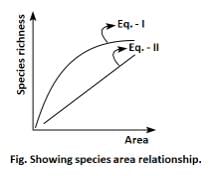
The great German naturalist and geographer Alexander von Humboldt observed that within a region species richness increased with increasing explored area, but only up to a limit. In fact, relation between species richness and area for a wide variety of taxa (angiosperm plants, birds, bats, freshwater fishes) turns out to be a rectangular hyperbola. Now find out correct equations shown in the graph:
Detailed Solution: Question 14
Test: Biodiversity & Conservation - 1 - Question 15

Loss of biodiversity may lead to all except:

Detailed Solution: Question 15

In general, loss of biodiversity in a region may lead to (a) decline in plant production, (b) lowered resistance to environmental perturbations such as drought and (c) increased variability in certain ecosystem processes such as plant productivity, water use, and pest and disease cycles.

Test: Biodiversity & Conservation - 1 - Question 16

Which of the following are also called lungs of our planet?

Detailed Solution: Question 16

Amzonian rain forests are called as lungs of forest because it contains different kinds of vegetation that purify the atmosphere of the earth.

Test: Biodiversity & Conservation - 1 - Question 17

Which one of the following have the highest number of species in nature?

Detailed Solution: Question 17

  • More than 70 per cent of all the species recorded are animals, while plants (including algae, fungi, bryophytes, gymnosperms and angiosperms) comprise no more than 22 per cent of the total.
  • Among animals, insects are the most species rich taxonomic group, making up more than 70 per cent of the total.

Test: Biodiversity & Conservation - 1 - Question 18

Which of the statements given above is/are correct?

i. India accounts for 8.1% of global species diversity despite covering only 2.4% of the world's land area.

ii. Approximately 45,000 plant species have been documented in India, along with twice as many animal species.

iii. According to global estimates, only 22% of all living species have been identified so far.

iv. It is estimated that there are less than 100,000 undiscovered plant species in India.

Detailed Solution: Question 18

To determine the correct statements, let's analyze each one:

- Statement i: Correct. India's share of global species diversity is indeed 8.1% while covering only 2.4% of the land area.

- Statement ii: Correct. The text states that nearly 45,000 species of plants and twice as many animals have been recorded; this means there are about 90,000 animal species documented.

- Statement iii: Correct. The text supports this claim by mentioning that only 22% of total species have been recorded globally.

- Statement iv: Incorrect. The text estimates that there are probably more than 100,000 plant species yet to be discovered, not less.

Test: Biodiversity & Conservation - 1 - Question 19

Which of the following statements regarding the diversity of plants and animals in tropical regions is/are correct?

i. Species diversity is generally higher in tropical regions compared to temperate and polar areas due to longer evolutionary timeframes.

ii. Tropical environments, being less seasonal and more constant, promote niche specialization which contributes to greater species diversity.

iii. The greater availability of solar energy in tropical regions leads to higher productivity, which indirectly supports greater biodiversity.

iv. Polar regions have been less affected by glaciation events than tropical regions, resulting in higher species diversity in the poles.

Detailed Solution: Question 19

The correct statements are i, ii, and iii.

1. Statement i is correct because the tropics have been relatively undisturbed for millions of years, allowing for more time for species diversification compared to temperate regions that have faced frequent glaciations.

2. Statement ii is also correct since the less seasonal and more stable environments in the tropics allow for niche specialization, thus enhancing species diversity.

3. Statement iii is correct as well; the greater solar energy availability in tropical regions contributes to higher productivity, which supports a wider range of species.

4. Statement iv is incorrect because polar regions have been significantly affected by glaciation events, leading to lower species diversity compared to tropical regions.

Therefore, the accurate answer is Option A: i, ii, and iii.

Test: Biodiversity & Conservation - 1 - Question 20

Which of the statements given above is/are correct regarding alien species invasions and co-extinctions?

i. The introduction of the Nile perch in Lake Victoria caused the decline of indigenous cichlid fish species.

ii. Invasive weed species such as Lantana and water hyacinth do not pose a significant threat to native species.

iii. Co-extinctions occur when a species extinction leads to the extinction of its associated mutualistic partners.

iv. The African catfish Clarias gariepinus has been legally introduced into rivers for aquaculture purposes.

Detailed Solution: Question 20

- Statement i is correct as the introduction of the Nile perch into Lake Victoria led to the extinction of over 200 species of cichlid fish.

- Statement ii is incorrect because invasive weed species like Lantana and water hyacinth are known to threaten native species and ecosystems.

- Statement iii is correct as co-extinctions occur when the extinction of one species, such as a host fish, leads to the extinction of its obligate parasites or mutualistic partners.

- Statement iv is incorrect because the introduction of Clarias gariepinus has been illegal and poses a threat to indigenous catfish populations.

Thus, the correct statements are i and iii, making option A the correct answer.

69 videos|305 docs|161 tests
Information about Test: Biodiversity & Conservation - 1 Page
In this test you can find the Exam questions for Test: Biodiversity & Conservation - 1 solved & explained in the simplest way possible. Besides giving Questions and answers for Test: Biodiversity & Conservation - 1, EduRev gives you an ample number of Online tests for practice
69 videos|305 docs|161 tests
Download as PDF