NEET Exam  >  NEET Test  >  Chemistry Class 12  >  Test: Diazonium Salts - NEET MCQ

Diazonium Salts - Free MCQ Practice Test with solutions, NEET Chemistry


MCQ Practice Test & Solutions: Test: Diazonium Salts (18 Questions)

You can prepare effectively for NEET Chemistry Class 12 with this dedicated MCQ Practice Test (available with solutions) on the important topic of "Test: Diazonium Salts". These 18 questions have been designed by the experts with the latest curriculum of NEET 2026, to help you master the concept.

Test Highlights:

  • - Format: Multiple Choice Questions (MCQ)
  • - Duration: 18 minutes
  • - Number of Questions: 18

Sign up on EduRev for free to attempt this test and track your preparation progress.

Test: Diazonium Salts - Question 1

Benzene diazonium chloride when reacts with hypophosphorus acid produces

Detailed Solution: Question 1

Test: Diazonium Salts - Question 2

p-amino azo benzene is obtained by treating diazoniumchloride with:

Detailed Solution: Question 2

p-amino azo benzene is obtained by treating diazonium chloride with aniline. The reactions are specifically acid catalyzed and involve pre‐equilibrium formation of amine and diazonium salt followed by rate‐limiting attack of the diazonium ion at a C‐atom (C‐coupling) to give the corresponding amino azo compounds.

Test: Diazonium Salts - Question 3

When hypophosphorous acid is treated with diazonium salts, it is reduced to:

Detailed Solution: Question 3

The correct answer is option A

Hypophosphorous acid when treated with diazonium salts is reduced to arenes.
ArN2Cl + H3PO2 + H2O ⟶ ArH + N2 + H3PO3 +HCl

Test: Diazonium Salts - Question 4

 Which of the following amine will form stable diazonium salt at 273-283 K ?

Detailed Solution: Question 4

The correct answer is Option A.
Aromatic Primary amine will form the most stable diazonium salt because it releases water when it reacts with nitronium ions. If aliphatic primary amine reacts with nitrosonium ion it Also releases water but in this case water reacts with alkyl diazonium salt and it forms alcohol while benzene diazonium salt does not react with water at this temperature.

Test: Diazonium Salts - Question 5

Replacement of diazo group by other groups is helpful in preparing those substituted aromatic compounds which cannot be prepared by

Detailed Solution: Question 5

Replacement of diazo group by other group is helpful in preparing compounds which are not/ cannot be produced by direct nucleophilic substitution reaction.This is because,to substitute in aromatic ring, the nucleophilic should leave the partial double bond, which is more energy required than in haloalkane.

Test: Diazonium Salts - Question 6

Detailed Solution: Question 6

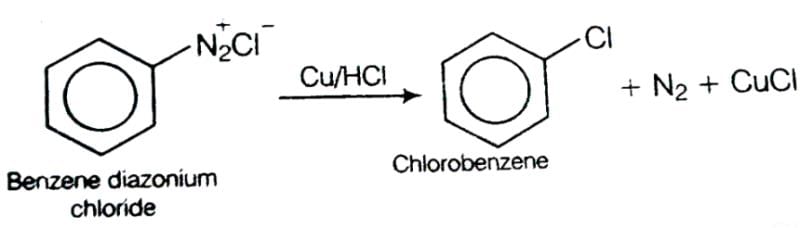
This reaction is called Gattermann reaction. In this reaction, Cl, Br and CN can be introduced into the benzene ring by simply treating diazonium salts with HCl, HBr, KCN. Respectively in presnce of copper powder instead of using Cu(I) salts.

Test: Diazonium Salts - Question 7

Which of the following amine gives diazonium salt on reaction with HNO2?

Detailed Solution: Question 7

C6H5NH2 reacts with HNO2 to forms diazonium salts, the reaction are as follows,
C6H5NH2 + HNO2 ------> C6H5OH + H2O + N2

Test: Diazonium Salts - Question 8

On heating an aliphatic primary amine with chloroform and ethanolic potassium hydroxide, the organic compound formed is 

Test: Diazonium Salts - Question 9

 What happens when benzene diazonium chloride is treated with potassium cyanide in presence of Cu powder?

Detailed Solution: Question 9

The correct answer is option D
By treating diazonium salts with cuprous cyanide or KCN and copper powder it forms aryl nitrile. Illustrative is the preparation of benzonitrile using the reagent cuprous cyanide:

Test: Diazonium Salts - Question 10

The conversion of primary aromatic amines into diazonium salts is known as:

Detailed Solution: Question 10

The process of conversion of primary aromatic amines into its diazonium salt is called diazotization. Diazonium salts are important synthetic intermediates that can undergo coupling reactions to form azo dyes and electrophilic substitution reactions to introduce functional groups.

Test: Diazonium Salts - Question 11

By treating diazonium salts with cuprous cyanide or KCN and copper powder it forms:

Detailed Solution: Question 11

The correct answer is option C
By treating diazonium salts with cuprous cyanide or KCN and copper powder it forms aryl nitrile.
CuCN/KCN
ArN2+ Cl–—————> ArCN + N2

Test: Diazonium Salts - Question 12

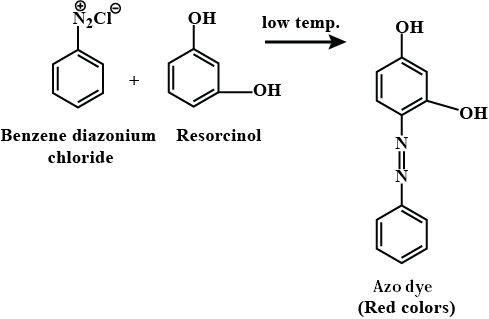
Benzene diazonium chloride forms orange red dye with:

Detailed Solution: Question 12

1155186_592885_ans_dec8ccc8a62543ad812bda44ee9368ad.png

Test: Diazonium Salts - Question 13

The stability of benzene diazonium salts is because of

Detailed Solution: Question 13

None of the errors that are pointed are correct.

Their stability is because of resonance. D is the correct answer.

What is the resonance structure of aromatic diazonium salt? - Quora

Test: Diazonium Salts - Question 14

 Azo-dye test is given by:

Detailed Solution: Question 14

This test is given by aromatic primary amines. Aromatic primary amines react with nitrous acid to form diazonium salts. These diazonium salts undergo coupling reaction with β-naphthol to form orange coloured azo dye.

Test: Diazonium Salts - Question 15

When diazonium salt solution is treated with KI, it forms:

Detailed Solution: Question 15

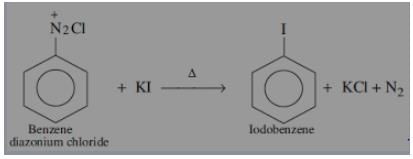
When diazonium salt solution is treated with KI it introduces −I group in benzene ring to form Iodobenzene as a major product.

Test: Diazonium Salts - Question 16

 Diazo coupling is useful to prepare:

Detailed Solution: Question 16

The correct answer is option C            
Azo dyes are derived by coupling of a phenol adsorbed on the surface of a fabric with a diazonium salt. Dyes can be prepared by diazo coupling.

Test: Diazonium Salts - Question 17

Benzene diazonium chloride on reaction with phenol in weakly basic medium gives:

Detailed Solution: Question 17

The correct answer is Option A.
Benzene diazonium chloride in reaction with phenol in a basic medium gives p-Hydroxy azobenzene. This is an example of the coupling reaction.

Test: Diazonium Salts - Question 18

When diazonium salt solution is treated with water at a temperature of 283 K it forms?

Detailed Solution: Question 18

Benzene diazonium chloride is hydrolysed to phenol when heated with water.
ArN2Cl + H2O ----> ArOH + N2 + HCl 

54 videos|290 docs|74 tests
Information about Test: Diazonium Salts Page
In this test you can find the Exam questions for Test: Diazonium Salts solved & explained in the simplest way possible. Besides giving Questions and answers for Test: Diazonium Salts, EduRev gives you an ample number of Online tests for practice
54 videos|290 docs|74 tests
Download as PDF