NEET Exam  >  NEET Test  >  Physics Class 11  >  Test: Dimensions of Physical Quantities - NEET MCQ

Dimensions of Physical Quantities - NEET Physics Class 11 Free MCQ Test


MCQ Practice Test & Solutions: Test: Dimensions of Physical Quantities (18 Questions)

You can prepare effectively for NEET Physics Class 11 with this dedicated MCQ Practice Test (available with solutions) on the important topic of "Test: Dimensions of Physical Quantities". These 18 questions have been designed by the experts with the latest curriculum of NEET 2026, to help you master the concept.

Test Highlights:

  • - Format: Multiple Choice Questions (MCQ)
  • - Duration: 18 minutes
  • - Number of Questions: 18

Sign up on EduRev for free to attempt this test and track your preparation progress.

Test: Dimensions of Physical Quantities - Question 1

Which of the following system of units is NOT based on the unit of mass, length and time alone

Detailed Solution: Question 1

The SI system of units is a modern system and hence involves all the quantities that can't be derived using all the other quantities of the set. While the rest systems are old and local methods and hence are not scientifically accurate and explainable and thus only have three basic quantities while SI have 7.

Test: Dimensions of Physical Quantities - Question 2

Which of the following statement is wrong ?

Detailed Solution: Question 2

The incorrect statement is:

d) Unit of surface tension is Newton metre.

The correct unit of surface tension is Newton per metre (N/m), not Newton metre.

Here's a breakdown:

  • a) Unit of K.E. is Newton-metre: True, because kinetic energy is measured in joules, and 1 joule equals 1 Newton-metre.
  • b) Unit of viscosity is poise: True, poise is indeed a unit of dynamic viscosity.
  • c) Work and energy have the same dimensions: True, both work and energy have the same dimensions and are measured in joules.
  • d) Unit of surface tension is Newton metre: Incorrect, it should be Newton per metre (N/m).

Test: Dimensions of Physical Quantities - Question 3

The angular frequency is measured in rad s-1. Its dimension in length are :

Detailed Solution: Question 3

Unit of angular frequency is rad/sec which can be said as angle/time. As angle is dimensionless and time has dimension T, we get the dimension of angular frequency as T-1. So it has 0 dimensions in length.

Test: Dimensions of Physical Quantities - Question 4

The dimensional formula of coefficient of viscosity is

Detailed Solution: Question 4

Coefficient of viscosity (η)= Fr/Av   

 F= tangential Force, Area, r= distance between the layers, v= velocity.

Dimensional Formula of Force = M1L1T-2.
Dimensional Formula of Area= M0L2T0.
Dimensional Formula of distance= M0L1T0.
Dimensional Formula of velocity= M0L1T-1.

Putting these values in above equation we get,

[η]= [M1L1T-2][M0L1T0] / [M0L2T0] [M0L1T-1] = [M1L-1T-1]

Test: Dimensions of Physical Quantities - Question 5

A pair of physical quantities having the same dimensional formula is :

Detailed Solution: Question 5

The dimensions of angular momentum are M L2T−1
That of torque is  M L2T−2
Also dimension of energy is  M L2T−2
Where as same of force is  M LT−2
And of power is  M L2T−3
Thus we get torque and energy have the same dimensional formulas.

Test: Dimensions of Physical Quantities - Question 6

 If momentum (P), area (A) and time (T) are taken to be fundamental quantities, then energy has the dimensional formula 

Detailed Solution: Question 6

[E] = [F][d]
= [P/T][A]½ 
[E] = P1A½T-1

Test: Dimensions of Physical Quantities - Question 7

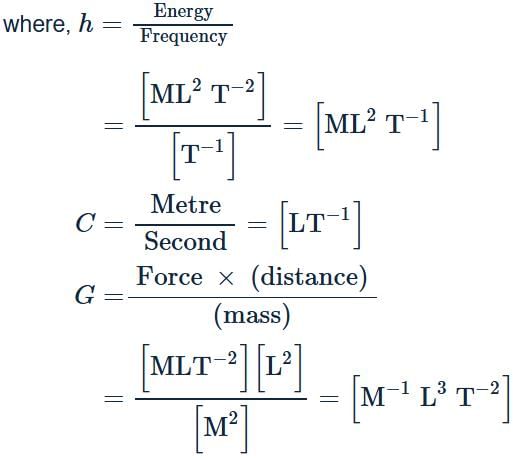
If C the velocity of light, h Planck's constant and G gravitational constant are taken as fundamental quantities, then the dimensional formula of mass is

Detailed Solution: Question 7

Let,


Comparing the coefficients M,L,T, of both sides we get

b−c=1
a + 2b + 3c = 0
−(a + b + 2c) = 0
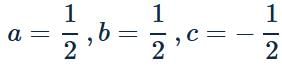
Solve the Eqs. (ii), (iii) and (iv), we get

So,
M=h1/2C1/2G−1/2

Test: Dimensions of Physical Quantities - Question 8

The dimensional representation of Planck's constant is identical to that of

Detailed Solution: Question 8

Planck's constant (h) has the dimensional formula [ML2T–1], where M stands for mass, L for length, and T for time.

Let's check each option: -

Torque and work both have dimensions of force × distance, which is [ML2T–2].

Stress is force per unit area, having the dimensions [ML–1T–2]. 

Angular momentum is defined as mass × velocity × radius, which is [M][LT–1][L] = [ML2T–1].

Therefore, only angular momentum has the same dimensional representation as Planck's constant ([ML2T–1]).

Thus, the answer is angular momentum.

Test: Dimensions of Physical Quantities - Question 9

The dimensions of the shear modulus of rigidity are

Detailed Solution: Question 9

Correct answer: D

Shear modulus is the ratio of shear stress to shear strain.

Shear stress = force/area. The dimensions of force are M1L1T-2, and area has dimensions L2, so the dimensions of shear stress are M1L-1T-2.

Shear strain is dimensionless.

Therefore the shear modulus has the same dimensions as shear stress: M1L-1T-2. Hence option D is correct.

Test: Dimensions of Physical Quantities - Question 10

Suppose refractive index μ is given as μ = A + B/λ2 where A and B are constants and λ is wavelength, then dimensions of B are same as that of

Detailed Solution: Question 10

Option D is correct.

μ (refractive index) is a dimensionless quantity, so every term on the right-hand side must be dimensionless.

Therefore A is dimensionless and B/λ2 must be dimensionless.

Thus B must have the same dimensions as λ2, i.e., length2.

Dimensions of length2 correspond to area; hence the correct option is area (Option D).

Test: Dimensions of Physical Quantities - Question 11

The M.K.S. units of coefficient of viscosity is-

Detailed Solution: Question 11

We know that coefficient of viscosity (η)= Fr/Av where F = tangential force, r = distance between the layers , v = velocity and A is the area of the surface.
 Thus we get [η] = MLT-2.L / L2. (L/T)
= M / LT
Thus its unit is kg / m sec

Test: Dimensions of Physical Quantities - Question 12

For 10(at+3) , the dimension of a is-

Detailed Solution: Question 12

As 'at' and 3 are added in the equation, we get at and 3 have same dimensions i.e.1
Thus a has dimensions same as 1/t.

Test: Dimensions of Physical Quantities - Question 13

The pressure of 106 dyne/cm2 is equivalent to

Detailed Solution: Question 13

We know that 105 dyne = 1N
And 104cm2  = 1 m2
Thus we get 10 dyne / cm2 = N / m2
Hence 106 dyne / cm2 =105 N / m2

Test: Dimensions of Physical Quantities - Question 14

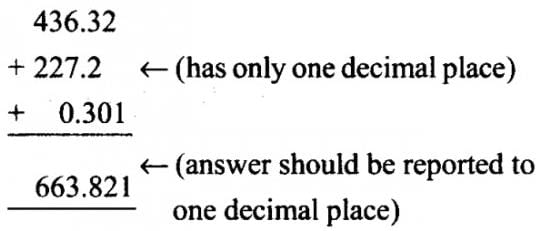
The sum of the numbers 436.32, 227.2 and 0.301 in appropriate significant figures is

Detailed Solution: Question 14

The result of an addition or subtraction in the number having different precisions should be reported to the same number of decimal places as present in the number having the least number of decimal places.

The final result should, therefore, be rounded off to one decimal place, i.e. 663.8

Test: Dimensions of Physical Quantities - Question 15

 The SI unit of length is the meter. Suppose we adopt a new unit of length which equals to x meters. The area 1m2 expressed in terms of the new unit has a magnitude-

Detailed Solution: Question 15

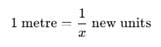
Let the new unit of length be 1 unit = x metres.
Then,

Now,

So, the magnitude of 1 m2 in terms of the new unit of area is: 1/x2

Test: Dimensions of Physical Quantities - Question 16

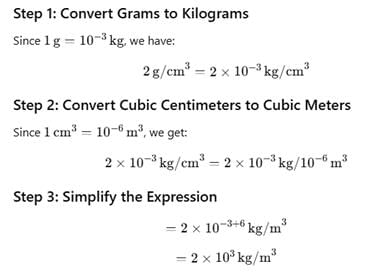
 r = 2 g/cm3 convert it into MKS system -

Detailed Solution: Question 16

Test: Dimensions of Physical Quantities - Question 17

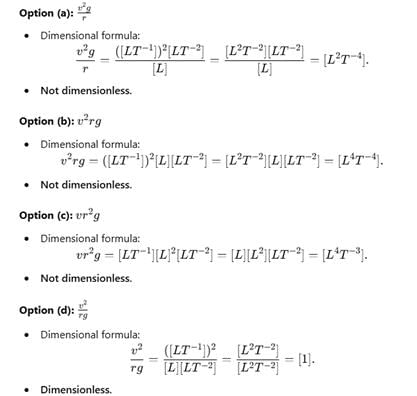
Given that v is the speed, r is radius and g is acceleration due to gravity. Which of the following is dimension less

Detailed Solution: Question 17

Test: Dimensions of Physical Quantities - Question 18

 The value of G = 6.67 × 10_11 N m2 (kg)_2. Its numerical value in CGS system will be :

Detailed Solution: Question 18

G = 6.67 × 10⁻¹¹ N m2 kg−2

To convert G from SI units to CGS units, we use:
1 N = 105 dynes
1 m = 100 cm
1 kg = 1000 g

So,
G = 6.67 × 10⁻¹¹ N m2 kg−2

= 6.67 × 10⁻¹¹ × [ (105 dynes) × (102 cm)2 ] / (103 g)2

= 6.67 × 10−11 × (105 × 104) / 106

= 6.67 × 10−11 × 109 / 106

= 6.67 × 10⁻⁸ dyne cm2 g−2

So, the correct value of G in the CGS system is 6.67 × 10⁻⁸.

97 videos|376 docs|98 tests
Information about Test: Dimensions of Physical Quantities Page
In this test you can find the Exam questions for Test: Dimensions of Physical Quantities solved & explained in the simplest way possible. Besides giving Questions and answers for Test: Dimensions of Physical Quantities, EduRev gives you an ample number of Online tests for practice
97 videos|376 docs|98 tests
Download as PDF