Electrical Engineering (EE) Exam  >  Electrical Engineering (EE) Test  >  GATE Mock Test Series 2027  >  Test: Encoders - Electrical Engineering (EE) MCQ

GATE Electrical Engineering (EE) Test: Encoders Free Online Test 2026


MCQ Practice Test & Solutions: Test: Encoders (10 Questions)

You can prepare effectively for Electrical Engineering (EE) GATE Electrical Engineering (EE) Mock Test Series 2027 with this dedicated MCQ Practice Test (available with solutions) on the important topic of "Test: Encoders". These 10 questions have been designed by the experts with the latest curriculum of Electrical Engineering (EE) 2026, to help you master the concept.

Test Highlights:

  • - Format: Multiple Choice Questions (MCQ)
  • - Duration: 20 minutes
  • - Number of Questions: 10

Sign up on EduRev for free to attempt this test and track your preparation progress.

Test: Encoders - Question 1

How many inputs will a decimal-to-BCD encoder have?

Detailed Solution: Question 1

An encoder is a combinational circuit encoding the information of 2n input lines to n output lines, thus producing the binary equivalent of the input. Thus, a Decimal-to-bcd converter has decimal values as inputs which range from 0-9. So, a total of 10 inputs are there in a decimal-to-BCD encoder.

Test: Encoders - Question 2

How is an encoder different from a decoder?

Detailed Solution: Question 2

An encoder is a combinational circuit encoding the information of 2n input lines to n output lines, thus producing the binary equivalent of the input. It performs the opposite operation of a decoder which results in 2n outputs from n inputs. Thus, an encoder different from a decoder because of the output of an encoder is a binary code for 1-of-N input.

Test: Encoders - Question 3

Can an encoder be a transducer?

Detailed Solution: Question 3

Of course, a transducer is a device that has the capability to emit data as well as to accept. Transducer converts signal from one form of energy to another.

Test: Encoders - Question 4

How many OR gates are required for an octal-to-binary encoder?

Detailed Solution: Question 4

An encoder is a combinational circuit encoding the information of 2n input lines to n output lines, thus producing the binary equivalent of the input. Thus, in octal to binary encoder there are 8 (= 23) inputs, thus 3 output lines.

Test: Encoders - Question 5

The discrepancy of 0 output due to all inputs being 0 or D0, being 0 is resolved by using additional input known as ___________

Detailed Solution: Question 5

Such problems are resolved by using enable input, which behaves as active if it gets 0 as input since it is an active-low pin.

Test: Encoders - Question 6

If we record any music in any recorder, such types of process is called ___________

Detailed Solution: Question 6

If we record any music in any recorder, it means that we are giving data to a recorder. So, such process is called encoding. Getting back the music from the recorded data is known as decoding.

Test: Encoders - Question 7

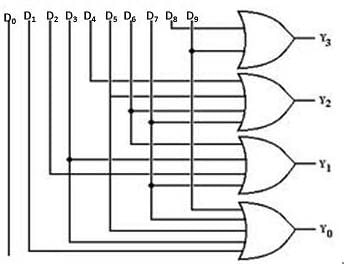
How many OR gates are required for a Decimal-to-bcd encoder?

Detailed Solution: Question 7

An encoder is a combinational circuit encoding the information of 2n input lines to n output lines, thus producing the binary equivalent of the input.
This is clear from the diagram that it requires 4 OR gates:

Test: Encoders - Question 8

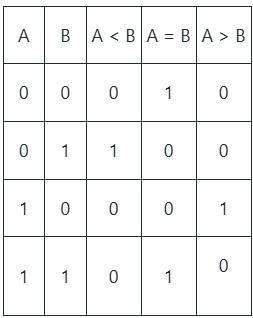
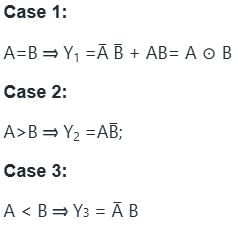
A single bit comparator compares two numbers A and B and produces three outputs Y1 (if A = B), Y2 (if A > B) and Y3(if A < B) as given below:
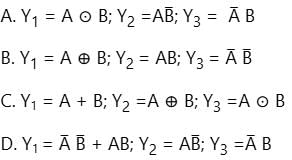
Choose the correct answer from the options given below:

Detailed Solution: Question 8
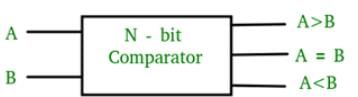
Concept:

A magnitude digital Comparator is a combinational circuit that compares two digital or binary numbers in order to find out whether one binary number is equal, less than or greater than the other binary number. We logically design a circuit for which we will have two inputs one for A and another for B and have three output terminals, one for A > B condition, one for A = B condition, and one for A < B condition.

Application:

1-Bit Magnitude Comparator:

A comparator used to compare two bits is called a single bit comparator. It consists of 2-inputs each for two single-bit numbers (0 or 1) and 3-outputs to generate less than, equal to and greater than between two binary numbers.

The truth table for a 1-bit comparator is given below:

Test: Encoders - Question 9

For an encoder, if the number of output lines is m, then the number of input lines will be _______ .

Detailed Solution: Question 9

  • The encoders are used for coding binary data. The encoder is a combinational logic circuit that converts an active input signal into a coded output signal.
  • It has n input lines, only one of which is active at any time and m output lines. It encodes one of the active inputs to a coded binary output with m bits. In an encoder, the number of output lines is less than the number of inputs. If an encoder has n input lines and m output lines than n<= 2m.

Example:

For 8 × 3 Encoder

n = 8

m = 3

8 = 23

n = 2m

For 7 × 3 Encoder

n = 7

m = 3

7 < 23

Test: Encoders - Question 10

If half adders and full adders are implements using gates, then for the addition of two 17 bit numbers (using minimum gates) the number of half adders and full adders required will be

Detailed Solution: Question 10

Take 2 numbers for 17 bits, for the first 2 bits of each number we need one-half adder and for rest(16 bit of each number) we will have one carry of previous sum and two bits of each number so we need one full adder for each rest of bits, that is, 16 full adder.

26 docs|247 tests
Information about Test: Encoders Page
In this test you can find the Exam questions for Test: Encoders solved & explained in the simplest way possible. Besides giving Questions and answers for Test: Encoders, EduRev gives you an ample number of Online tests for practice
Download as PDF