NEET Exam  >  NEET Test  >  Physics Class 11  >  Test: Fluid Mechanics - 1 - NEET MCQ

Fluid Mechanics - 1 - Free MCQ Practice Test with solutions, NEET Physics


MCQ Practice Test & Solutions: Test: Fluid Mechanics - 1 (25 Questions)

You can prepare effectively for NEET Physics Class 11 with this dedicated MCQ Practice Test (available with solutions) on the important topic of "Test: Fluid Mechanics - 1". These 25 questions have been designed by the experts with the latest curriculum of NEET 2026, to help you master the concept.

Test Highlights:

  • - Format: Multiple Choice Questions (MCQ)
  • - Duration: 60 minutes
  • - Number of Questions: 25

Sign up on EduRev for free to attempt this test and track your preparation progress.

Test: Fluid Mechanics - 1 - Question 1

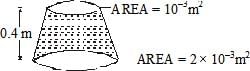
A uniformly tapering vessel shown in Fig. is filled with liquid of density 900 kg/m3. The force that acts on the base of the vessel due to liquid is (take 
g = 10 m/s2) -
Detailed Solution: Question 1

The force acting on the base of the vessel due to the liquid can be calculated using the formula for pressure. The pressure at the base is given by:

  • P = ρgh
  • Where:
    • ρ = density of the liquid (900 kg/m3)
    • g = acceleration due to gravity (10 m/s2)
    • h = height of the liquid column

The force F on the base can be calculated as:

  • F = PA
  • Where A is the area of the base.

Assuming a height h of the liquid column and a base area A, the total force can be expressed as:

  • F = ρghA

Substituting the values:

  • F = 900 kg/m3 × 10 m/s2 × h × A

To find the specific force, we need the dimensions of the vessel to calculate A and h. However, based on the given options, the correct answer is:

  • 7.2 N

Test: Fluid Mechanics - 1 - Question 2

A liquid of mass 1 kg is filled in a flask as shown in figure. The force exerted by the flask on the liquid is (g = 10 m/s2)

[Neglect atmospheric pressure]

Detailed Solution: Question 2

The force exerted by the flas on the liquid is equal to the force applied by the liquid on the flask which is equal to its weight = mg = 10N

Test: Fluid Mechanics - 1 - Question 3

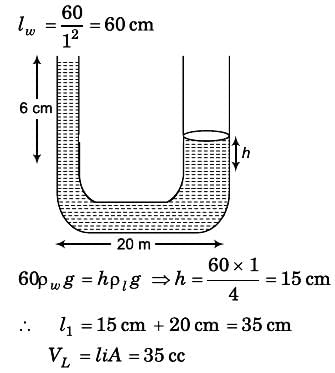
A U-tube having horizontal arm of length 20 cm, has uniform cross-sectional area = 1 cm2. It is filled with water of volume 60 cc. What volume of a liquid of density 4 g/cc should be poured from one side into the U-tube so that no water is left in the horizontal arm of the tube?

Detailed Solution: Question 3
Test: Fluid Mechanics - 1 - Question 4

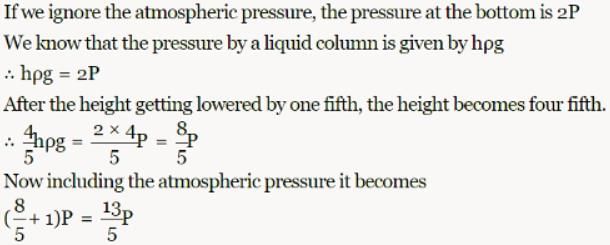
The pressure at the bottom of a tank of water is 3P where P is the atmospheric pressure. If the water is drawn out till the level of water is lowered by one fifth., the pressure at the bottom of the tank will now be

Detailed Solution: Question 4
Test: Fluid Mechanics - 1 - Question 5

An open-ended U-tube of uniform cross-sectional area contains water (density 1.0 gram/centimeter3) standing initially 20 centimeters from the bottom in each arm. An immiscible liquid of density 4.0 grams/centimeter3 is added to one arm until a layer 5 centimeters high forms, as shown in the figure above. What is the ratio h2/h1 of the heights of the liquid in the two arms ?


Detailed Solution: Question 5

5 × 4 × 10 + (h1 - 5) × 10 = h2 × 1 × 10
200 + 10h1 – 50 = 10h2
10h2 - 10h1 = 150
h2 - h1 = 15
h2 + h1 = 20 + 20 + 5 = 45
2h2 = 60
h2 = 30
h1 = 15
h2/h1 = 30/15
h2/h1 = 2/1

Test: Fluid Mechanics - 1 - Question 6

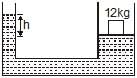
The area of cross-section of the wider tube shown in figure is 800 cm2. If a mass of 12 kg is placed on the massless piston, the difference in heights h in the level of water in the two tubes is :
                         

Detailed Solution: Question 6

h × ρ × 10 = 120/800 × 10-4 
h × ρ = 12/8 × 10
h × ρ = 150m
h × 1000 = 150m
h = 15cm

Test: Fluid Mechanics - 1 - Question 7

 A body is just floating in a liquid (their densities are equal) If the body is slightly pressed down and released it will -

Detailed Solution: Question 7

The body will sink to the bottom as it gains a downward velocity and has no force to bring it back up. The weight becomes greater than upwards thrust.
 

As body is just floating, its density is same as that of the liquid.
If pressed below, it will gain momentum downwards, and continue to sink till bottom.
When the body is slightly pressed, the contraction in volume decreases upthrust, so weight becomes greater than upthrust, body moves down. The upthrust further decreases, since more and more contraction occurs as the body moves down. The body thus, sinks to the bottom.

Test: Fluid Mechanics - 1 - Question 8

Two stretched membranes of areas 2 and 3 m2 are placed in a liquid at the same depth. The ratio of the pressure on them is -

Detailed Solution: Question 8

Pressure depends on depth of container irrespective of its shape and in the above case depth for both the vessels are given same. Therefore the hydraulic pressure for the containers will be in the ratio 1: 1

Test: Fluid Mechanics - 1 - Question 9

An ice block floats in a liquid whose density is less than water. A part of block is outside the liquid. When whole of ice has melted, the liquid level will -

Detailed Solution: Question 9

When ice floats in a liquid, the volume of the ice block submerged in the liquid displaces an amount of liquid equal to the weight of the ice. Since the liquid is less dense than water, the ice block displaces more liquid than it would in water, but still, some part of the ice remains above the surface.

When the ice melts, it turns into water, which has a higher density than the liquid in which the ice was floating. The melted water will mix with the liquid, but since water is denser, it will contribute less to the liquid level than the volume of the ice that was initially displacing the liquid.

As a result, the overall liquid level will decrease when the ice has fully melted.

Test: Fluid Mechanics - 1 - Question 10

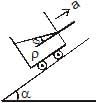
A fluid container is containing a liquid of density r is is accelerating upward with acceleration a along the inclined place of inclination a as shwon. Then the angle of inclination q of free surface is :
                     

Detailed Solution: Question 10

First resolve all components in the along and perpendicular to incline. Pressure difference is created in a vertical column full of liquid. This is because of gravity acting in downward direction. Similarly, pressure difference will be created too along the incline. So, p = h * d * g * cosa (in perpendicular direction) and
p = hd (a + g sina) (along incline).
So, tan(theta) = (a + gsina)/(gcosa)

Test: Fluid Mechanics - 1 - Question 11

Two bodies having volumes V and 2V are suspended from the two arms of a common balance and they are found to balance each other. If larger body is immersed in oil (density d1 = 0.9 gm/cm3) and the smaller body is immersed in an unknown liquid, then the balance remain in equilibrium. The density of unknown liquid is given by :

Test: Fluid Mechanics - 1 - Question 12

A boy carries a fish in one hand and a bucket (not full) of water in the other hand. If the places the fish in the bucket, the weight now carried by him (assume that water does not spill) :

Detailed Solution: Question 12

Buoyant force on fish due to water will be equal and opposite to the force on water by fish.
These two forces are internal forces for the fish bucket system.
Hence, they will not affect the weight the boy carries.
 

Test: Fluid Mechanics - 1 - Question 13

A piece of steel has a weight W in air, W1 when completely immersed in water and W2 when completely immersed in an unknown liquid. The relative density (specific gravity) of liquid is :

Detailed Solution: Question 13

If the loss of weight of a body in water is 'a' while in liquid is 'b' then
Sigma in liquid / sigma in water = upthrust on body in liquid / upthrust on body in water
Then a / b = (W air - W liquid) / (W air - W water).

Test: Fluid Mechanics - 1 - Question 14

A ball of relative density 0.8 falls into water from a height of 2m. The depth to which the ball will sink is (neglect viscous forces) :

Detailed Solution: Question 14

https://cn.edurev.in/ApplicationImages/Temp/509091_29770b35-b22d-4999-a643-72b53ecc4fbe_lg.png
Let us calculate the buoyancy force by water try to stop the ball.
Buoyancy force = weight of displaced water
= Density of water x Volume of the ball x g
= d x V x g  --- (1)
But buoyant force = ma
Therefore, ma = d x V x g
or a = (dVg) / m --- (2)
Let the density of the ball be d'.
→ m = d'V 
Substituting in equation 2, we get
a = (dVg) / d'V
= dg / d'
= (d/d') x g
Given that relative density, (d / d') = 0.8 
So, a = g / (0.8)
= 10 / 0.8
→ a = 12.5 m/s^2
Net deceleration of ball, a' = a - g = 12.5 - 10
= 2.5 m/s^2
Final speed of ball v' = 0
Using the equation - v'^2 = v^2 + 2a's (where s = depth of ball in the water)
Substituting the values in the above equation, we get
40 = 0 + 2 x 2.5 x s
s = 8m

Test: Fluid Mechanics - 1 - Question 15

A cube of iron whose sides are of length L, is put into mercury. The weight of iron cube is W. The density of iron is rI, that of mercury is rM. The depth to which the cube sinks is given by the expression _

Test: Fluid Mechanics - 1 - Question 16

 A metal ball of density 7800 kg/m3 is suspected to have a large number of cavities. It weighs 9.8 kg when weighed directly on a balance and 1.5 kg less when immersed in water. The fraction by volume of the cavities in the metal ball is approximately :

Detailed Solution: Question 16

Here when put in water the water displaces/fills the empty cavity.
Volume of only metal = mass/density = 9.8/7800 = 1.25X10⁻³ cubic m
Volume of whole ball including cavity = weight of water displaced/density of water
Density of water is 1000 kg/cubic m.
Volume of whole ball = 1.5X10⁻³ cubic m
Volume of cavity = Volume of ball - volume of metal
= 1.5X10⁻³ - 1.25X10-3 
= 0.25X10⁻³ cubic m
Ratio of volume of cavity/ball = 0.25X10^-3 / 1.5X10^-3 = 0.16 = 16%
0.16 fraction of whole ball is a cavity i.e. 16%

Test: Fluid Mechanics - 1 - Question 17

 A sphere of radius R and made of material of relative density s has a concentric cavity of radius r. It just floats when placed in a tank full of water. The value of the ratio R/r will be

Detailed Solution: Question 17

If the sphere is "just" floating means the sphere is exactly immersed in water (or) the buoyant force acting on it is exactly equal to its weight. The cavity reduces the weight of the actual sphere but has no role in the buoyant force.
https://cn.edurev.in/ApplicationImages/Temp/c50502aa-4134-4f66-8c47-5f1e057de586_lg.jpg

Test: Fluid Mechanics - 1 - Question 18

 A beaker containing water is placed on the platform of a spring balance. The balance reads 1.5 kg. A stone of mass 0.5 kg and density 500 kg/m3 is immersed in water without touching the walls of beaker. What will be the balance reading now ?

Detailed Solution: Question 18

Since the weight of the block must be equal to the buoyant force acting on the block for it to remain in equilibrium, 

B=0.5kg

The reading of the spring balance = Weight of water + Buoyant force' reaction pair force downwards

=1.5kg+0.5kg=2kg

Test: Fluid Mechanics - 1 - Question 19

A cylindrical block of area of cross-section A and of material of density r is placed in a liquid of density one-third of density of block. The block compresses a spring and compression in the spring is one-third of the length of the block. If acceleration due to gravity is g, the spring constant of the spring is


Detailed Solution: Question 19
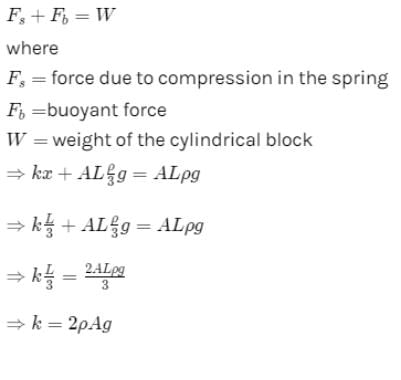
Since the block is at rest, net force on the cylinderical block is zero, ie net upward = net downward force 

Test: Fluid Mechanics - 1 - Question 20

A body of density r' is dropped from rest at a height h into a lake of density r, where r > r'. Neglecting all disipative froces, calculate the maximum depth to which the body sinks before returning of float on the surface.

Test: Fluid Mechanics - 1 - Question 21

Water is flowing in a horizontal pipe of

non-uniform cross - section. At the most contracted place of the pipe –

Detailed Solution: Question 21

Continuity equation states that, "For a non-viscous liquid and streamlined flow the volume flow rate (Area of cross section x velocity) is constant throughout the flow at any point". 
According to this, Av = constant. So if at any point the cross-section area decreases then velocity of liquid at that point increases and vice-versa.
Bernoulli's equation states that, "For a streamlined and non-viscous flow the total energy (kinetic energy and pressure gradient) remains constant throughout the liquid.
According to this, kinetic energy + Pressure gradient = constant. So, if at any point the velocity increases the pressure at that point decreases and vice-versa.
At the most contracted place of the pipe area of cross section is minimum 
⇒ velocity is maximum 
⇒ pressure is minimum

Test: Fluid Mechanics - 1 - Question 22

Water is flowing in a tube of non-uniform radius. The ratio of the radii at entrance and exit ends of tube is 3 : 2. The ratio of the velocities of water entering in and exiting from the tube will be –

Detailed Solution: Question 22

We know, for the fluid flowing through the non-uniform pipe the velocity of fluid is inversely proportional to the area of cross-section.
Hence, if v1, v2 are the velocities of entry and exit end of the pipe and a1, a2 are the area of cross-sections of entry and exit end of the pipe, then
v1/v2=a2/a1
⇒v1/v2​=(r2)2/(r1)2
∴v1/v2​=(2)2/(3)2​=4/9​

Test: Fluid Mechanics - 1 - Question 23

A rectangular tank is placed on a horizontal ground and is filled with water to a height H above the base. A small hole is made on one vertical side at a depth D below the level of the water in the tank. The distance x from the bottom of the tank at which the water jet from the tank will hit the ground is

Detailed Solution: Question 23

Time taken by liquid drop to fall
S=ut+(1/2)​at2
t=√2(H−D)/​​g
Horizontal velocity of liquid =√2gD​
Range =√2(H−D)/g​​× √2gD​
Range =2√D(H−D)

Test: Fluid Mechanics - 1 - Question 24

 A jet of water with cross section of 6 cm2 strikes a wall at an angle of 60º to the normal and rebounds elastically from the wall without losing energy. If the velocity of the water in the jet is 12 m/s, the force acting on the wall is

Detailed Solution: Question 24
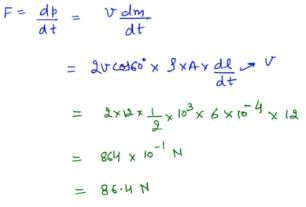
Test: Fluid Mechanics - 1 - Question 25

The cross sectional area of a horizontal tube increases along its length linearly, as we move in the direction of flow. The variation of pressure, as we move along its length in the direction of flow (x-direction), is best depicted by which of the following graphs

Detailed Solution: Question 25
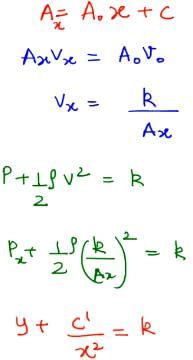

So, it will be a downward facing parabola.

97 videos|376 docs|98 tests
Information about Test: Fluid Mechanics - 1 Page
In this test you can find the Exam questions for Test: Fluid Mechanics - 1 solved & explained in the simplest way possible. Besides giving Questions and answers for Test: Fluid Mechanics - 1, EduRev gives you an ample number of Online tests for practice
97 videos|376 docs|98 tests
Download as PDF