
Gauss-Siedel Method - Free MCQ Practice Test with solutions, GATE EE Power
MCQ Practice Test & Solutions: Test: Gauss-Siedel Method (10 Questions)
You can prepare effectively for Electrical Engineering (EE) Power Systems with this dedicated MCQ Practice Test (available with solutions) on the important topic of "Test: Gauss-Siedel Method". These 10 questions have been designed by the experts with the latest curriculum of Electrical Engineering (EE) 2026, to help you master the concept.
Test Highlights:
- - Format: Multiple Choice Questions (MCQ)
- - Duration: 30 minutes
- - Number of Questions: 10
Sign up on EduRev for free to attempt this test and track your preparation progress.

In G - S method of power flow problem, the number of iterations
Detailed Solution: Question 1






In comparison to Gauss Seidel, Newton Raphson method takes
Detailed Solution: Question 2

Which of the following has a problem in convergence for a system with long radial lines?
Detailed Solution: Question 3
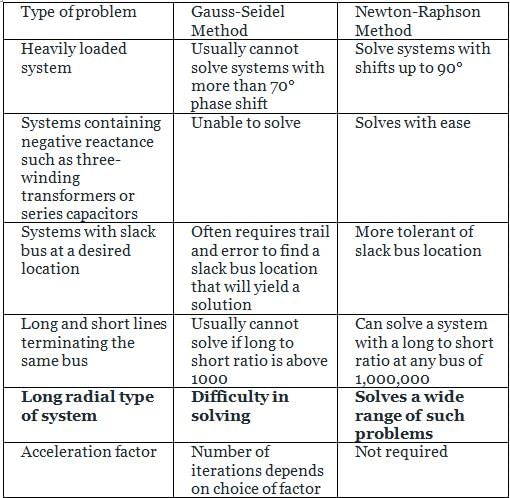
Number of iterations required for convergence of a load flow algorithm increases significantly with increase of number of buses with
Detailed Solution: Question 4
A 500 × 500 bus admittance matrix for an electric power system 4000 non-zero elements the minimum number of branches in this system are –
Detailed Solution: Question 5

For the set of linear equations given below, what is the value of voltage V1 after first iteration of Gauss Siedal method? Assume the initial approximation is V1 = 0
10V1 + 2V2 = 10, 4V1 + 7V2 = 15
10V1 + 2V2 = 10, 4V1 + 7V2 = 15
Detailed Solution: Question 6
In Gauss Seidel method of power flow problem the number of iterations may be reduced if the correction in voltage at each bus is multiplied by
Detailed Solution: Question 7
If the reference bus is changed in two load flow runs with same system data and power obtained for reference bus taken as specified P and Q in the latter run
Detailed Solution: Question 8
The Gauss Seidel load flow method has following disadvantages. Mark the incorrect statement
Detailed Solution: Question 9
In G - S method of power flow problem, the number of iterations
Detailed Solution: Question 10

21 videos|112 docs|45 tests |
