CBSE Class 4  >  Class 4 Test  >  Mathematics  >  Test: Geometry- 2 - Class 4 MCQ

Geometry- 2 - Free MCQ Practice Test with solutions, Class 4 Mathematics


MCQ Practice Test & Solutions: Test: Geometry- 2 (10 Questions)

You can prepare effectively for Class 4 Mathematics for Class 4 with this dedicated MCQ Practice Test (available with solutions) on the important topic of "Test: Geometry- 2". These 10 questions have been designed by the experts with the latest curriculum of Class 4 2026, to help you master the concept.

Test Highlights:

  • - Format: Multiple Choice Questions (MCQ)
  • - Duration: 15 minutes
  • - Number of Questions: 10

Sign up on EduRev for free to attempt this test and track your preparation progress.

Test: Geometry- 2 - Question 1

What is the number of the geometric shapes used to create tangrams?

Detailed Solution: Question 1
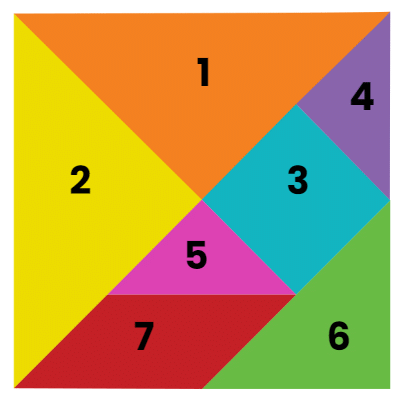
- Tangrams are a type of dissection puzzle consisting of seven flat shapes, known as tans.


- These pieces are typically cut from a square and include:
- 2 large triangles
- 1 medium triangle
- 2 small triangles
- 1 square
- 1 parallelogram
- The objective is to rearrange these pieces to form a specific shape using all seven pieces without overlap.
- The number of geometric shapes in a tangram is seven, making the correct answer B.

Test: Geometry- 2 - Question 2

Which of the following best describes a polygon?

Detailed Solution: Question 2

A polygon is defined as a closed shape made up of three or more straight lines. Examples of polygons include triangles, quadrilaterals, and pentagons. Understanding polygons is fundamental in geometry, as they form the basis for more complex geometric concepts.

Test: Geometry- 2 - Question 3

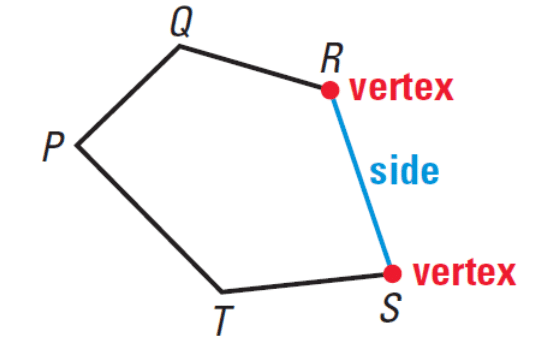
What is the term for the point where two sides of a polygon meet?

Detailed Solution: Question 3

The point where two sides of a polygon meet is called a vertex. Each polygon has a certain number of vertices that correspond to its number of sides. For instance, a triangle has three vertices, while a quadrilateral has four. This concept is essential for analyzing polygon properties.

Test: Geometry- 2 - Question 4

Which of the following shapes is NOT classified as a polygon?

Detailed Solution: Question 4

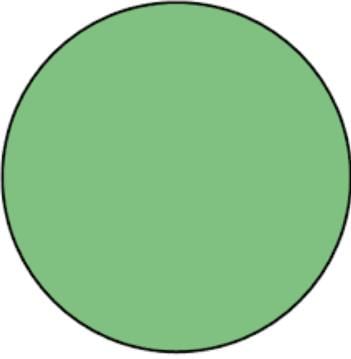
A circle is not classified as a polygon because it does not consist of straight lines. Polygons must be closed figures formed by straight line segments, while circles are defined by their round shape and lack of corners, showcasing the diversity of geometric forms.

Test: Geometry- 2 - Question 5

What is the diameter of a circle?

Detailed Solution: Question 5

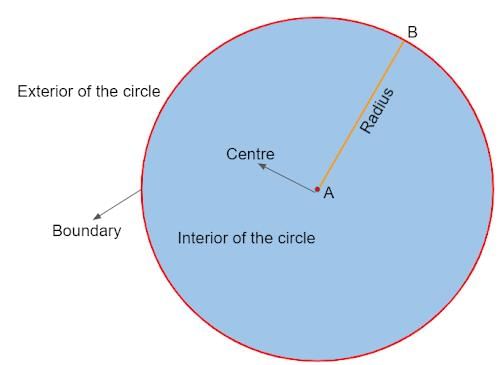
The diameter of a circle is defined as a chord that passes through the center of the circle, effectively dividing it into two equal halves. The diameter is twice the radius, making it a crucial measurement in understanding the properties of circles.

Test: Geometry- 2 - Question 6

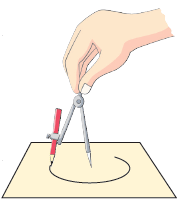
How can a circle be drawn using a piece of thread and a pencil?

Detailed Solution: Question 6

To draw a circle using a piece of thread and a pencil, you can fix one end of the thread to a pin on the paper and attach the pencil to the other end. By holding the thread taut and rotating the pencil around the pin, you create a perfect circle. This method demonstrates the principle of a fixed radius in circle geometry.

Test: Geometry- 2 - Question 7

What is the term for the length of the boundary of a circle?

Detailed Solution: Question 7

The length of the boundary of a circle is called its circumference. The circumference can be calculated using the formula C = 2πr, where r is the radius. Understanding circumference is vital for solving problems related to circular shapes in mathematics.

Test: Geometry- 2 - Question 8

If the radius of a circle is 4 cm, what is the diameter?

Detailed Solution: Question 8

The diameter of a circle can be calculated as twice the radius. Therefore, if the radius is 4 cm, the diameter is 4 cm × 2 = 8 cm. This relationship between the radius and diameter is fundamental in geometry and is essential for various applications.

Test: Geometry- 2 - Question 9

What do we call the area inside a circle?

Detailed Solution: Question 9

The area inside a circle is referred to as the interior of the circle. This area can be calculated using the formula A = πr², where r is the radius. Understanding the interior is important for calculating space and area in geometric problems.

Test: Geometry- 2 - Question 10

In the context of circles, what is a chord?

Detailed Solution: Question 10

A chord is defined as a line segment that joins any two points on the circumference of the circle. Chords can vary in length, with the longest chord being the diameter. Understanding chords is essential for exploring the properties and relationships within circles.

35 videos|168 docs|30 tests
Information about Test: Geometry- 2 Page
In this test you can find the Exam questions for Test: Geometry- 2 solved & explained in the simplest way possible. Besides giving Questions and answers for Test: Geometry- 2, EduRev gives you an ample number of Online tests for practice
35 videos|168 docs|30 tests
Download as PDF