NEET Exam  >  NEET Test  >  Biology Class 12  >  Test: Human Health & Disease - 1 - NEET MCQ

Human Health & Disease - 1 - NEET Biology Class 12 Free MCQ Test with solutions


MCQ Practice Test & Solutions: Test: Human Health & Disease - 1 (15 Questions)

You can prepare effectively for NEET Biology Class 12 with this dedicated MCQ Practice Test (available with solutions) on the important topic of "Test: Human Health & Disease - 1". These 15 questions have been designed by the experts with the latest curriculum of NEET 2026, to help you master the concept.

Test Highlights:

  • - Format: Multiple Choice Questions (MCQ)
  • - Duration: 15 minutes
  • - Number of Questions: 15

Sign up on EduRev for free to attempt this test and track your preparation progress.

Test: Human Health & Disease - 1 - Question 1

Which one of the following is a matching pair of a drug and its category?

Detailed Solution: Question 1

Amphetamines is kind of drug which is used as stimulant. It is a strong CNS stimulant that is used in the treatment of ADHD. Lysergic acid dimethyl amide is not a narcotic and heroin is not a psychotropic agent.

Topic in NCERT: Addiction and dependence

Line in NCERT: "drugs like barbiturates, amphetamines, benzodiazepines, and other similar drugs, that are normally used as medicines to help patients cope with mental illnesses like depression and insomnia, are often abused."
Test: Human Health & Disease - 1 - Question 2

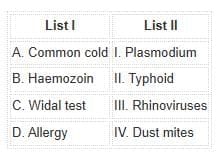
Match List I with List II:
Detailed Solution: Question 2


  • Common cold is caused by Rhinoviruses.
  • Haemozoin is a toxic pigment released by Plasmodium during malaria infection.
  • Widal test is used for the diagnosis of Typhoid caused by Salmonella typhi.
  • Allergy is commonly caused by allergens like dust mites.

Hence, A-III, B-I, C-II, D-IV is correct.

Test: Human Health & Disease - 1 - Question 3

Match List I with List II:

Choose the correct answer from the options given below:

Detailed Solution: Question 3


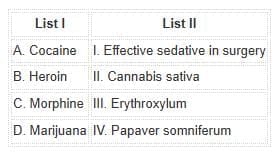
  • Cocaine is obtained from Erythroxylum coca.
  • Heroin is derived from Papaver somniferum (opium poppy).
  • Morphine acts as an effective sedative and pain reliever used in surgery.
  • Marijuana is obtained from Cannabis sativa.

Thus, A-III, B-IV, C-I, D-II is correct.

Test: Human Health & Disease - 1 - Question 4

Match List I with List II:

Choose the correct answer from the options given below.

Detailed Solution: Question 4

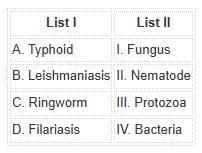
  • Typhoid is caused by Salmonella typhi (Bacterium).
  • Leishmaniasis is caused by Leishmania (Protozoan parasite).
  • Ringworm is caused by fungi such as Microsporum or Trichophyton.
  • Filariasis is caused by a nematode (Wuchereria bancrofti).

Hence, A-IV, B-III, C-I, D-II is correct.

Test: Human Health & Disease - 1 - Question 5

Given below are two statements:

Statement I: Bone marrow is the main lymphoid organ where all blood cells, including lymphocytes, are produced.

Statement II: Both bone marrow and thymus provide microenvironments for the development and maturation of T-lymphocytes.

Choose the most appropriate answer from the options given below:

Detailed Solution: Question 5

Statement I: Bone marrow is the main lymphoid organ where all blood cells, including lymphocytes, are produced.

This is correct because:

  • Bone marrow is the primary lymphoid organ.

  • All blood cells, including lymphocytes (B-cells and T-cell precursors), are formed in the bone marrow.

So, Statement I is correct.

Statement II: Both bone marrow and thymus provide microenvironments for the development and maturation of T-lymphocytes.

This is also considered correct at the Class 12 level because:

  • In the bone marrow, the earliest T-cell precursors (pro-T cells) are formed.
    This is the first step in T-cell development.

  • These immature cells then move to the thymus, where they develop and mature into fully functional T-lymphocytes.

So, both organs together help in the development pathway of T-cells:

  • Bone marrow → formation of T-cell precursors

  • Thymus → development and maturation of T-cells

Test: Human Health & Disease - 1 - Question 6

Assertion (A): Some human organs like liver, kidney fail to function normally and transplantation is the only remedy to enable the patient to live a normal life.

Reason (R): Tissue matching and blood group matching are essential before undertaking any transplant and patient has to take immunosuppressant thereafter.

Choose the correct answer from the options given below:

Detailed Solution: Question 6

Assertion (A): True
Sometimes organs such as the liver or kidney may fail due to disease or damage, and in severe cases organ transplantation becomes the only effective treatment to allow the patient to survive and live normally.

Reason (R): True
Before transplantation:

  • Blood group and tissue matching are necessary to reduce the chances of rejection.

  • After transplant, the patient must take immunosuppressant drugs to prevent the immune system from attacking the transplanted organ.

Why (R) is not the correct explanation of (A):
The reason only describes procedures and precautions involved in transplantation, not why transplantation becomes necessary when organs fail.

Therefore, both statements are correct, but the reason does not explain the assertion.

Test: Human Health & Disease - 1 - Question 7

Which is the particular type of drug that is obtained from the plants whose one flowering branch is shown below? 
      

Detailed Solution: Question 7

The image of above flowering plant shown is of Datura and it is well-known plant for its hallucinogenic properties.

Test: Human Health & Disease - 1 - Question 8

Allergic reactions primarily involve which of the following immunoglobulins and chemical mediators?

Detailed Solution: Question 8

Allergies are hypersensitivity reactions involving IgE antibodies bound to mast cells. Upon exposure to allergens, these cells release histamine and serotonin, producing symptoms like sneezing and difficulty in breathing.

Test: Human Health & Disease - 1 - Question 9

Which of the following statements about autoimmune diseases is correct?

Detailed Solution: Question 9

Autoimmune diseases arise when the immune system attacks self-antigens, mistaking them for foreign molecules. This leads to tissue damage, as seen in rheumatoid arthritis.

Test: Human Health & Disease - 1 - Question 10

Which of the following pairs is correctly matched regarding type of tumor and its property?

Detailed Solution: Question 10

Benign tumors remain localized and do not invade other tissues. Malignant tumors invade and destroy nearby tissues and can metastasize to distant organs through blood or lymph.

Test: Human Health & Disease - 1 - Question 11

Which among the following is a biological agent capable of inducing cancer in humans?

Detailed Solution: Question 11

Oncogenic viruses contain viral oncogenes that can transform normal cells into cancerous ones. Examples include certain DNA and RNA viruses responsible for specific cancers.

Test: Human Health & Disease - 1 - Question 12

Which diagnostic technique relies on non-ionising radiations and strong magnetic fields to detect internal abnormalities?

Detailed Solution: Question 12

MRI (Magnetic Resonance Imaging) uses non-ionising radiation and strong magnetic fields to detect structural and physiological changes within tissues, providing high-resolution internal images.

Test: Human Health & Disease - 1 - Question 13

Which of the following lymphoid organs is primarily responsible for the maturation of T-lymphocytes?

Detailed Solution: Question 13

The thymus is the primary lymphoid organ where T-lymphocytes mature and become antigen-sensitive. The bone marrow produces all blood cells, including lymphocytes, but T-cell maturation occurs in the thymus.

Test: Human Health & Disease - 1 - Question 14

Which of the following statements regarding AIDS is incorrect?

Detailed Solution: Question 14

HIV is transmitted via sexual contact, contaminated needles, blood transfusion, or from mother to child through placenta, not through food or water. ELISA is used for HIV detection.

Test: Human Health & Disease - 1 - Question 15

Which of the following properties is lost in cancer cells leading to uncontrolled growth?

Detailed Solution: Question 15

Normal cells exhibit contact inhibition, stopping division upon contact with other cells. Cancer cells lose this property, leading to uncontrolled proliferation and tumor formation.

69 videos|305 docs|161 tests
Information about Test: Human Health & Disease - 1 Page
In this test you can find the Exam questions for Test: Human Health & Disease - 1 solved & explained in the simplest way possible. Besides giving Questions and answers for Test: Human Health & Disease - 1, EduRev gives you an ample number of Online tests for practice
69 videos|305 docs|161 tests
Download as PDF