Electrical Engineering (EE) Exam  >  Electrical Engineering (EE) Test  >  Basic Electrical Technology  >  Test: Kirchhoff’s Laws & Network Solutions - Electrical Engineering (EE) MCQ

Kirchhoff’s Laws & Network Solutions - Free MCQ Practice Test with solutions,


MCQ Practice Test & Solutions: Test: Kirchhoff’s Laws & Network Solutions (15 Questions)

You can prepare effectively for Electrical Engineering (EE) Basic Electrical Technology with this dedicated MCQ Practice Test (available with solutions) on the important topic of "Test: Kirchhoff’s Laws & Network Solutions". These 15 questions have been designed by the experts with the latest curriculum of Electrical Engineering (EE) 2026, to help you master the concept.

Test Highlights:

  • - Format: Multiple Choice Questions (MCQ)
  • - Duration: 10 minutes
  • - Number of Questions: 15

Sign up on EduRev for free to attempt this test and track your preparation progress.

Test: Kirchhoff’s Laws & Network Solutions - Question 1

​​​The algebraic sum of voltages around any closed loop circuit is equal to:

Detailed Solution: Question 1
Sum of voltage drops + Sum of voltage rise = 0

Test: Kirchhoff’s Laws & Network Solutions - Question 2

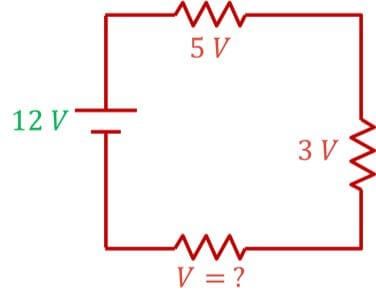
In circuit below voltage V is:

​​​​​

Detailed Solution: Question 2

Σ Voltage rise = Σ Voltage drop

12 V = 5 V + 3 V + V

V = 12 – 5 – 3 = 4 V

Test: Kirchhoff’s Laws & Network Solutions - Question 3

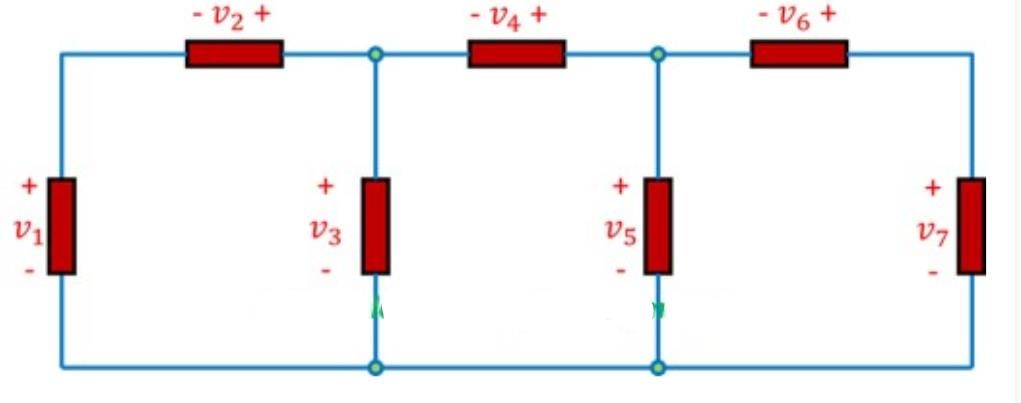
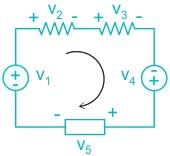
The loop equation for central loop of circuit is:
Detailed Solution: Question 3

According to Kirchhoff's Voltage Law:

V3 + V4 - V= 0

Hence,

V3 + V4 = V5

Test: Kirchhoff’s Laws & Network Solutions - Question 4

The value of unknown voltage source V1 in circuit given below is:
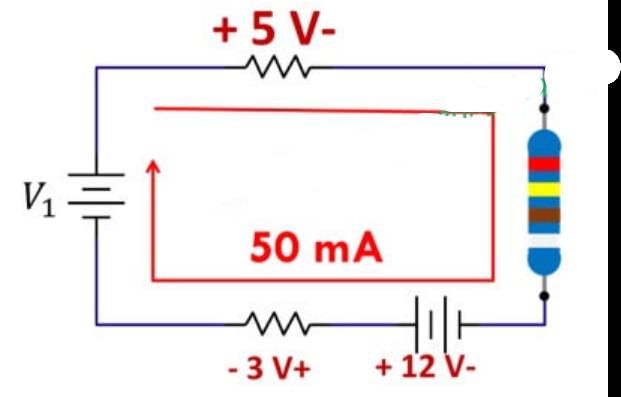
Resistor colors: Red Yellow Brown Gray

Detailed Solution: Question 4

Resistor color coding: Red Yellow Brown Gray = 240 Ω ±10%

For resistor V = IR = 50 mA * 240 ohms = 12 V

Applying Kirchhoff’s voltage law:

Σ Voltage rise = Σ Voltage drop

V1 + 12 V = 12 V + 3 V + 5 V

V1 = 20 V – 12 V = 8 V

Test: Kirchhoff’s Laws & Network Solutions - Question 5

Which of the following expression correctly represents Kirchhop's Voltage Law (KVL) for the given circuit diagram?
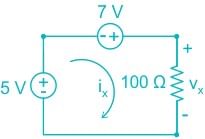
Detailed Solution: Question 5
Kirchhoffs Voltage Law (KVL):

  • Kirchhoffs Voltage Law or KVL, states that “in any closed loop network, the total voltage around the loop is equal to the sum of all the voltage drops within the same loop” which is also equal to zero.
  • In other words, the algebraic sum of all voltages within the loop must be equal to zero i.e. ∑V = 0
  • KVL is based on the law of conservation of energy.

Consider the figure shown below:

∴ According to KVL,

V1 + V2 + V3 + V4 + V5 = 0

Calculation:

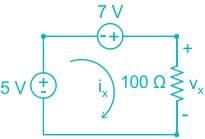
The circuit diagram given in the question can be modified as:

Now by applying KVL in the above circuit, we get

5 + 7 - Vx = 0

∴ - 5 - 7 + Vx = 0

Test: Kirchhoff’s Laws & Network Solutions - Question 6

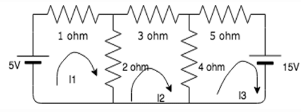
Find the value of I1, I2 and I3.

Detailed Solution: Question 6

Correct option: C. The calculated values are I1 = 1.5 A, I2 = -0.188 A and I3 = -1.19 A (rounded).

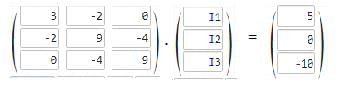
Writing mesh KVL equations for the three clockwise mesh currents gives the linear system:

3I1 - 2I2 = 5

-2I1 + 9I2 - 4I3 = 0

-4I2 + 9I3 = -10

In the first equation the coefficient 3 is 1 Ω + 2 Ω (top and shared bottom resistor) and -2 is the shared 2 Ω to the middle mesh. The third equation has 9 = 5 Ω + 4 Ω and the RHS is -10 V from the right-hand source orientation.

From the first equation I1 = (5 + 2I2)/3.

Substituting into the second and simplifying yields 23I2 - 12I3 = 10.

From the third equation I3 = (4I2 - 10)/9.

Substituting this into 23I2 - 12I3 = 10 and solving gives I2 = -10/53 ≈ -0.188 A.

Then I1 = (5 + 2I2)/3 = 245/159 ≈ 1.54 A, which rounds to 1.5 A as given in the options.

Finally I3 = -190/159 ≈ -1.195 A, rounded to -1.19 A.

Therefore, after standard rounding used in the options, I1 = 1.5 A, I2 = -0.188 A, I3 = -1.19 A, so option C is the correct choice.

Test: Kirchhoff’s Laws & Network Solutions - Question 7

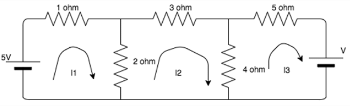
 Find the value of V, if the value of I3= 0A.
Detailed Solution: Question 7

5 -3 (I1) + 2 (I2) = 0

9 (I2) - 2(I1) = 0

-4 (I2) + V = 0
On solving,V = 1.739 V.

Test: Kirchhoff’s Laws & Network Solutions - Question 8

Find the value of R if the power in the circuit is 1000W.

Detailed Solution: Question 8

To find the value of I:

V*I = P

=> 100*I = 1000

=> I = 10A

  • Voltage across the 2 ohm resistor
    = 20V
  • Voltage across the R resistor
    = 100 - 20 = 80 V

R = V / I

=> R = 80 / 10 = 8 ohm.

Test: Kirchhoff’s Laws & Network Solutions - Question 9

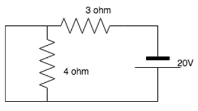
Find the current in the 4 ohm resistor.
Detailed Solution: Question 9

  • The 4 ohm resistor gets shorted since current always prefers the low resistance path.
  • All the current flows to the branch which is connected in parallel to the 4 ohm branch, hence no current flows in the 4 ohm resistance.

Test: Kirchhoff’s Laws & Network Solutions - Question 10

Nodal analysis is generally used to determine_______

Detailed Solution: Question 10

Nodal analysis uses Kirchhoff’s Current Law to find all the node voltages.

Hence it is a method used to determine voltage.

Test: Kirchhoff’s Laws & Network Solutions - Question 11

Mesh analysis is generally used to determine_________

Detailed Solution: Question 11
Mesh analysis uses Kirchhoff’s Voltage Law to find all the mesh currents.

Hence it is a method used to determine current.

Test: Kirchhoff’s Laws & Network Solutions - Question 12

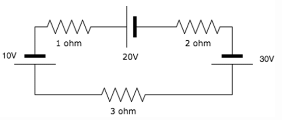
What is the current in the circuit?

Detailed Solution: Question 12

If we move in the clockwise direction, we get the total voltage to be equal to:

-10 - 20 + 30 = 0V

Since I = V / R = 0 / 4 = 0

I = 0 A

Test: Kirchhoff’s Laws & Network Solutions - Question 13

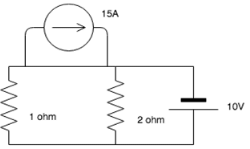
 Does the 15A source have any effect on the circuit?
Detailed Solution: Question 13

 The 15A current source has a lower resistance path associated with it and hence it keeps moving in that particular loop.

It does not leave that loop and enter the circuit, hence the circuit is not affected by it.

Test: Kirchhoff’s Laws & Network Solutions - Question 14

KVL is associated with____________

Detailed Solution: Question 14

KVL employs mesh analysis to find the different mesh currents by finding the I*R products in each mesh.

Test: Kirchhoff’s Laws & Network Solutions - Question 15

Kirchhoff's laws are valid for

Detailed Solution: Question 15

Concept of Kirchoff's Laws:

  • Kirchhoff’s laws are used for voltage and current calculations in electrical circuits.
  • These laws can be understood from the results of the Maxwell equations in the low-frequency limit.
  • They are applicable for DC and AC circuits at low frequencies where the electromagnetic radiation wavelengths are very large when we compare with other circuits. So they are only applicable for lumped parameter networks.

Kirchhoff's laws (KCL and KVL) is applicable to networks that are:

  1. Unilateral or bilateral 
  2. Active or passive 
  3. Linear or non-linear
  4. Lumped network

76 docs|62 tests
Information about Test: Kirchhoff’s Laws & Network Solutions Page
In this test you can find the Exam questions for Test: Kirchhoff’s Laws & Network Solutions solved & explained in the simplest way possible. Besides giving Questions and answers for Test: Kirchhoff’s Laws & Network Solutions, EduRev gives you an ample number of Online tests for practice
Download as PDF