NEET Exam  >  NEET Test  >  Physics Class 12  >  Test: Nuclei: Radioactivity - NEET MCQ

Nuclei: Radioactivity - Free MCQ Practice Test with solutions, NEET Physics


MCQ Practice Test & Solutions: Test: Nuclei: Radioactivity (5 Questions)

You can prepare effectively for NEET Physics Class 12 with this dedicated MCQ Practice Test (available with solutions) on the important topic of "Test: Nuclei: Radioactivity". These 5 questions have been designed by the experts with the latest curriculum of NEET 2026, to help you master the concept.

Test Highlights:

  • - Format: Multiple Choice Questions (MCQ)
  • - Duration: 10 minutes
  • - Number of Questions: 5

Sign up on EduRev for free to attempt this test and track your preparation progress.

Test: Nuclei: Radioactivity - Question 1

The control rods in a nuclear reactor

Detailed Solution: Question 1

Control rods are used in nuclear reactors to control the fission rate of uranium and plutonium. They are composed of chemical elements such as boron, silver, indium and cadmium that are capable of absorbing many neutrons without themselves fissioning.

Test: Nuclei: Radioactivity - Question 2

A sample of radioactive material contains 1018 atoms. The half life of the material is 2 days, then the activity of the sample is​

Detailed Solution: Question 2

To find activity of the sample --->which is the rate of disintegration.

Since radioactivity comes under 1o kinetics.

[R]=k[A]     [A]-->amount of initial sample 1018 atoms

Given,

Half-life=2days

K=0.693/2x24x60x60 sec

R=(0.693/2x24x60x60)x1018

R≈3.5x10¹² Bq

Test: Nuclei: Radioactivity - Question 3

γ (Gamma) rays are​

Detailed Solution: Question 3

A gamma ray, or gamma radiation, is a penetrating form of electromagnetic radiation arising from the radioactive decay of atomic nuclei. It consists of the shortest wavelength electromagnetic waves and so imparts the highest photon energy.

Test: Nuclei: Radioactivity - Question 4

When a radioactive nucleus emits a β – particle, the mass number of the atom

Detailed Solution: Question 4
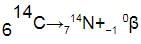
A beta particle forms when a neutron changes the mass number stays the same.
Example
Carbon-14 decays into nitrogen-14 by emitting a beta particle. This is the balanced equation for the reaction:

Notice that:

  • the mass number of the nucleus stays the same, 14
  • the atomic number of the nucleus increases by 1, from 6 to 7
  • the numbers at the top and bottom give the same totals on both sides, as (7 - 1) = 6

Nitrogen nuclei have 7 protons, so their nuclear charge is +7. They have one more proton than carbon nuclei, which have 6 protons and so a nuclear charge of +6.
 

Test: Nuclei: Radioactivity - Question 5

The number of protons or atomic number is reduced to 2 by which form of radioactive decay?

Detailed Solution: Question 5

In alpha decay, an atomic nucleus emits an alpha particle, which consists of two protons and two neutrons. This emission results in the reduction of the atomic number by 2 and the mass number by 4.

74 videos|347 docs|82 tests
Information about Test: Nuclei: Radioactivity Page
In this test you can find the Exam questions for Test: Nuclei: Radioactivity solved & explained in the simplest way possible. Besides giving Questions and answers for Test: Nuclei: Radioactivity, EduRev gives you an ample number of Online tests for practice
74 videos|347 docs|82 tests
Download as PDF