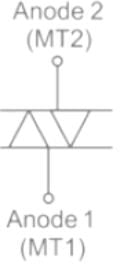
Electrical Engineering (EE) Exam  >  Electrical Engineering (EE) Test  >  Power Electronics  >  Test: Other members of thyristor family - Electrical Engineering (EE) MCQ

Other members of thyristor family - Free MCQ Practice Test with solutions,


MCQ Practice Test & Solutions: Test: Other members of thyristor family (10 Questions)

You can prepare effectively for Electrical Engineering (EE) Power Electronics with this dedicated MCQ Practice Test (available with solutions) on the important topic of "Test: Other members of thyristor family". These 10 questions have been designed by the experts with the latest curriculum of Electrical Engineering (EE) 2026, to help you master the concept.

Test Highlights:

  • - Format: Multiple Choice Questions (MCQ)
  • - Duration: 30 minutes
  • - Number of Questions: 10

Sign up on EduRev for free to attempt this test and track your preparation progress.

Test: Other members of thyristor family - Question 1

What is the total anode current of SCR in the equivalent circuit from the two-transistor (T1 & T2) analogy of SCR?

Detailed Solution: Question 1
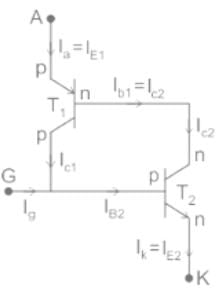
The relation between the collector current and emitter current is shown below.


Here, IC is collector current, IE is emitter current

Two transistor model of the SCR bisecting the SCRs middle two layers.

  • The two-transistor equivalent circuit shows that the collector current of the NPN transistor T2 feeds directly into the base of the PNP transistor T1, while the collector current of T1 feeds into the base of T2.
  • These two inter-connected transistors rely upon each other for conduction as each transistor gets its base-emitter current from the other’s collector-emitter current.
  • So, until one of the transistors is given some base current nothing can happen even if an Anode-to-Cathode voltage is present.
  • IB1 = IC2; anode current is Ia = IC1 + IB1 = IC1 + IC2 i.e. total anode current of SCR in the equivalent circuit from the two-transistor (T1 &T2) analogy of SCR is the sum of both the collector current.
  • If applied gate current is Ig then cathode current will be the summation of anode current and gate current i.e. IK = Ia + Ig

Test: Other members of thyristor family - Question 2

TRIAC is used in

Detailed Solution: Question 2

TRIAC Application:

TRIAC is used in Colour TV sets.

It has the capacity to obtain current up to 25 A (500 V).

Apart from Colour TV sets, TRIAC is also used in the following equipment:

  • Control the power of AC circuit by means of switching operation
  • Controlling of the lighting circuit
  • Controlling the temperature of electric furnace
  • Speed control of electric motor
  • Reduction of radio interference
  • AC Voltage regulator

Test: Other members of thyristor family - Question 3

A triac is a semi-conductor device which acts as a

Detailed Solution: Question 3
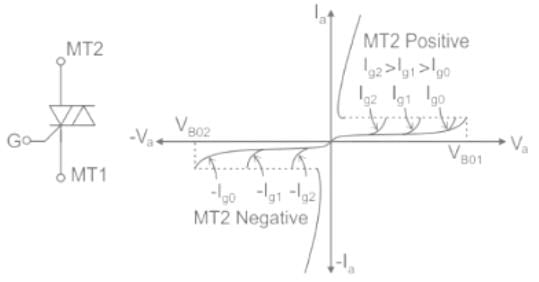
Triac:

  • A Triac is a bidirectional thyristor with three terminals i.e. it can conduct in both directions.
  • Its three terminals are usually designated as MT1 (Anode 1), MT2 (Anode 2), and the gate by G as in a thyristor.
  • When in operation, a Triac is equivalent to two SCRs connected in antiparallel.
  • As the Triac can conduct in both directions, the terms anode and cathode are not applicable to Triac.
  • It is used extensively for the control of power in ac circuits.
     

The symbol and the i-v characteristics of triac are shown below.

A triac may sometimes operate in the rectifier mode rather than in the bidirectional mode. This may happen due to the following reasons.

  • For a given value of positive gate current, a triac may turn on with MT2 positive in the first quadrant but may fail to turn on with MT2 negative.
  • With constant negative gate current, the triac may turn on with MT2 negative in the third quadrant but may not turn on with MT2 positive.

Test: Other members of thyristor family - Question 4

Which of the following is used for turning ON DIAC?

Detailed Solution: Question 4
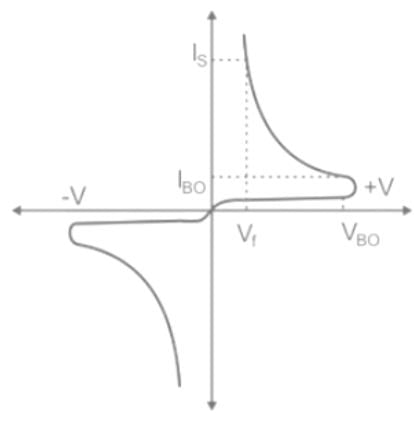
DIAC:

  • The DIAC is a diode that conducts electrical current only after its break over-voltage, VBO, has been reached momentarily.
  • A DIAC is equivalent to a pair of four-layer SCRs.
  • A DIAC has two PN terminals.

Test: Other members of thyristor family - Question 5

The SCR is turned OFF when the anode current is ______ holding current

Detailed Solution: Question 5

The turn-off time of SCR:

  • Once the thyristor is switched ON (the anode current is above latching current), the gate loses control over it. That means the gate circuit cannot turn off the device.
  • For turning off the SCR anode current must fall below the holding current. After the anode current falls to zero, we cannot apply a forward voltage across the device due to the presence of the carrier. So, we must sweep out or recombine these charges to proper turn off of SCR.
  • So, the turn-off time of SCR can be defined as the interval between anode current falls to zero and the device regains its forward blocking mode.
     

Circuit turn-off time:

  • It is defined as the time during which a reverse voltage is applied across the thyristor during its commutation process.
  • ​An SCR is turned off when its turn-off time is less than the circuit turn-off time.

Note:

  • If the circuit turn-off time is less than the device turn-off time then forward bias voltage gets applied across even before the thyristor could regain its forward blocking capabilities and gets turn on again or the device turn-off is unsuccessful.

Test: Other members of thyristor family - Question 6

How many terminals are in DIAC ?

Detailed Solution: Question 6

he DIAC is a 2-terminal semiconductor device and may be considered equivalent to two diodes connected in antiparallel.

Test: Other members of thyristor family - Question 7

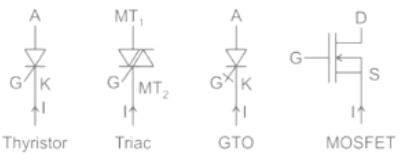
Four power semiconductor devices are shown in the figure along with their relevant terminals. The device(s) that can carry dc current continuously in the direction shown when gated appropriately is (are)
Detailed Solution: Question 7

Thyristor allows the conduction of current from anode to cathode. Hence, the current cant flow in the given direction.

Triac can allow current in both directions. Hence, the current can flow in a given direction.

The MOSFET is a bidirectional device. Hence, the current can flow in a given direction.

GTO is a unidirectional device. Hence, the current can't flow in the given direction.

Test: Other members of thyristor family - Question 8

Which of the following is NOT an advantage of SCR as a switch?

Detailed Solution: Question 8

Advantages of SCR:

  • It can handle large voltages, currents, and power.
  • The voltage drop across conducting SCR is small. This will reduce the power dissipation in the SCR.
  • Easy to turn on.
  • The operation does not produce harmonics.
  • Triggering circuits are simple.
  • It has no moving parts.
  • It gives noiseless operation at high efficiency.
  • We can control the power delivered to the load.

 
Drawbacks of SCR:

  • It can conduct only in one direction. So it can control power only during the one-half cycle of ac.
  • It can turn on accidentally due to the high dv/dt of the source voltage.
  • It is not easy to turn off the conducting SCR. We have to use special circuits called commutation circuits to turn off a conducting SCR.
  • SCR cannot be used at high frequencies or perform high-speed operations. The maximum frequency of its operation is 400 Hz.
  • Gate current cannot be negative.

Applications of SCR: Controlled rectifiers, DC to DC converters or choppers, DC to AC converters or inverters, As a static switch, Battery chargers, Speed control of DC and AC motors, Lamp dimmers, fan speed regulators, AC voltage stabilizers.

Test: Other members of thyristor family - Question 9

Which one of the following is/are not true with reference to a thyristor?

1. Latching current (IL) is associated with the turn-off process and holding current (IH) with the turn-on process.
2. Holding current is associated with the turn-off process and latching current with the turn-on process
3. A thyristor can be termed as an AC switch

Detailed Solution: Question 9
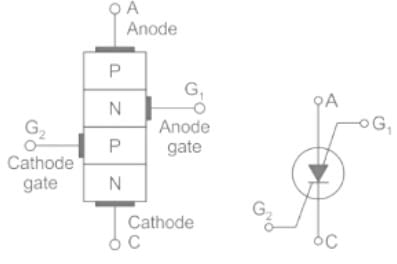
Silicon Controlled Rectifier is a device that has four layers and three PN junctions. The silicon control rectifier (SCR) consists of four layers of semiconductors, which form NPNP or PNPN structures, having three P-N junctions labeled J1, J2 and J3, and three terminals.

  • The anode terminal of an SCR is connected to the p-type material of a PNPN structure, and the cathode terminal is connected to the n-type layer, while the gate of the SCR is connected to the p-type material nearest to the cathode.
  • A thyristor or SCR (silicon-controlled rectifier) can only conduct in one direction so it is mostly called a DC switch.

 
Latching & Holding Current:

  • Latching Current is the minimum anode current required to maintain the thyristor in the ON state immediately after a thyristor has been turned on and the the gate signal has been removed.
  • Holding Current is the minimum anode current to maintain the thyristor in the on-state.
  • Latching current is always greater than holding current.
  • Latching current is the minimum value of anode current which it must attain during turn – ON process to maintain conduction when gate signal is removed.
  • Holding current is the minimum value of anode current below which it must fall for turning – OFF the thyristor.

Test: Other members of thyristor family - Question 10

Consider the following devices:
1. TRIAC
2. GTO
3. BJT
4. MOSFET
5. DIAC
Which of these devices does not belong to the family of thyristors?

Detailed Solution: Question 10
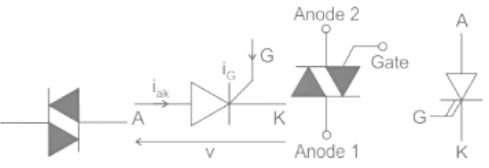
The P-N-P-N devices with zero, one or two gates constitute the basic thyristor. But with the advancement in technology thyristor family includes other similar multilayer devices also.

Devices in Thyristor family:

The following symbols represent DIAC, SCR, TRIAC, and GTO respectively.

  • The most important member is SCR (silicon-controlled rectifier); It is a four-layer (P-N-P-N), three junction semiconductor devices with three terminals, namely, the anode, the cathode, and the gate; It is a unidirectional device
  • DIAC and TRIAC are bidirectional devices, The DIAC is a two-terminal, three-layer device and is commonly used for triggering TRIACs; The TRIAC is a 3-terminal semiconductor device and may be considered equivalent to two SCRs connected in antiparallel
  • A gate turn-off thyristor (GTO) is a special type of thyristor, which is a high-power semiconductor device; Normal thyristors (silicon-controlled rectifiers) are not fully controllable switches but GTO can be Turned ON as well as Turned OFF using Gate signal
  • A bipolar junction transistor (bipolar transistor or BJT) is a type of transistor that uses both electrons and holes as charge carriers; BJTs can be used as amplifiers or switches

5 videos|78 docs|46 tests
Information about Test: Other members of thyristor family Page
In this test you can find the Exam questions for Test: Other members of thyristor family solved & explained in the simplest way possible. Besides giving Questions and answers for Test: Other members of thyristor family, EduRev gives you an ample number of Online tests for practice
5 videos|78 docs|46 tests
Download as PDF