Chemistry Exam  >  Chemistry Test  >  Organic   >  Test: Oxidizing and Reducing Reagents - Chemistry MCQ

Oxidizing and Reducing Reagents - Free MCQ Practice Test with solutions,


MCQ Practice Test & Solutions: Test: Oxidizing and Reducing Reagents (10 Questions)

You can prepare effectively for Chemistry Organic Chemistry with this dedicated MCQ Practice Test (available with solutions) on the important topic of "Test: Oxidizing and Reducing Reagents ". These 10 questions have been designed by the experts with the latest curriculum of Chemistry 2026, to help you master the concept.

Test Highlights:

  • - Format: Multiple Choice Questions (MCQ)
  • - Duration: 30 minutes
  • - Number of Questions: 10

Sign up on EduRev for free to attempt this test and track your preparation progress.

Test: Oxidizing and Reducing Reagents - Question 1

How many isomers of C4H8O when reacts with CH3MgBr followed by acidification to alcohol (only consider carbonyl isomers and Including stereoisomers)?

Detailed Solution: Question 1
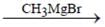
C4H8O  2° Alcohol, if we consider only carbonyl isomer.
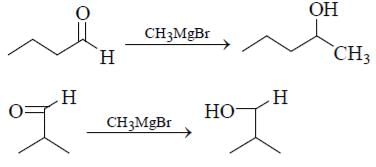
We Will 2 ismoers as shown below.

Test: Oxidizing and Reducing Reagents - Question 2

How can we prepare RR’ R” OH by the action of excess of a suitable Grignard reagent on which of the following reactants?

Detailed Solution: Question 2
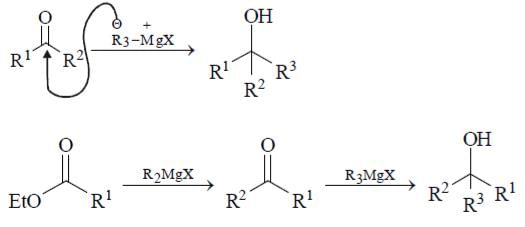
Preparation of 3° alcohol from ketone and ester by the action of excess of a suitable Grignard reagent is carried out as shown below:

Test: Oxidizing and Reducing Reagents - Question 3

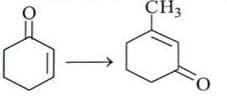
Which is the correct combination of reagent which can carry out following conversion?
Detailed Solution: Question 3

Here CH3 will attack at C=O and dehydration will take pass and again water will attack at meta position as a nucleophile at the ring. PCC will covert -OH into = O.

Test: Oxidizing and Reducing Reagents - Question 4

Which is the mildest reducing agent which reduces only carbonyl group in presence of nitro, carboxyl, double bond and ester groups?

Detailed Solution: Question 4

NaBH4 is mild reducing agent for this conversion. It is very effective for the reduction of aldehydes and ketones to alcohols. By itself, it will generally not reduce esters, carboxylic acids, or amides (although it will reduce acyl chlorides to alcohols).

Test: Oxidizing and Reducing Reagents - Question 5

Which of the will give effective reduction of 3-hexyne to trans-3-hexene?

Detailed Solution: Question 5

Na/liq. NH3 will give an effective reduction for the following case:

Test: Oxidizing and Reducing Reagents - Question 6

How acetophenone can be converted to phenol by reaction?

Detailed Solution: Question 6


m-CPBA can convert ketone into amide and after ester hydrolysis it is reduced into phenol.

Test: Oxidizing and Reducing Reagents - Question 7

What will be the product for the given reactant and reagents?

Detailed Solution: Question 7
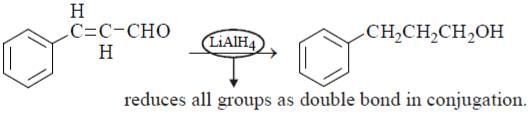
LiAlH4 will reduce double bond into single bond and aldehyde group into alcohol.

Test: Oxidizing and Reducing Reagents - Question 8

Which of the reagent will give effective transformation of given compounds?
Detailed Solution: Question 8

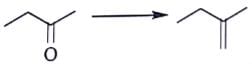
Ph3P = CH2 will give the most effective transformation of ketone into alkene (Wittig reaction). The Wittig reaction is a popular method for the synthesis of alkene from ketones and aldehydes. The Wittig reagent can generally tolerate carbonyl compounds containing several kinds of functional groups such as OH, OR, aromatic nitro and even ester groups.

Test: Oxidizing and Reducing Reagents - Question 9

Which is the suitable catalyst for bringing out the transformation given below?

Detailed Solution: Question 9

BF3 increases the electrophilicity of carbonyl carbon due to which sulphur attacks on carbonyl carbon.

Test: Oxidizing and Reducing Reagents - Question 10

What reagent sequence can be used to carry out the following transformation?

Cyclohexene → Adipic acid (hexanedioic acid)

Detailed Solution: Question 10


  • Cyclohexene is a simple alkene, and the goal is to convert it into adipic acid, a dicarboxylic acid.

  • Ozonolysis of alkenes breaks the double bond, forming carbonyl compounds. In this case, it cleaves the cyclohexene ring into two aldehyde groups.

  • Subsequent oxidation with KMnO4 converts these aldehyde groups into carboxylic acids.

  • This two-step process effectively transforms cyclohexene into adipic acid, a 6-carbon diacid.

  • Option A is the correct sequence: Ozonolysis followed by oxidation with KMnO4.


  •  

39 videos|96 docs|46 tests
Information about Test: Oxidizing and Reducing Reagents Page
In this test you can find the Exam questions for Test: Oxidizing and Reducing Reagents solved & explained in the simplest way possible. Besides giving Questions and answers for Test: Oxidizing and Reducing Reagents , EduRev gives you an ample number of Online tests for practice
39 videos|96 docs|46 tests
Download as PDF