Electrical Engineering (EE) Exam  >  Electrical Engineering (EE) Test  >  GATE Mock Test Series 2027  >  Test: Performance of Transmission Lines, Line Parameters & Corona of Power Systems - Electrical Engineering (EE) MCQ

GATE Electrical Engineering (EE) Test: Performance of Transmission Lines,


MCQ Practice Test & Solutions: Test: Performance of Transmission Lines, Line Parameters & Corona of Power Systems (10 Questions)

You can prepare effectively for Electrical Engineering (EE) GATE Electrical Engineering (EE) Mock Test Series 2027 with this dedicated MCQ Practice Test (available with solutions) on the important topic of "Test: Performance of Transmission Lines, Line Parameters & Corona of Power Systems". These 10 questions have been designed by the experts with the latest curriculum of Electrical Engineering (EE) 2026, to help you master the concept.

Test Highlights:

  • - Format: Multiple Choice Questions (MCQ)
  • - Duration: 30 minutes
  • - Number of Questions: 10

Sign up on EduRev for free to attempt this test and track your preparation progress.

Test: Performance of Transmission Lines, Line Parameters & Corona of Power Systems - Question 1

The bus admittance (Ybus ) matrix of a 3-bus power system is given below.
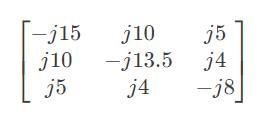
Considering that there is no shunt inductor connected to any of the buses, which of the following can NOT be true?

Detailed Solution: Question 1
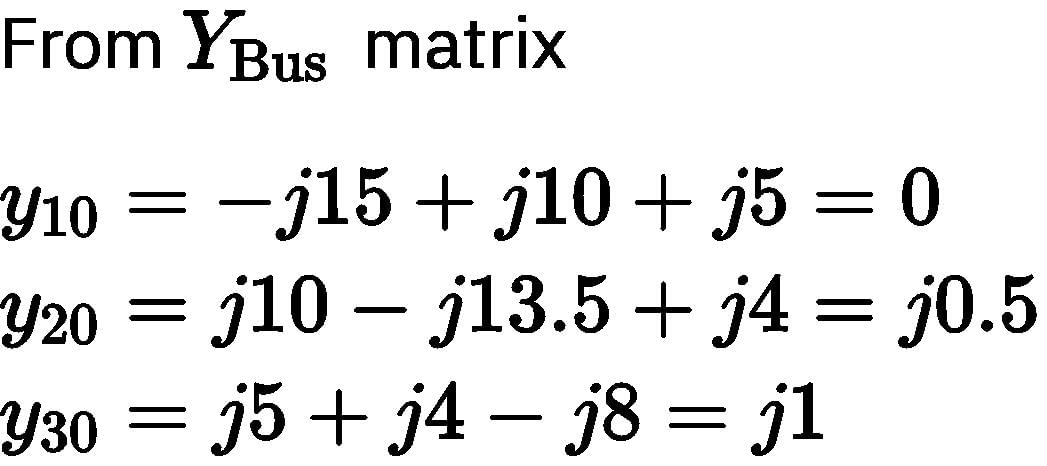
Power system network :

Hence, option (A) will not be correct.

Test: Performance of Transmission Lines, Line Parameters & Corona of Power Systems - Question 2

A single-phase, two wire transmission line, 15 km long, is made up of round conductors, each 0.8 cm radius, separated from each other by 40 cm. The equivalent diameter of a fictitious hollow, thin-walled conductor having the same inductance as the original line is given by

Detailed Solution: Question 2
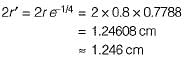
The fictitious conductor is one whose radius is r' and whose diameter is therefore,

Test: Performance of Transmission Lines, Line Parameters & Corona of Power Systems - Question 3

If the conductor radius increases, inductance of the line,

Detailed Solution: Question 3
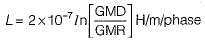
Inductance,

Here, GMR radius of conductor.
Hence, if radius increases, GMR also increases. As a result of which inductance will decrease.

Test: Performance of Transmission Lines, Line Parameters & Corona of Power Systems - Question 4

For an underground cable, the surge impedance is generally taken as

Detailed Solution: Question 4

For underground cable, Zs = 40 Ω
For overhead line, Zs = 400 Ω

Test: Performance of Transmission Lines, Line Parameters & Corona of Power Systems - Question 5

Consider the following phenomenon occuring in a power system:
1. Corona loss
2. Charging current
3. Ferranti effect
4. Dielectric loss
5. Skin effect
Which of the above are associated with transmission lines?

Detailed Solution: Question 5

Dielectric loss occurs in underground cables not in a transmission line.

Test: Performance of Transmission Lines, Line Parameters & Corona of Power Systems - Question 6

The corona loss or the critical disruptive voltage in a transmission line at a temperature (f) and pressure (b) can be foundout by Using “air density correction factor (δ)” given by

Test: Performance of Transmission Lines, Line Parameters & Corona of Power Systems - Question 7

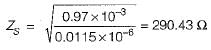
A three-phase, 50 Hz, 400 kV, transmission line is 300 km long. The line inductance is 0.97 mH/km per phase and capacitance is 0.0115 μF/km per phase. Assuming a lossless line, the surge impedance of the line will be

Detailed Solution: Question 7

Surge impedance of the line is given by

or, 

Test: Performance of Transmission Lines, Line Parameters & Corona of Power Systems - Question 8

The resistance and reactance of a short line are equal. At zero regulation the load will be

Detailed Solution: Question 8
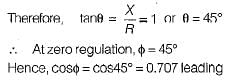
Zero regulation of a transmission line occurs at a leading power factor when φ = θ.
Since R = X

Test: Performance of Transmission Lines, Line Parameters & Corona of Power Systems - Question 9

Shunt reactors are needed

Detailed Solution: Question 9

Shunt reactors are used to bring down receiving end voltage during light load or no-load condition to overcome Ferranti effect.

Test: Performance of Transmission Lines, Line Parameters & Corona of Power Systems - Question 10

Operating transmission lines close to their maximum power transfer capability will impair

Detailed Solution: Question 10

Option A is correct.

The maximum active power transferable over a lossless line is given by P = (V_s V_r / X) sin δ, where δ is the power-angle difference between sending and receiving ends.

Maximum power occurs at δ = 90°, giving P_max = V_s V_r / X. Operating near this limit means the system has very little stability margin; a small disturbance can push the rotor angle beyond the stable region and cause loss of synchronism.

Increased loading does raise currents and therefore I²R losses, which reduces transmission efficiency, and reactive limits can degrade the voltage profile. These are important secondary effects but the primary constraint when loading approaches the maximum transfer capability is the power-angle (stability) limit.

Hence, stability is the main quantity impaired when operating close to maximum power transfer capability.

26 docs|247 tests
Information about Test: Performance of Transmission Lines, Line Parameters & Corona of Power Systems Page
In this test you can find the Exam questions for Test: Performance of Transmission Lines, Line Parameters & Corona of Power Systems solved & explained in the simplest way possible. Besides giving Questions and answers for Test: Performance of Transmission Lines, Line Parameters & Corona of Power Systems, EduRev gives you an ample number of Online tests for practice
Download as PDF