NEET Exam  >  NEET Test  >  Biology Class 11  >  Test: Plant Growth & Development - 1 - NEET MCQ

Plant Growth & Development - 1 - Free MCQ Practice Test with solutions,


MCQ Practice Test & Solutions: Test: Plant Growth & Development - 1 (15 Questions)

You can prepare effectively for NEET Biology Class 11 with this dedicated MCQ Practice Test (available with solutions) on the important topic of "Test: Plant Growth & Development - 1". These 15 questions have been designed by the experts with the latest curriculum of NEET 2026, to help you master the concept.

Test Highlights:

  • - Format: Multiple Choice Questions (MCQ)
  • - Duration: 15 minutes
  • - Number of Questions: 15

Sign up on EduRev for free to attempt this test and track your preparation progress.

Test: Plant Growth & Development - 1 - Question 1

Gibberellic acid is a/an:

Detailed Solution: Question 1

  • Gibberellic acid is a Terpene.
  • All known gibberellins are diterpenoid acids that are synthesized by the terpenoid pathway in plastids and then modified in the endoplasmic reticulum and cytosol until they reach their biologically-active form.
  • All gibberellins are derived via the ent-gibberellane skeleton, but are synthesized via ent-kaurene.

Topic in NCERT: Gibberellins

Line in NCERT: "gibberellic acid (ga) was one of the first gibberellins to be discovered and remains the most intensively studied form."

Test: Plant Growth & Development - 1 - Question 2

Which of the following is essential for fruit ripening?

Detailed Solution: Question 2

The following are plant growth regulators or phytohormones that control various developmental as well as physiological functions of a plant:

Auxin:

  • It helps in cell elongation, growth, and differentiation.
  • It is present mainly at the root and shoots apices.
  • It is responsible for the phenomenon of apical dominance, where the apical buds inhibit the growth of lateral buds.
  • It results in increasing the height of a plant due to apical dominance.
  • It can also initiate root growth in stem cuttings.
  • It may also promote flowering and prevent early fruit drop.

Cytokinin:

  • It is mainly associated with cell division and is present in regions of rapid cell division.
  • It helps to overcome apical dominance and promotes lateral shoot growth.

Ethylene:

  • It is a gaseous phytohormone produced in the tissues undergoing senescence.
  • It helps in fruit ripening and other senescence-related activities.
  • It breaks seed and bud dormancy to initiate germination in some species.
  • It also induces leaf epinasty under stress conditions.
  • The triple response of ethylene includes reducing the rate of elongation, increasing lateral expansion, and swelling of the region below the hook in seedlings.

Abscisic acid:

  • As the name suggests, it helps in abscission and dormancy.
  • It inhibits plant growth, metabolism, and seed germination.
  • It also plays an important role in the closure of stomata under stress conditions.

Topic in NCERT: Ethylene

Line in NCERT: "ethylene is highly effective in fruit ripening."

Test: Plant Growth & Development - 1 - Question 3

Stem elongation is affected by

Detailed Solution: Question 3

Stem elongation is a kind of growth of stem.

Auxin and Gibberellin are known as growth hormones of plants. Therefore, stem elongation is affected by hormones Auxin and Gibberellin.

Topic in NCERT: Gibberellins

Line in NCERT: "gibberellins also promotes bolting (internode elongation just prior to flowering) in beet, cabbages and many plants with rosette habit."

Test: Plant Growth & Development - 1 - Question 4

Apical dominance means

Detailed Solution: Question 4

Auxins are generally produced by the growing apices of the stems and roots, from where they migrate to the regions of their action. In most higher plants, the growing apical bud inhibits the growth of the lateral (axillary) buds, a phenomenon called apical dominance.

Topic in NCERT: Plant growth regulators

Line in NCERT: "in most higher plants, the growing apical bud inhibits the growth of the lateral (axillary) buds, a phenomenon called apical dominance."

Test: Plant Growth & Development - 1 - Question 5

Auxin inhibits the growth of

Detailed Solution: Question 5

The apical bud produces an auxin hormone that inhibits the growth of the lateral buds further down on the stem towards the axillary bud.

Topic in NCERT: Plant growth regulators

Line in NCERT: "in most higher plants, the growing apical bud inhibits the growth of the lateral (axillary) buds, a phenomenon called apical dominance."

Test: Plant Growth & Development - 1 - Question 6

What is the effect of abscisic acid (ABA) on plant stomata?

Detailed Solution: Question 6

Abscisic acid (ABA) induces the closure of plant stomata, helping plants to conserve water during drought conditions. This role as a stress hormone showcases ABA's importance in plant responses to environmental stress. An additional fact is that ABA also plays a crucial role in seed dormancy, ensuring seeds only germinate under favorable conditions

Topic in NCERT: Abscisic acid

Line in NCERT: "aba stimulates the closure of stomata and increases the tolerance of plants to various kinds of stresses."

Test: Plant Growth & Development - 1 - Question 7

Leaf fall occurs when the content of

Detailed Solution: Question 7

Due to a reduction in photosynthesis, this may trigger the abscission of leaves (separation of leaves) and this abscission layer is produced when auxin content falls below a minimum causing leaf or other plant part to fall off.

Topic in NCERT: Auxins

Line in NCERT: "they help to prevent fruit and leaf drop at early stages but promote the abscission of older mature leaves and fruits."

Test: Plant Growth & Development - 1 - Question 8

Which of the following statements about plant growth regulators is true?

Detailed Solution: Question 8

Auxins, gibberellins, and cytokinins can indeed act synergistically in promoting plant growth. These hormones work together to regulate various aspects of growth and development, such as cell division, elongation, and differentiation. This synergy allows plants to adapt their growth in response to environmental conditions.

An interesting fact is that while these hormones can promote growth, they can also interact with other hormones like abscisic acid and ethylene, which can inhibit growth under certain conditions, demonstrating the complex regulation of plant development.

Topic in NCERT: Plant growth regulators

Line in NCERT: "the pgrs can be broadly divided into two groups based on their functions in a living plant body. one group of pgrs are involved in growth promoting activities, such as cell division, cell enlargement, pattern formation, tropic growth, flowering, fruiting and seed formation. these are also called plant growth promoters, e.g., auxins, gibberellins and cytokinins."

Test: Plant Growth & Development - 1 - Question 9

Coconut milk contains a cytokinin called ____ which promotes plant growth.

Detailed Solution: Question 9

trans-zeatin riboside is the most abundant type of cytokinin found in coconut water (Table 2). trans-zeatin is normally used to induce plantlet regeneration from callus in plant tissue culture. Based on experimental data, trans-zeatin plays a key role in the G2-M transition of tobacco cells.

Topic in NCERT: Cytokinins

Line in NCERT: "search for natural substances with cytokinin-like activities led to the isolation of zeatin from corn-kernels and coconut milk."
Test: Plant Growth & Development - 1 - Question 10

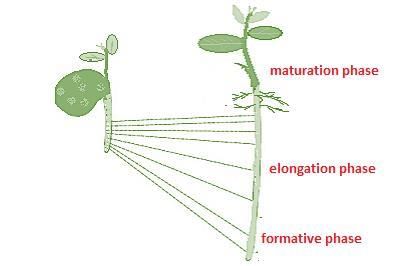
In a growing plant, the first phase during the process of growth is

Detailed Solution: Question 10

Phases Of Plant Growth

1. Meristematic Phase

  • The cells in the root and shoot apex of a plant are constantly dividing. They represent the meristematic phase of growth.
  • The cells in these regions have large nuclei and are rich in protoplasm and their cell walls are thin and contain cellulose.

2. Elongation Phase

  • The cells in the zone just after the meristematic region represent the phase of elongation.
  • The characteristics of cells in this zone are cell enlargement, increased vacuole formation and new cell wall deposition.

3. Maturation Phase

  • Just close to the phase of elongation, but away from the apex lies the phase of maturation.
  • The cells in this region reach their maximum size with respect to their protoplasm and cell wall thickening.

Phases of Plant Growth:

CBSE NCERT Notes Class 11 Biology Plant Growth Development

Topic in NCERT: Phases of growth

Line in NCERT: "the constantly dividing cells, both at the root apex and the shoot apex, represent the meristematic phase of growth."

Test: Plant Growth & Development - 1 - Question 11

Cytokinin does not help in:

Detailed Solution: Question 11

  • Cytokinin does not help in promoting leaf senescence.
  • Cytokinin production slows down the process of senescence. However, the accumulation of sugars during senescence, due to the breakdown of accumulated starch or the preferential export of N2 from the leaf, can block the effect of cytokinin, especially in low light.
  • Ethylene is regarded as a multifunctional phytohormone that regulates both growth, and senescence.
  • It promotes or inhibits growth and senescence processes depending on its concentration, timing of application, and the plant species.

Topic in NCERT: Cytokinins

Line in NCERT: "cytokinins help overcome the apical dominance. they promote nutrient mobilisation which helps in the delay of leaf senescence."

Test: Plant Growth & Development - 1 - Question 12

The natural plant hormones were first isolated from

Detailed Solution: Question 12

Auxins were first isolated from human urine. The term auxin is applied to the indole-3-acetic acid (IAA), and to other natural and synthetic compounds having certain growth-regulating properties.

Cytokinins have specific effects on cytokinesis and were discovered as kinetin from the autoclaved herring sperm DNA.
Kinetin does not occur naturally in plants. Search for natural substances with cytokinin-like activities led to the isolation of zeatin from corn kernels (corn germ oil) and coconut milk.

Hence option C is correct.

Topic in NCERT: Auxins

Line in NCERT: "auxins (from greek ‘auxein': to grow) was first isolated from human urine."

Test: Plant Growth & Development - 1 - Question 13

Auxin does not:

Detailed Solution: Question 13

They help to initiate rooting in stem cuttings, an application widely used for plant propagation. Auxins promote flowering e.g. in pineapples. They help to prevent fruit and leaf drop at early stages but promote the abscission of older mature leaves and fruits.

Test: Plant Growth & Development - 1 - Question 14

Plants bend toward the light because

Detailed Solution: Question 14

For a plant organ to bend in response to a stimulus, differential growth of cells on either side of the organ is required.

Example: For the stem of a plant to bend toward a light source, cells on the shaded side of the stem near the shoot tip must elongate faster than cells on the lighted side. 

Topic in NCERT: The discovery of plant growth regulators

Line in NCERT: "the coleoptiles of canary grass responded to unilateral illumination by growing towards the light (phototropism)."

Test: Plant Growth & Development - 1 - Question 15

Plants follow different pathways in response to the environment or phases of life to form different kinds of structures. This ability is called:

Detailed Solution: Question 15

Plasticity refers to the ability of plants to adjust and form different kinds of structures in response to changing environmental conditions or different phases of life. This term specifically describes a plant's capacity to alter its form and structure based on various factors such as light, water availability, or nutrient levels.

142 videos|410 docs|135 tests
Information about Test: Plant Growth & Development - 1 Page
In this test you can find the Exam questions for Test: Plant Growth & Development - 1 solved & explained in the simplest way possible. Besides giving Questions and answers for Test: Plant Growth & Development - 1, EduRev gives you an ample number of Online tests for practice
142 videos|410 docs|135 tests
Download as PDF