
Properties of D-block elements - Free MCQ Practice Test with solutions,
MCQ Practice Test & Solutions: Test: Properties of D-block elements (20 Questions)
You can prepare effectively for JEE Chemistry for JEE Main & Advanced with this dedicated MCQ Practice Test (available with solutions) on the important topic of "Test: Properties of D-block elements". These 20 questions have been designed by the experts with the latest curriculum of JEE 2026, to help you master the concept.
Test Highlights:
- - Format: Multiple Choice Questions (MCQ)
- - Duration: 20 minutes
- - Number of Questions: 20
Sign up on EduRev for free to attempt this test and track your preparation progress.

Which of the following is not a condition for complex formation?
Detailed Solution: Question 1
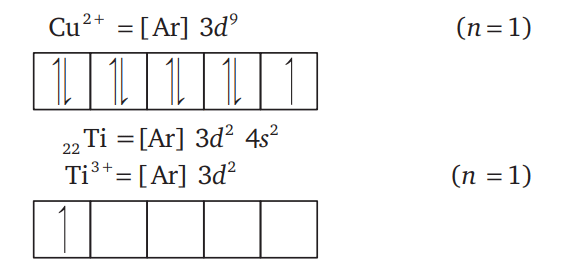
Which one of the following is a diamagnetic ion?
Detailed Solution: Question 2

The inner transition elements are the elements in which the added electrons go to:
Detailed Solution: Question 3
Which of the following pairs of ions are colourless?
Detailed Solution: Question 4

Which of the following is not correct about transition metals?
Detailed Solution: Question 5
Zinc and mercury do not show variable valency like  -block element because
-block element becauseDetailed Solution: Question 6
 and
and  have
have  -shells completely filled hence they do not exhibit variable valency.
Which one of the following is diamagnetic ion?
Detailed Solution: Question 7
 is diamagnetic as it does not contain any unpaired electron while others contain.
Which group contains coloured ions out of
1. Cu2+
2. Ti4+
3. Co2+
4. Fe2+
1. Cu2+
2. Ti4+
3. Co2+
4. Fe2+
Detailed Solution: Question 8

 are coloured ions
 .
.A compound of a metal ion  has a spin only magnetic moment of
  Bohr Magnetons. The number of unpaired electrons in the compound are
has a spin only magnetic moment of Bohr Magnetons. The number of unpaired electrons in the compound areDetailed Solution: Question 9
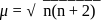 where
where  number of unpaired electrons
Cuprous ion is colourless while cupric ion is coloured because
Detailed Solution: Question 10
 there is no unpaired electron,
  contains one unpaired electron hence coloured.
Among the following, the compound that is both paramagnetic and coloured, is
Detailed Solution: Question 11
 is both paramagnetic and coloured.
Mercury is the only metal which is liquid at  . This is due to its
Detailed Solution: Question 12
Which of the following pair of ions have same paramagnetic moment?
Detailed Solution: Question 13

The correct order of decreasing second ionisation enthalpy of Ti (22), V (23), Cr (24) and Mn (25) is-
Detailed Solution: Question 14




Which pair of ions have same magnetic moment?
Detailed Solution: Question 15
 magnetic moment as 3.87
 magnetic moment as 3.87
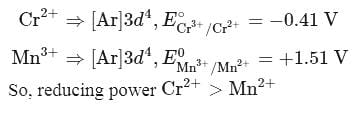
The correct statement about Cr2+ and Mn3+ among the following is (Given, atomic numbers of Cr = 24 and Mn = 25)
Detailed Solution: Question 16
A transition element containing only one electron in 4s-orbital is:
Detailed Solution: Question 17
 has the electronic structure of
  . One electron moves from the 45 -orbital to attain a more stable state with completely filled
  orbital.
Which of the following characteristics of the transition metals is associated with their catalytic activity?
Detailed Solution: Question 18
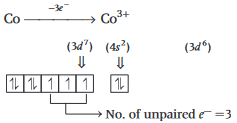
How many unpaired electrons will be present in the ground state of an atom which has valence electronic configuration  in its +3 oxidation state?
Detailed Solution: Question 19
 will be
  .
.
Which of the following is the common oxidation state for 'transition' elements?
Detailed Solution: Question 20
 -orbital, and removing the electrons from the sub shell below it requires immense amounts of energy, this limits them to a +2 charge most of the time. Hence, the correct option is (c).
335 videos|699 docs|300 tests |
