Roots, Stems, Leaves & Parts of Flower - Free MCQ Practice Test with solutions,
MCQ Practice Test & Solutions: Test: Roots, Stems, Leaves & Parts of Flower (15 Questions)
You can prepare effectively for NEET Topic-wise MCQ Tests for NEET with this dedicated MCQ Practice Test (available with solutions) on the important topic of "Test: Roots, Stems, Leaves & Parts of Flower". These 15 questions have been designed by the experts with the latest curriculum of NEET 2026, to help you master the concept.
Test Highlights:
- - Format: Multiple Choice Questions (MCQ)
- - Duration: 15 minutes
- - Number of Questions: 15
Sign up on EduRev for free to attempt this test and track your preparation progress.

Roots originate from the base of the stem and constitute the fibrous root system in which of the following plants?
Detailed Solution: Question 1
Topic in NCERT: THE ROOT
Line in NCERT: "These roots originate from the base of the stem and constitute the fibrous root system, as seen in the wheat plant."
Actinomorphic nature of flower is represented by which of the following symbols?
Detailed Solution: Question 2

Which of the following conditions is correct with respect to family Solanaceae?
Detailed Solution: Question 3
Detailed Solution: Question 4
Topic in NCERT: THE LEAF
Line in NCERT: "The leaf is a lateral, generally flattened structure borne on the stem... They are the most important vegetative organs for photosynthesis."
Root hairs develop from the region of
Detailed Solution: Question 5
Topic in NCERT: Region of maturation
Line in NCERT: "From this region some of the epidermal cells form very fine and delicate, thread-like structures called root hairs."
Arrangement of sepals & petals with respect of other is:
Detailed Solution: Question 6
Topic in NCERT: Aestivation
Line in NCERT: "Aestivation: The mode of arrangement of sepals or petals in floral bud with respect to the other members of the same whorl is known as aestivation."
Consider the following statement and answer the question that follows.
Various groups of floral parts develop one after another from the receptacle.
Which of the following parts of a plant are the first to form?
Detailed Solution: Question 7
Topic in NCERT: Calyx
Line in NCERT: "The calyx is the outermost whorl of the flower and the members are called sepals."
The technical term used for the androecium in the flower of pea is
Detailed Solution: Question 8
Topic in NCERT: Androecium
Line in NCERT: "When stamens are attached to the petals, they are epipetalous as in brinjal, or epiphyllous when attached to the perianth as in the flowers of lily. The stamens in a flower may either remain free (polyandrous) or may be united in varying degrees. The stamens may be united into one bunch or one bundle (monoadelphous) as in china rose, or two bundles (diadelphous) as in pea, or into more than two bundles (polyadelphous) as in citrus."
Detailed Solution: Question 9
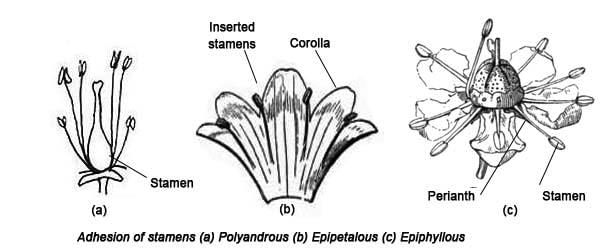
Topic in NCERT: Androecium
Line in NCERT: "When stamens are attached to the petals, they are epipetalous as in brinjal, or epiphyllous when attached to the perianth as in the flowers of lily."
Detailed Solution: Question 10
Topic in NCERT: THE FLOWER
Line in NCERT: "The flower is a modified shoot wherein the shoot apical meristem changes to floral meristem."