NEET Exam  >  NEET Test  >  Biology Class 11  >  Test: Structural Organisation in Animals - NEET MCQ

Structural Organisation in Animals - Free MCQ Practice Test with solutions,


MCQ Practice Test & Solutions: Test: Structural Organisation in Animals (15 Questions)

You can prepare effectively for NEET Biology Class 11 with this dedicated MCQ Practice Test (available with solutions) on the important topic of "Test: Structural Organisation in Animals". These 15 questions have been designed by the experts with the latest curriculum of NEET 2026, to help you master the concept.

Test Highlights:

  • - Format: Multiple Choice Questions (MCQ)
  • - Duration: 10 minutes
  • - Number of Questions: 15

Sign up on EduRev for free to attempt this test and track your preparation progress.

Test: Structural Organisation in Animals - Question 1

Recognise the figure and find out the correct match.
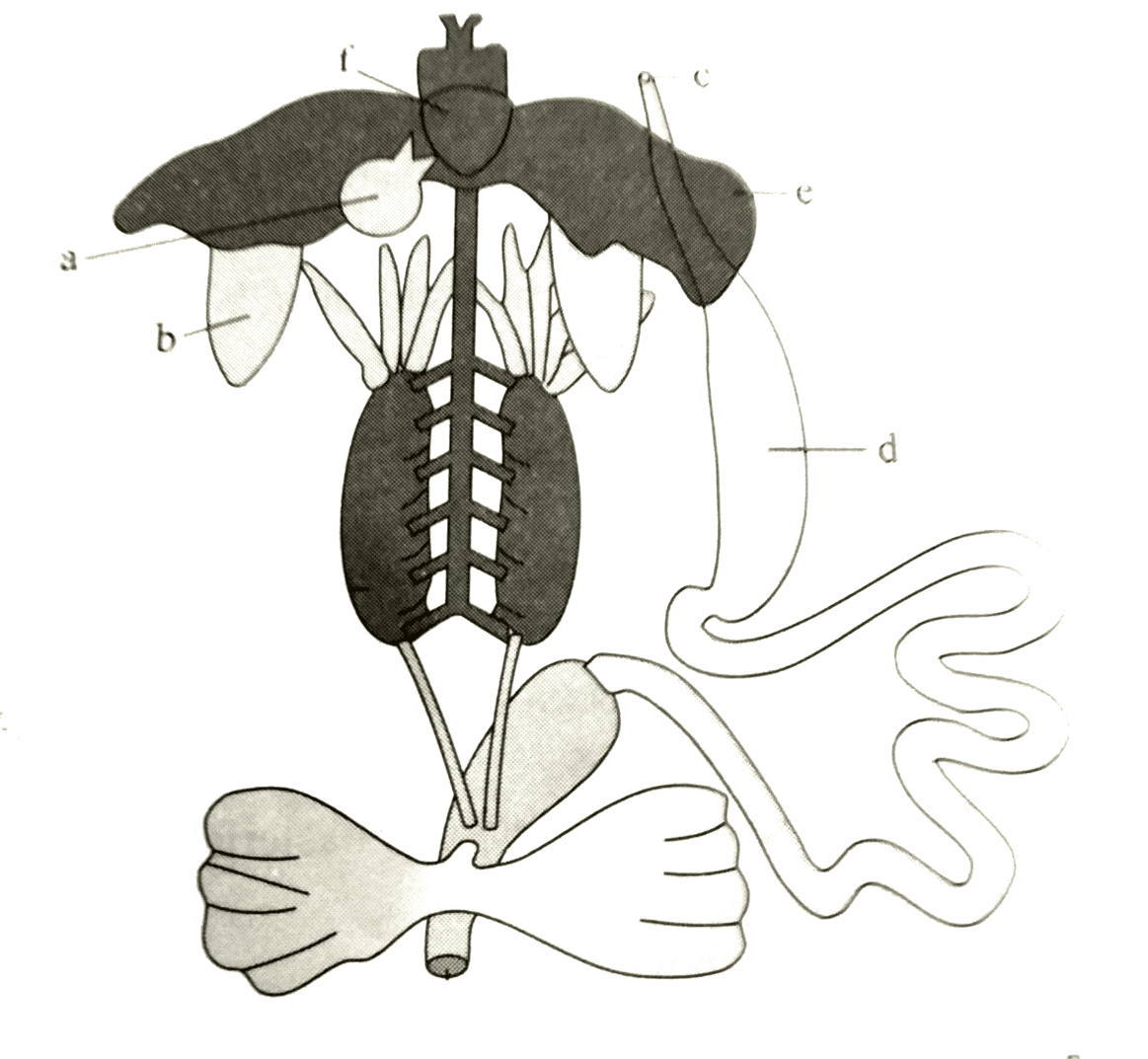
Recognise the figure and find out the correct matching.

Detailed Solution: Question 1

ocr_image

Test: Structural Organisation in Animals - Question 2

Which of the following statements regarding the digestive system of Rana tigrina (Frog) are correct?
A. The liver is bilobed and helps in digestion of fats.
B. Digestion of food is completed in the stomach.
C. The pancreas is present and secretes digestive enzymes.
D. The intestine is differentiated into duodenum, ileum and rectum.
E. The cloaca is the common chamber for digestive, excretory and reproductive systems.

Detailed Solution: Question 2

The correct answer is Option A - A, C, D and E only

The liver of the frog is a large, two-lobed (bilobed) organ that produces bile; bile aids the digestion of fats by emulsification, making fat droplets accessible to lipase action.

The stomach carries out initial mechanical and protein digestion (pepsin action), but digestion is not completed there; most chemical digestion and absorption occur in the small intestine, so the statement that digestion is completed in the stomach is incorrect.

The pancreas is present in frog and secretes digestive enzymes (pancreatic enzymes) into the duodenum, contributing to the breakdown of carbohydrates, proteins and fats.

The intestine is differentiated into the duodenum, ileum (parts of the small intestine) and the rectum (part of the large intestine), with the duodenum receiving bile and pancreatic secretions for further digestion.

The cloaca is a common chamber into which the digestive, excretory and reproductive ducts open, serving as the single external opening for these systems.

Therefore, statements A, C, D and E are correct, which corresponds to Option A.

Topic in NCERT: Digestive system

Line in NCERT: "digestion of food takes place by the action of hcl and gastric juices secreted from the walls of the stomach."
"final digestion takes place in the intestine."
"the main digestive glands are liver and pancreas."
"the alimentary canal consists of oesophagous, stomach, intestine and rectum, which open into the cloaca."
"the cloaca is a small, median chamber that is used to pass faecal matter, urine and sperms to the exterior."

Test: Structural Organisation in Animals - Question 3

Match List-I with List-II regarding the circulatory system of Frog:
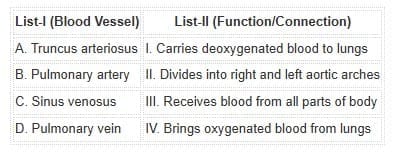
Detailed Solution: Question 3

The correct answer is Option D - A: A-II, B-I, C-III, D-IV

Truncus arteriosus divides anteriorly into branches that form the right and left aortic arches, so it corresponds to II.

Pulmonary artery carries deoxygenated blood from the heart to the lungs for oxygenation, so it corresponds to I.

Sinus venosus collects venous blood from the body through precaval, postcaval and hepatic veins and hence receives blood from all parts of the body, corresponding to III.

Pulmonary vein returns oxygenated blood from the lungs to the heart, so it corresponds to IV.

All four individual correspondences are correct; therefore the given combination in Option D is consistent and correct.

Topic in NCERT: Heart anatomy

Line in NCERT: "heart is a muscular structure situated in the upper part of the body cavity. it has three chambers, two atria and one ventricle and is covered by a membrane called pericardium."

Test: Structural Organisation in Animals - Question 4

In the nervous system of Frog, the brain is divided into forebrain, midbrain and hindbrain. Which of the following correctly matches the parts with their respective divisions?
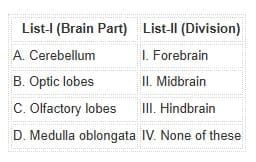
Detailed Solution: Question 4

The correct answer is Option A - A-III, B-II, C-I, D-III

Cerebellum is part of the hindbrain and is mainly involved in the coordination of voluntary movements and maintenance of posture.

Optic lobes constitute the major portion of the midbrain and serve as the primary visual processing centres in frogs.

Olfactory lobes develop from the forebrain and are responsible for receiving and processing olfactory (smell) information.

Medulla oblongata belongs to the hindbrain and contains vital autonomic centres that regulate functions such as respiration and heart activity.

Topic in NCERT: Nervous system

Line in NCERT: "the brain is divided into fore-brain, mid-brain and hind-brain. forebrain includes olfactory lobes, paired cerebral hemispheres and unpaired diencephalon. the midbrain is characterised by a pair of optic lobes. hind-brain consists of cerebellum and medulla oblongata."

Test: Structural Organisation in Animals - Question 5

Which of the following statements about the reproductive system of male Frog (Rana tigrina) is NOT incorrect?

Detailed Solution: Question 5

Option C is correct: The ureter acts as a urinogenital duct in males.

Sperm produced in the testes pass into the vasa efferentia, which open into the renal region; from there sperm enter the ureter and are carried to the cloaca.

Because the same duct conveys both urine and sperm, the ureter functions as a urinogenital duct in the male frog.

  • Statement A is incorrect: the testes are actually paired structures lying close to the kidneys; the edited option that says they are unpaired is false.
  • Statement B is incorrect: the vasa efferentia connect the testes to the renal region of the kidneys, not directly to the ureter.
  • Statement D is incorrect: Bidder's canal is not a structure present only in males; the claim that it is male-only is false.

Test: Structural Organisation in Animals - Question 6

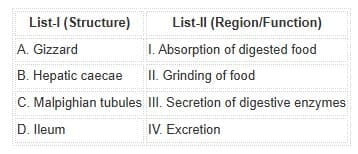
Match List-I with List-II regarding the digestive system of Cockroach:
Detailed Solution: Question 6

The correct answer is Option A - A: A-II, B-III, C-IV, D-I

Gizzard performs the grinding of food by strong muscular walls often with sclerotised teeth-like structures; this matches II.

Hepatic caecae secrete digestive juices/enzymes and increase the digestive surface, so their function is secretion of digestive enzymes, matching III.

Malpighian tubules are the excretory structures that remove nitrogenous wastes and help in osmoregulation; this corresponds to IV (excretion).

Ileum, as part of the posterior gut, is involved in the absorption of digested food (and reabsorption of water), therefore it corresponds to I.

Test: Structural Organisation in Animals - Question 7

Which of the following statements about respiration in frogs are correct for an adult frog?

Detailed Solution: Question 7

Option A - A, B and C only is correct.

Cutaneous respiration occurs across the moist skin, which is highly vascularised and allows diffusion of oxygen and carbon dioxide; this contributes substantially to gas exchange in adult frogs.

Buccopharyngeal respiration takes place across the moist lining of the buccopharyngeal cavity; rhythmic movements of the floor of the mouth ventilate this surface and permit gas exchange in adults.

Pulmonary respiration is carried out by paired lungs; air is moved into the lungs by buccal pumping and gas exchange occurs across the lung surfaces in adult frogs.

Tracheal respiration through spiracles is not a mode of respiration in frogs; this mechanism is characteristic of many insects, so statement D is incorrect for adult frogs.

Branchial respiration using gills occurs in the larval tadpole stage and is lost during metamorphosis; therefore adult frogs do not perform branchial respiration and statement E does not apply to adults.

Thus only statements A, B and C are correct for the adult frog, matching Option A.

Test: Structural Organisation in Animals - Question 8

In the nervous system of Cockroach, the nerve ring is formed by:

Detailed Solution: Question 8

The correct answer is Option C - Supra-oesophageal ganglion and sub-oesophageal ganglion connected by circum-oesophageal connectives

  • The supra-oesophageal ganglion is the dorsal brain region located above the oesophagus; it receives sensory input from the head appendages.
  • The sub-oesophageal ganglion lies below the oesophagus and controls mouthparts and associated muscles.
  • A pair of circum-oesophageal connectives runs around the oesophagus, linking the supra- and sub-oesophageal ganglia; together these three elements form a nerve ring that encircles the gut.
  • The paired ventral nerve cord with its thoracic and abdominal ganglia runs along the ventral side and does not form the nerve ring; it serves segmental motor and sensory functions.
  • Hence, the configuration described in Option C correctly identifies the structures that form the nerve ring; the other options are incomplete or refer to different parts of the nervous system.

Test: Structural Organisation in Animals - Question 9

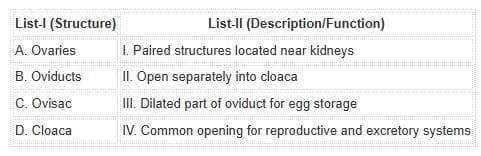
Which of the following are correctly matched regarding the reproductive system of female Frog?
Detailed Solution: Question 9

The correct answer is Option A - A: A-I, B-II, C-III, D-IV

The ovaries are paired glands located close to the kidneys in adult female frogs; they produce and release ova.

The oviducts are long, coiled tubular structures; each opens separately into the cloaca and carries eggs from the ovaries toward the external opening.

The ovisac is the dilated posterior part of the oviduct that temporarily stores eggs before they are expelled.

The cloaca is a single chamber with a single external opening that acts as the common outlet for the digestive, urinary and reproductive systems.

Thus, all four given matches in the chosen option are correct.

Topic in NCERT: Female reproductive system

Line in NCERT: "the female reproductive organs include a pair of ovaries (figure 7.4). the ovaries are situated near kidneys and there is no functional connection with kidneys. a pair of oviduct arising from the ovaries opens into the cloaca separately."

Test: Structural Organisation in Animals - Question 10

The cockroach shows sexual dimorphism. Which of the following features help in distinguishing male from female?
A. Males have anal styles which are absent in females.
B. Females have longer antennae than males.
C. Males have wings that extend beyond the abdomen.
D. Females have a boat-shaped structure formed by 7th sternum.
E. The abdomen of females is broader than males.

Detailed Solution: Question 10

The correct answer is Option A - A, C, D and E only

Anal styles are present as a pair of short conical projections at the posterior end of the male abdomen; these structures are absent in the female. This is a reliable male character.

The statement about antennae is incorrect; there is no consistent sexual difference in antenna length that can be used to distinguish male and female cockroaches-both sexes possess long filiform antennae used as sensory organs.

In many cockroach species the wings extend beyond the abdomen in males, while in females the wings are shorter and do not project beyond the tip of the abdomen; this is a recognised male character.

The female shows a boat-shaped structure formed by the 7th sternum on the ventral side (a modified plate), which is absent or differently shaped in the male; this is a female-specific feature.

The abdomen of females is broader and more rounded than that of males, reflecting differences related to the reproductive system; this helps distinguish the sexes.

Therefore, statements A, C, D and E are correct and statement B is incorrect, so Option A is the correct choice.

Test: Structural Organisation in Animals - Question 11

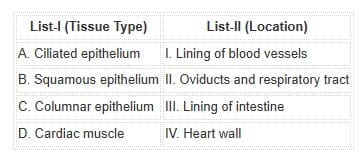
Match List-I with List-II regarding the various tissues and their locations in Frog:
Detailed Solution: Question 11

The correct answer is Option A - A: A-II, B-I, C-III, D-IV

Ciliated epithelium is present in the oviducts and respiratory tract; the cilia on these cells move ova and mucus, so A-II is correct.

Squamous epithelium (simple squamous) forms the endothelium that lines blood vessels, providing a thin surface for exchange; hence B-I is correct.

Columnar epithelium (simple columnar) lines the intestine; these tall cells often include goblet cells and are specialised for absorption and secretion, so C-III is correct.

Cardiac muscle composes the heart wall, consisting of striated involuntary fibres with intercalated discs for coordinated contraction; therefore D-IV is correct.

All four matches in Option A are correct.

Test: Structural Organisation in Animals - Question 12

Which of the following statements about epithelial tissues are correct?
A. Simple epithelium is composed of a single layer of cells.
B. Compound epithelium mainly performs secretion and absorption.
C. Ciliated epithelium helps in moving particles in a specific direction.
D. Squamous epithelium is found in the walls of blood vessels.
E. Cuboidal epithelium mainly provides protection against mechanical stress.

Detailed Solution: Question 12

Simple epithelium consists of a single layer of cells. Ciliated epithelium helps in moving mucus or particles in a specific direction. Squamous epithelium lines blood vessels and air sacs. Compound epithelium mainly provides protection, not secretion and absorption. Cuboidal epithelium mainly performs secretion and absorption, not protection. Hence, A, C and D are correct.

Test: Structural Organisation in Animals - Question 13

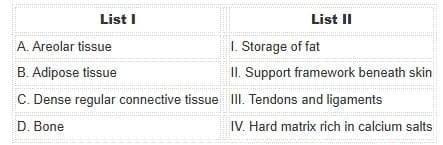
Match List-I with List-II regarding connective tissues:
Detailed Solution: Question 13

Areolar tissue forms a support framework beneath the skin. Adipose tissue stores fat. Dense regular connective tissue forms tendons and ligaments. Bone has a hard matrix rich in calcium salts and collagen fibres. Therefore, the correct match is A-II, B-I, C-III and D-IV.

Test: Structural Organisation in Animals - Question 14

Which of the following statements regarding the nervous system of cockroach are correct?
A. It consists of segmentally arranged ganglia joined by longitudinal connectives.
B. Supra-oesophageal ganglion supplies nerves to antennae and compound eyes.
C. There are three thoracic and six abdominal ganglia.
D. Cockroach has monocular vision with high resolution.
E. Each compound eye contains about 2000 ommatidia.

Detailed Solution: Question 14

The cockroach nervous system has segmentally arranged ganglia connected by longitudinal connectives. The supra-oesophageal ganglion supplies nerves to antennae and compound eyes. There are three thoracic and six abdominal ganglia. Each compound eye contains about 2000 ommatidia. Cockroach exhibits mosaic vision with high sensitivity but low resolution, so statement D is incorrect. Therefore, A, B, C and E are correct.

Test: Structural Organisation in Animals - Question 15

Which of the following statements regarding muscle tissues are correct?
A. Skeletal muscle fibres are striated and voluntary in action.
B. Smooth muscles are found in the walls of stomach and blood vessels.
C. Cardiac muscle cells are multinucleate and non-branching.
D. Intercalated discs are present in cardiac muscle.
E. Smooth muscles show striations under the microscope.

Detailed Solution: Question 15

Skeletal muscles are striated and voluntary in action. Smooth muscles are involuntary and found in the walls of internal organs such as stomach and blood vessels. Cardiac muscles are branched and usually uninucleate, not multinucleate, so statement C is incorrect. Intercalated discs are characteristic of cardiac muscle and help in coordinated contraction. Smooth muscles do not show striations; therefore statement E is incorrect. Hence, A, B and D are correct.

142 videos|410 docs|135 tests
Information about Test: Structural Organisation in Animals Page
In this test you can find the Exam questions for Test: Structural Organisation in Animals solved & explained in the simplest way possible. Besides giving Questions and answers for Test: Structural Organisation in Animals, EduRev gives you an ample number of Online tests for practice
142 videos|410 docs|135 tests
Download as PDF