
GATE Electrical Engineering (EE) Test: Transistor Biasing & Thermal Stabilization
MCQ Practice Test & Solutions: Test: Transistor Biasing & Thermal Stabilization - 1 (10 Questions)
You can prepare effectively for Electrical Engineering (EE) GATE Electrical Engineering (EE) Mock Test Series 2027 with this dedicated MCQ Practice Test (available with solutions) on the important topic of "Test: Transistor Biasing & Thermal Stabilization - 1". These 10 questions have been designed by the experts with the latest curriculum of Electrical Engineering (EE) 2026, to help you master the concept.
Test Highlights:
- - Format: Multiple Choice Questions (MCQ)
- - Duration: 30 minutes
- - Number of Questions: 10
Sign up on EduRev for free to attempt this test and track your preparation progress.

If a change in base current does not change the collector current, the transistor amplifier is said to be
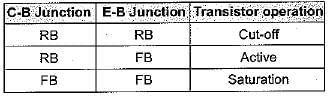
In a BJT, if the collector junction is reverse biased and the emitter junction is reverse - biased, it is said to operate in
Detailed Solution: Question 2

On applying a positive voltage signal to the' base of a normally biased n-p-n CE transistor amplifier
Assertion (A): The process of giving proper supply voltages and resistances for obtaining the desired Q-point is called biasing.
Reason (R): In order to produce distortion free output in amplifier circuits, the supply voltages and resistances in the circuit must be suitably chosen.
Reason (R): In order to produce distortion free output in amplifier circuits, the supply voltages and resistances in the circuit must be suitably chosen.
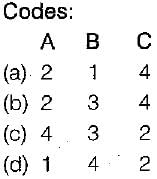
Match List-I (Transistor parameters) with List-ll (Temperature effect) and select the correct answer using the codes given below the lists:
List-I
A. Base-emitter voltage (VBE)
B. Transistor current gain (β)
C. Reverse saturation current (Ico)
List-ll
1. Independent of temperature
2. Decreases by 2.5 mV per oC
3. Increases with temperature
4. Increase by 7% per oC
List-I
A. Base-emitter voltage (VBE)
B. Transistor current gain (β)
C. Reverse saturation current (Ico)
1. Independent of temperature
2. Decreases by 2.5 mV per oC
3. Increases with temperature
4. Increase by 7% per oC
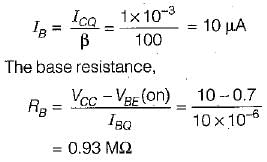
For the transistor circuit shown below, the Q-point values are given as ICQ = 1 mA and VCEQ = 6V
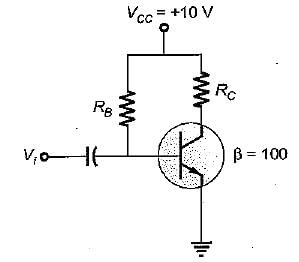
If VBE (on) = 0.7 V, the values of the RB and Rc will be respectively
If VBE (on) = 0.7 V, the values of the RB and Rc will be respectively
Detailed Solution: Question 6

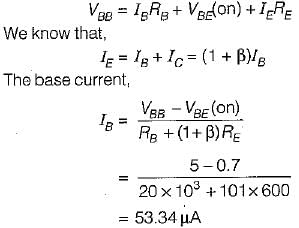
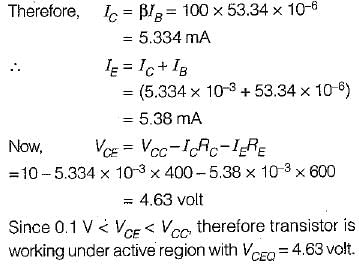
For the transistor circuit shown below,β = 100 and VBE(on) = 0.7 V.
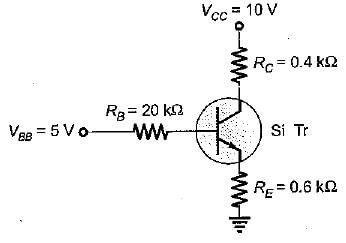
The transistor is working under
The transistor is working under
Detailed Solution: Question 7
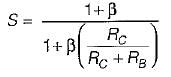
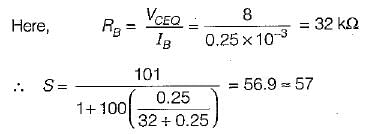
In a collector-to-base CE amplifier circuit having Vcc = 12 V, Rc = 250 Ω , IB = 0.25 mA, β = 100 and VCEQ = 8 V, the stability factor will be approximately given by (neglect VBE)
Detailed Solution: Question 8
A self-bias circuit (with an emitter resiistor) stabilizes the__________ of the circuit against variations in temperature and process parameters.
Detailed Solution: Question 9
In typical circuits, the stabilization factor S = (ΔICICO) is
Detailed Solution: Question 10
26 docs|247 tests |
