CBSE Class 9  >  Class 9 Test  >  : Additional Practice  >  Test: The Fundamental Unit of Life- Case Based Type Questions- 1 - Class 9 MCQ

The Fundamental Unit of Life- Case Based Type Questions- 1 - Free Questions


MCQ Practice Test & Solutions: Test: The Fundamental Unit of Life- Case Based Type Questions- 1 (10 Questions)

You can prepare effectively for Class 9 Class 9: Additional Practice with this dedicated MCQ Practice Test (available with solutions) on the important topic of "Test: The Fundamental Unit of Life- Case Based Type Questions- 1". These 10 questions have been designed by the experts with the latest curriculum of Class 9 2026, to help you master the concept.

Test Highlights:

  • - Format: Multiple Choice Questions (MCQ)
  • - Duration: 20 minutes
  • - Number of Questions: 10

Sign up on EduRev for free to attempt this test and track your preparation progress.

Test: The Fundamental Unit of Life- Case Based Type Questions- 1 - Question 1

Direction: Study the given diagram of the bacterial cell and answer the following questions.

Q. Nearly half of the bacteria are motile due to the presence of ___________.

Detailed Solution: Question 1

Nearly half of the bacteria are motile due to the presence of flagella. These are long, thin, helical appendages.

Test: The Fundamental Unit of Life- Case Based Type Questions- 1 - Question 2

Direction: Study the given diagram of bacterial cell and answer the following questions.
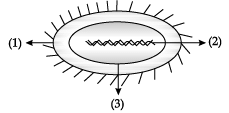
Q. The nuclear region in the diagram contains

Detailed Solution: Question 2

  • Chromosome beasis genes present in nuclear region.

  • Genes are contained in chromosomes, which are in the cell nucleus.

  • A chromosome contains hundreds to thousands of genes.

  • Every normal human cell contains 23 pairs of chromosomes, for a total of 46 chromosomes.

  • A trait is any gene-determined characteristic and is often determined by more than one gene.

Test: The Fundamental Unit of Life- Case Based Type Questions- 1 - Question 3

Direction: Study the given diagram of bacterial cell and answer the following questions.

Q. The parts (1), (2) and (3) are

Detailed Solution: Question 3
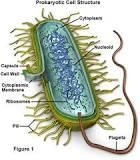
It is a gel-like matrix composed of water, enzymes, nutrients, wastes, and gases and contains cell structures such as ribosomes, a chromosome, and plasmids. The cell envelope encases the cytoplasm and all its components. Unlike the eukaryotic (true) cells, bacteria do not have a membrane enclosed nucleus.

The outer structure (1) is the cell wall.

Then the genetic data(2) is nucleoid.

The second layer(3) is the plasma membrane.

Test: The Fundamental Unit of Life- Case Based Type Questions- 1 - Question 4

Direction: Study the given diagram of bacterial cell and answer the following questions.
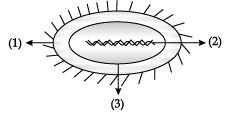
Q. Bacteria has no nucleus so, bacteria is

Detailed Solution: Question 4

Prokaryotes do not have nucleus or undefined and undeveloped nucleus.

A prokaryotic cell does not have a defined nucleus; the nuclear material in a prokaryote is known as a nucleoid. DNA present in the nucleoids of prokaryotes is of circular, double stranded type which is tightly coiled. Hence, due to the circular structure and tight coiling, the DNA in prokaryotes is not scattered throughout the cell, even though the cell has no defines nucleus.

Test: The Fundamental Unit of Life- Case Based Type Questions- 1 - Question 5

Direction: Study the diagram of a plan cell and answer the following Questions-
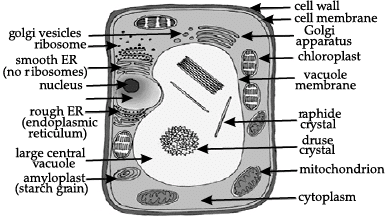
Q. Which cell organelle is involved in synthesis of vacuoles ?

Detailed Solution: Question 5

Golgi help in the synthesis of vacuoles containing cellular secretion, digestive enzymes, protein etc.

Test: The Fundamental Unit of Life- Case Based Type Questions- 1 - Question 6

Direction: Study the diagram of a plan cell and answer the following Questions-

Q. The special structures in plant cell known as Kitchen of the Cell

Detailed Solution: Question 6

Plants contains Plastids and Chloroplast is a type of Plastid where photosynthesis take place.

Test: The Fundamental Unit of Life- Case Based Type Questions- 1 - Question 7

Direction: Study the diagram of a plan cell and answer the following Questions-
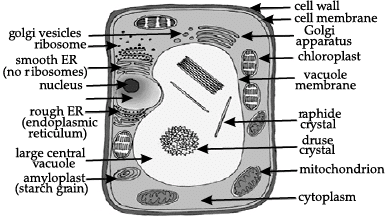
Q. Plant Cell wall is made up of

Detailed Solution: Question 7

Plant cell wall is made up of cellulose, hemicellulose and pectin. Plant cell walls are primarily made of cellulose, which is the most abundant macromolecule on Earth. Cellulose fibers are long, linear polymers of hundreds of glucose molecules. These fibers aggregate into bundles of about 40, which are called microfibrils.

Test: The Fundamental Unit of Life- Case Based Type Questions- 1 - Question 8

Direction: Study the diagram of a plan cell and answer the following Questions-
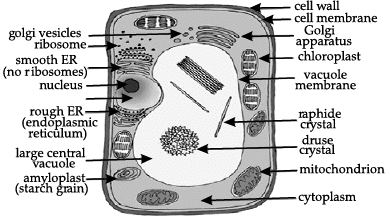
Q. Plant Cell have large _______ than animal cells.

Detailed Solution: Question 8

In a plant cell,vacuoles plays very important role as they store toxic metabolic byproducts or and product and provide turgidity and provide turgidity and rigidity to plant cell.

Test: The Fundamental Unit of Life- Case Based Type Questions- 1 - Question 9

Direction: All living Organisms are made up of cells and these cells perform all the functions essential for the survival of the Organism eg. respiration, digestion, excretion etc. In Unicellular organisms, a single cell carries out all these functions and in multicellular organisms different group of cells carry out different functions.

Q. The Cell which do not have a fixed shape

Detailed Solution: Question 9

Both human red blood cells (due to their flexibility in moving through capillaries) and Amoeba (because of its ability to change shape during movement) lack a fixed shape. This makes option D correct.

In contrast:

  • Paramecium maintains a definite structure, so it is excluded.

Test: The Fundamental Unit of Life- Case Based Type Questions- 1 - Question 10

Direction: All living Organisms are made up of cells and these cells perform all the functions essential for the survival of the Organism eg. respiration, digestion, excretion etc. In Unicellular organisms, a single cell carries out all these functions and in multicellular organisms different group of cells carry out different functions.

Q. The structural and functional unit of life is

Detailed Solution: Question 10

Cell is the basic building block of all living organisms and perform all the activities required to sustain life. So, it is the structural and functional unit of life.

4 docs|108 tests
Information about Test: The Fundamental Unit of Life- Case Based Type Questions- 1 Page
In this test you can find the Exam questions for Test: The Fundamental Unit of Life- Case Based Type Questions- 1 solved & explained in the simplest way possible. Besides giving Questions and answers for Test: The Fundamental Unit of Life- Case Based Type Questions- 1, EduRev gives you an ample number of Online tests for practice
Download as PDF