
Work and Energy- Case Based Type Questions- 2 - Free Questions with solutions
MCQ Practice Test & Solutions: Test: Work and Energy- Case Based Type Questions- 2 (10 Questions)
You can prepare effectively for Class 9 Class 9: Additional Practice with this dedicated MCQ Practice Test (available with solutions) on the important topic of "Test: Work and Energy- Case Based Type Questions- 2". These 10 questions have been designed by the experts with the latest curriculum of Class 9 2026, to help you master the concept.
Test Highlights:
- - Format: Multiple Choice Questions (MCQ)
- - Duration: 20 minutes
- - Number of Questions: 10
Sign up on EduRev for free to attempt this test and track your preparation progress.

Direction: Study the given passage and answer the following questions .
The following diagram shows that a simple pendulum consisting of a bob of mass 100 gm. Initially the bob of the pendulum is at rest at ‘O’. It is then displaced to one side at A. The height of ‘A’ above ‘O’ is 5 cm. (Take g = 10 m/s2)
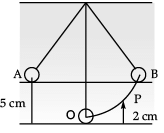
Q. What is the value of potential energy of bob at ‘A’ and where does it come from?
Detailed Solution: Question 1
Direction: Study the given passage and answer the following questions .
The following diagram shows that a simple pendulum consisting of a bob of mass 100 gm. Initially the bob of the pendulum is at rest at ‘O’. It is then displaced to one side at A. The height of ‘A’ above ‘O’ is 5 cm. (Take g = 10 m/s2)
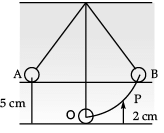
Q. What is the value of kinetic energy of the bob at mean position ‘O’?
Detailed Solution: Question 2

Direction: Study the given passage and answer the following questions .
The following diagram shows that a simple pendulum consisting of a bob of mass 100 gm. Initially the bob of the pendulum is at rest at ‘O’. It is then displaced to one side at A. The height of ‘A’ above ‘O’ is 5 cm. (Take g = 10 m/s2)
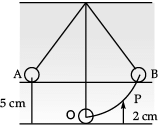
Q. What is the value of total energy of the bob at position A?
Detailed Solution: Question 3
Direction: Study the given passage and answer the following questions .
The following diagram shows that a simple pendulum consisting of a bob of mass 100 gm. Initially the bob of the pendulum is at rest at ‘O’. It is then displaced to one side at A. The height of ‘A’ above ‘O’ is 5 cm. (Take g = 10 m/s2)
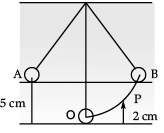
Q. What is kinetic energy?
Detailed Solution: Question 4
Direction: Study the given passage and answer the following questions .
The following diagram shows that a simple pendulum consisting of a bob of mass 100 gm. Initially the bob of the pendulum is at rest at ‘O’. It is then displaced to one side at A. The height of ‘A’ above ‘O’ is 5 cm. (Take g = 10 m/s2)
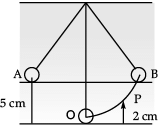
Q. What is the value of kinetic energy and potential energy of the bob at the position ‘P’ whose height above O is 2 cm?
Detailed Solution: Question 5
Study the given passage and answer any four questions.
In the month of September, four devices of power 100 W each is used for 10 hours daily.
Q. Find the energy in kWh.
Detailed Solution: Question 6
Study the given passage and answer any four questions.
In the month of September, four devices of power 100 W each is used for 10 hours daily.
Q. Relate 1 kWh to joules.
Detailed Solution: Question 7
Study the given passage and answer any four questions.
In the month of September, four devices of power 100 W each is used for 10 hours daily.
Q. Define 1 kWh.
Detailed Solution: Question 8
Study the given passage and answer any four questions.
In the month of September, four devices of power 100 W each is used for 10 hours daily.
Q. If the heater works 60 joules in one minute, what is its power?
Detailed Solution: Question 9
Study the given passage and answer any four questions.
In the month of September, four devices of power 100 W each is used for 10 hours daily.
Q. Define power.
Detailed Solution: Question 10
4 docs|108 tests |
