CBSE Class 9  >  Class 9 Test  >  Science   >  MCQ: Speed and Velocity - Class 9 MCQ

Speed and Velocity - Class 9 Science Free MCQ Test with solutions


MCQ Practice Test & Solutions: MCQ: Speed and Velocity (20 Questions)

You can prepare effectively for Class 9 Science Class 9 with this dedicated MCQ Practice Test (available with solutions) on the important topic of "MCQ: Speed and Velocity". These 20 questions have been designed by the experts with the latest curriculum of Class 9 2026, to help you master the concept.

Test Highlights:

  • - Format: Multiple Choice Questions (MCQ)
  • - Duration: 20 minutes
  • - Number of Questions: 20

Sign up on EduRev for free to attempt this test and track your preparation progress.

MCQ: Speed and Velocity - Question 1

The SI unit for speed is

Detailed Solution: Question 1

Speed can be calculated by the formula: speed = distance/time.

To find the unit of speed we need to know the units for distance and time first.

The standard unit (SI) for measurement of distance is meter (m) and time is second (s), so the unit of speed will be in meters per second (m/s).

Thus, the speed is measured in meters per second (m/s) in the SI system

Topic in NCERT: speed 

Line in NCERT: "The SI unit of speed is metre per second. This is represented by the symbol m s⁻¹ or m/s."

    MCQ: Speed and Velocity - Question 2

    How far will a car travel in 25 minutes at 12 m/s?

    Detailed Solution: Question 2

    Using the formula Distance = Speed × Time, convert 25 minutes to seconds (1500 s). Then calculate 12 m/s × 1500 s = 18,000 meters, which is 18 km.

    MCQ: Speed and Velocity - Question 3

    What is the average velocity of a car that moved 60 km in 3 hours?

    Detailed Solution: Question 3

    Average Velocity Calculation
    - Average velocity is calculated by dividing the total distance traveled by the total time taken to travel that distance.
    - In this case, the car moved 60 km in 3 hours.
    - Therefore, the average velocity is calculated as 60 km / 3 hours = 20 km/h.
    Therefore, the average velocity of the car is 20 km/h. So, the correct answer is B: 20 km/h.

    MCQ: Speed and Velocity - Question 4

    The ______ of a distance versus time graph is speed.

    Detailed Solution: Question 4

    We can use Steepness, or slope, of a line in a distance - time  graph  to determine the speed of an object if speed is constant. The slope of the line is calculated by dividing the change in distance by the change in time for that time interval. 

    Topic in NCERT: DISTANCE-TIME GRAPHS

    Line in NCERT: "We can use the distance-time graph to determine the speed of an object."

    MCQ: Speed and Velocity - Question 5

    1 km/ h = ________ m/s

    Detailed Solution: Question 5

    Conversion of km/h to m/s

    1 km = 1000 m and 1 hour = 3600 s

    • 1 km/h is equal to 1000 m/3600 s
    • Therefore, 1 km/h = 5/18 m/s
    • So, the correct answer is D: 5/18

    MCQ: Speed and Velocity - Question 6

    If car A is at 40 km/h and car B is at 10 km/h in the opposite direction, what is the velocity of the car A relative to the car B?

    Detailed Solution: Question 6

    Taking the formula when both bodies are moving along opposite direction we have :

    V(AB) =  V(A) -  V(B)  =  40 - (-10 ) = 50 km/hr

    Hence the velocity of car A with respect to car B is 50 km/hr in opposite direction.

    MCQ: Speed and Velocity - Question 7

    Which of the following is a correct measure of velocity?

    Detailed Solution: Question 7

    Velocity is a vector quantity requiring both magnitude (speed) and direction.- Option A (30 seconds): Measures time, not velocity.- Option B (30 m/s): Speed only, missing direction.- Option C (South): Direction only, lacking magnitude.- Option D (30 m/s, South): Provides both 30 m/s (magnitude) and South (direction), making it correct.Thus, the correct measure of velocity is 30 m/s, South.

    MCQ: Speed and Velocity - Question 8

    If a person walked at 2 m/s for 12 s he/she would travel a distance of

    Detailed Solution: Question 8

    Calculating Distance Travelled:

    Speed = 2 m/s

    Time = 12 s

    [Distance = Speed x Time]

    Therefore, Distance = 2 m/s x 12 s = 24 meters

    MCQ: Speed and Velocity - Question 9

    The speed at any instant of time is known as

    Detailed Solution: Question 9

    The instantaneous speed of an object is defined as the speed of the object at any given instant. The instantaneous speed of an object can be determined by determining the average speed over a short distance (and short time), and using this approximation as the instantaneous speed.

    MCQ: Speed and Velocity - Question 10

    An object travels 20 m in 5 sec and then another 40 m in 5 sec. What is the average speed of the object?

    Detailed Solution: Question 10

    Answer: a) 6 m/s

    Why?
    Average speed = total distance ÷ total time

    • First part: 20 m in 5 s
    • Second part: 40 m in 5 s
    • Total distance = 20 + 40 = 60 m
    • Total time = 5 + 5 = 10 s

    So, average speed = 60 ÷ 10 = 6 m/s.

    Quick check of other options:

    b) 2 m/s → too small (would mean only 20 m in 10 s).

    c) 12 m/s → too large (would mean 120 m in 10 s).

    d) 0 m/s → would mean no movement, which is false here.

    Tip to remember: Average speed depends on the overall distance and time, not on the speeds in each part separately.

    MCQ: Speed and Velocity - Question 11

    ______________ describes how fast something is going, whereas, __________ describes how fast something is going in a certain direction.

    Detailed Solution: Question 11

    Speed is the quantity which show only magnitude of the body whereas velocity is the quantity which shows the both magnitude and direction.

    Topic in NCERT: SPEED WITH DIRECTION

    Line in NCERT: "The quantity that specifies both these aspects is called velocity. Velocity is the speed of an object moving in a definite direction."

    MCQ: Speed and Velocity - Question 12

    Which of the following is a scalar quantity?

    Detailed Solution: Question 12

    Scalar quantities have only magnitude and no direction. Speed is the scalar quantity here. Therefore, the correct answer is: D) Speed

    MCQ: Speed and Velocity - Question 13

    A car travels 240 km in 4 hours. Its average speed is:

    Detailed Solution: Question 13

    Average Speed Calculation
    • Average speed is calculated by dividing the total distance traveled by the total time taken.
    • In this case, the car travels 240 km in 4 hours.
    • Therefore, the average speed = Total distance / Total time = 240 km / 4 hours = 60 km/h.
    • So, the correct answer is B: 60 km/h.

    MCQ: Speed and Velocity - Question 14

    The speed-time graph for a particle moving at constant speed is a straight-line ________ to the time axis.

    Detailed Solution: Question 14

    The speed-time graph for a particle moving at constant speed is a straight-line parallel to the time axis.

    speed time graph when an object ...

    Topic in NCERT: VELOCITY-TIME GRAPHS

    Line in NCERT: "The height of its velocity-time graph will not change with time."

    MCQ: Speed and Velocity - Question 15

    Distance covered by a body from velocity-time graph is

    Detailed Solution: Question 15

    The area under the line in a velocity-time graph represents the distance travelled. To find the distance travelled in the graph above, you need to find the area of the light-blue triangle and the dark-blue rectangle. The width of the rectangle is 6 seconds and the height is 8 metres per second.

    Topic in NCERT: VELOCITY-TIME GRAPHS

    Line in NCERT: "The area under the velocity-time graph gives the distance (magnitude of displacement) moved by the car in a given interval of time."

    MCQ: Speed and Velocity - Question 16

    Anjali travels 15km with a speed of 30 km/h. She travels another 25 km with a speed of10 km/h. What is her average speed for the entire journey? 

    Detailed Solution: Question 16

    Calculation of Average Speed
    - Step 1: Calculate the total distance traveled
    - Anjali travels 15 km + 25 km = 40 km in total.
    - Step 2: Calculate the total time taken
    - Time taken to travel the first 15 km = 15 km / 30 km/h = 0.5 hours
    - Time taken to travel the next 25 km = 25 km / 10 km/h = 2.5 hours
    - Total time taken = 0.5 hours + 2.5 hours = 3 hours
    - Step 3: Calculate the average speed
    - Average speed = Total distance / Total time taken
    - Average speed = 40 km / 3 hours = 40/3 km/h
    Therefore, Anjali's average speed for the entire journey is 40/3 km/h. So, the correct answer is A: 40/3 km/h.

    MCQ: Speed and Velocity - Question 17

    If a car travels 60 km at a speed of 30 km/h, how long will it take to reach its destination?

    Detailed Solution: Question 17

    Calculating the Time Taken to Reach Destination
    - Given:
    - Distance traveled: 60 km
    - Speed of the car: 30 km/h
    - Formula:
    - Time = Distance / Speed
    - Calculation:
    - Time = 60 km / 30 km/h
    - Time = 2 hours
    Therefore, it will take 2 hours for the car to reach its destination. So, the correct answer is option A: 2 hours.

    MCQ: Speed and Velocity - Question 18

    How long would it take to travel 50 km traveling at a speed of 10 km/hr?

    Detailed Solution: Question 18

    We know that distance = speed x  time 

    time = distance / speed =50 km / 10 km h-1 = 5 hours 

    MCQ: Speed and Velocity - Question 19

    Name the instrument used to measure instantaneous speed of a vehicle

    Detailed Solution: Question 19

    The speedometer device is used to measure speed. A speedometer is also called a speedometer, it is a gauge that measures and displays the instantaneous speed of a vehicle.

    MCQ: Speed and Velocity - Question 20

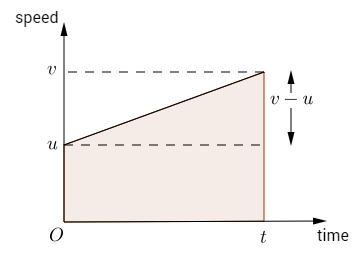
    The area under the speed-time graph gives the ________.

    Detailed Solution: Question 20

    Area under the speed-time graph gives the distance:

    Numeracy, Maths and Statistics - Academic Skills Kit

    • When calculating the area under a speed-time graph, you are essentially finding the total distance travelled by an object over a certain period of time.
    • This is because the area under a speed-time graph represents the total distance covered by an object as it moves at varying speeds.
    • By finding the area under the curve on a speed-time graph, you can determine the total distance travelled by the object during that time interval.

    Topic in NCERT: VELOCITY-TIME GRAPHS

    Line in NCERT: "The area under the velocity-time graph gives the distance (magnitude of displacement) moved by car in a given interval of time."

    88 videos|481 docs|61 tests
    Information about MCQ: Speed and Velocity Page
    In this test you can find the Exam questions for MCQ: Speed and Velocity solved & explained in the simplest way possible. Besides giving Questions and answers for MCQ: Speed and Velocity, EduRev gives you an ample number of Online tests for practice
    88 videos|481 docs|61 tests
    Download as PDF